
Hot Keywords:
- All
- Product Name
- Product Keyword
- Product Model
- Product Summary
- Product Description
- Multi Field Search

The manufacturing of electronic components, semiconductors, and precision electronic products requires a controlled indoor environment. Dust particles, temperature and humidity fluctuations, static electricity, and heat generated by production equipment can all affect product quality and production stability. In processes such as chip manufacturing, PCB production, display panel manufacturing, and precision assembly, conventional industrial ventilation systems are often insufficient to meet clean production requirements.
Therefore, a cleanroom ventilation solution for electronics manufacturing facilities needs to integrate air purification, temperature and humidity control, airflow organization, pressure management, and energy-efficient operation to create a stable and clean production environment.
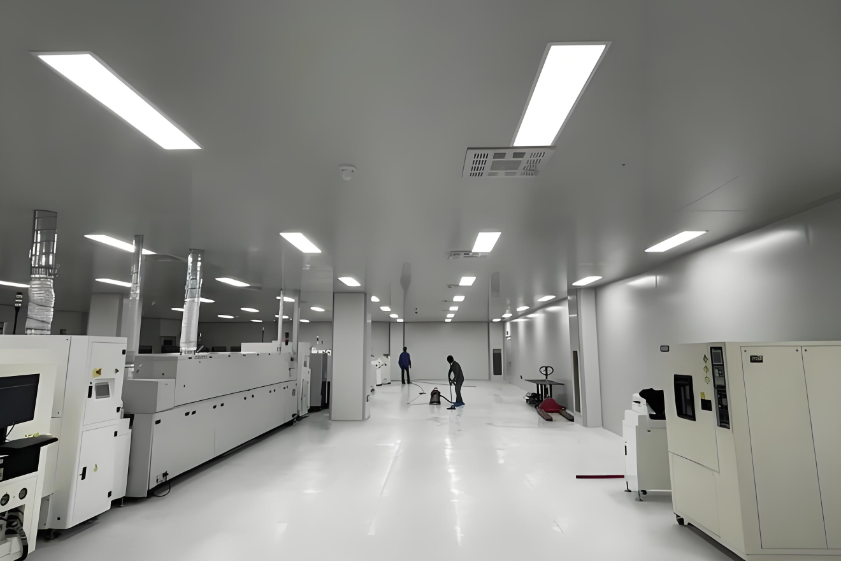
During electronic product manufacturing, microscopic particles can settle on components, circuit boards, or precision equipment, potentially affecting product performance and yield. Cleanroom ventilation systems reduce airborne particle concentrations through filtration, supply air, return air, and other air-handling processes.
Unlike ordinary workshops that rely mainly on natural ventilation, clean manufacturing facilities require appropriate air filtration systems based on the cleanliness requirements of different production areas.
Electronic components can be sensitive to temperature and humidity. Excessively high temperatures may affect equipment cooling, while high humidity can increase moisture-related risks. Low humidity may also increase the possibility of static electricity.
Therefore, ventilation systems in electronics manufacturing facilities are often integrated with air conditioning, humidification, and dehumidification equipment to maintain environmental conditions according to specific production requirements.
SMT machines, testing equipment, servers, and other automated production equipment generate heat during operation. If this heat cannot be removed effectively, localized hot spots may develop and affect equipment stability and employee comfort.
Proper supply and return airflow organization can remove excess heat while maintaining stable temperatures in clean production areas.
Airflow organization directly affects cleanroom air quality. During system design, the layout of production equipment, personnel movement, clean areas, and return air locations should all be considered.
Common approaches include ceiling supply, side-wall supply, and supply through high-efficiency filters. For areas with higher cleanliness requirements, high-efficiency filtered air can be distributed evenly throughout the workspace, while the return air system removes contaminants and excess heat.
Electronics manufacturing facilities often divide production areas according to different cleanliness requirements. Controlling pressure differences between adjacent rooms helps reduce the infiltration of contaminated air into clean production areas.
Personnel entering clean areas can also pass through changing rooms, airlocks, and buffer zones to create progressive cleanliness control and reduce particle contamination caused by personnel movement.
A complete cleanroom ventilation system requires air-handling equipment, fans, filters, ductwork, and automatic control systems selected according to the facility size and manufacturing processes.
| Equipment | Main Function | Common Applications |
|---|---|---|
| Air Handling Unit | Treats and conditions indoor air | Central HVAC systems for cleanrooms |
| HEPA Filter | Removes fine airborne particles | Clean production areas |
| Supply Air System | Delivers treated air into clean areas | Electronics assembly, SMT workshops |
| Return Air System | Recirculates indoor air | Cleanroom air circulation |
| Exhaust System | Removes heat and process exhaust | Production equipment areas |
| Ventilation Fan | Provides airflow and circulation power | Various cleanroom ventilation systems |
| Automatic Control System | Monitors and adjusts operating parameters | Temperature, humidity, pressure, and airflow control |
SMT production includes processes such as component placement, soldering, and inspection. Production equipment is often densely arranged, and these processes can generate heat and certain soldering-related fumes.
The ventilation system needs to balance air cleanliness, temperature control, and local exhaust. Dedicated exhaust systems can be installed for equipment that generates fumes to prevent contaminants from entering the clean recirculated air.
Semiconductor and Precision Electronics Facilities
Semiconductor and precision electronics manufacturing generally has stricter particle control requirements. These areas require high-efficiency air filtration and carefully designed clean airflow patterns.
At the same time, personnel and material movement should be managed to minimize their impact on the clean environment. Clean corridors, buffer zones, and appropriate pressure differentials can help maintain stable production conditions.
Although electronic product assembly areas may have lower cleanliness requirements than some advanced manufacturing processes, good air circulation and stable temperature and humidity are still important.
A combination of centralized air handling and local exhaust can meet clean production requirements while also addressing equipment heat dissipation and employee comfort.
Ventilation systems in electronics manufacturing facilities often operate for extended periods, making energy consumption an important consideration during system design. Traditional systems may operate continuously at a fixed airflow rate, resulting in unnecessary energy consumption.
Variable-frequency-drive fans, temperature and humidity sensors, pressure sensors, and intelligent control systems can dynamically adjust airflow according to actual production requirements.
For example, when production loads decrease, the supply airflow in certain areas can be reduced. When temperature, humidity, or pressure differences deviate from target values, the control system can automatically make adjustments.
For large electronics manufacturing facilities, zoning control and operating schedule management can further reduce unnecessary HVAC and ventilation energy consumption.
HEPA filters gradually accumulate particles during operation, increasing airflow resistance over time. Filters should therefore be inspected and replaced according to pressure differential readings and actual operating conditions.
Dust accumulation inside ventilation ducts can affect the quality of supply air. Regular inspection of ducts, air outlets, and return air areas is therefore important to reduce the risk of secondary contamination.
Temperature, humidity, pressure differential, and cleanliness are key parameters in electronics manufacturing facilities. Real-time monitoring through sensors and centralized control platforms can help identify abnormal conditions and enable timely adjustments.
A cleanroom ventilation solution for electronics manufacturing facilities is more than a basic air circulation system. It is an integrated environmental control system that combines air filtration, temperature and humidity regulation, pressure management, airflow organization, and intelligent control.
For SMT workshops, semiconductor facilities, electronic assembly areas, and precision manufacturing environments, properly selected air-handling equipment, filtration systems, and ventilation methods can help reduce airborne contaminants, control temperature and humidity, and improve equipment operating conditions.
As electronics manufacturing becomes increasingly precise and automated, reliable cleanroom ventilation systems will continue to play an important role in modern electronics manufacturing facilities, supporting product quality, production efficiency, and long-term operational stability.
