
Hot Keywords:
- All
- Product Name
- Product Keyword
- Product Model
- Product Summary
- Product Description
- Multi Field Search

With the continued development of highways, urban expressways, and mountainous road infrastructure, the number and length of highway tunnels are increasing. Tunnels are relatively enclosed transportation spaces. In the event of a vehicle fire, traffic accident, or other emergency, smoke and harmful gases can spread rapidly, affecting evacuation, firefighting operations, and overall tunnel safety. Therefore, establishing a reliable highway tunnel smoke extraction and ventilation solution is an important part of tunnel safety system design.
Vehicles traveling through tunnels continuously produce exhaust emissions, which may contain particulate matter, nitrogen oxides, and other pollutants. When natural ventilation is limited, these pollutants can accumulate in certain areas.
A ventilation system can continuously organize airflow, introduce fresh air, and remove polluted air. This helps improve the internal air environment and provides safer conditions for vehicles and people traveling through the tunnel.
Compared with normal ventilation, smoke extraction during a tunnel fire places much higher demands on the ventilation system. When a fire occurs, high-temperature smoke can spread rapidly along the tunnel. If airflow and smoke movement are not effectively controlled, smoke may obstruct evacuation routes and make firefighting operations more difficult.
Therefore, the highway tunnel smoke extraction system should work together with fire protection, monitoring, and emergency evacuation systems. When a fire occurs, the ventilation system should be able to quickly switch to the appropriate emergency operating mode.
Main Types of Highway Tunnel Smoke Extraction and Ventilation
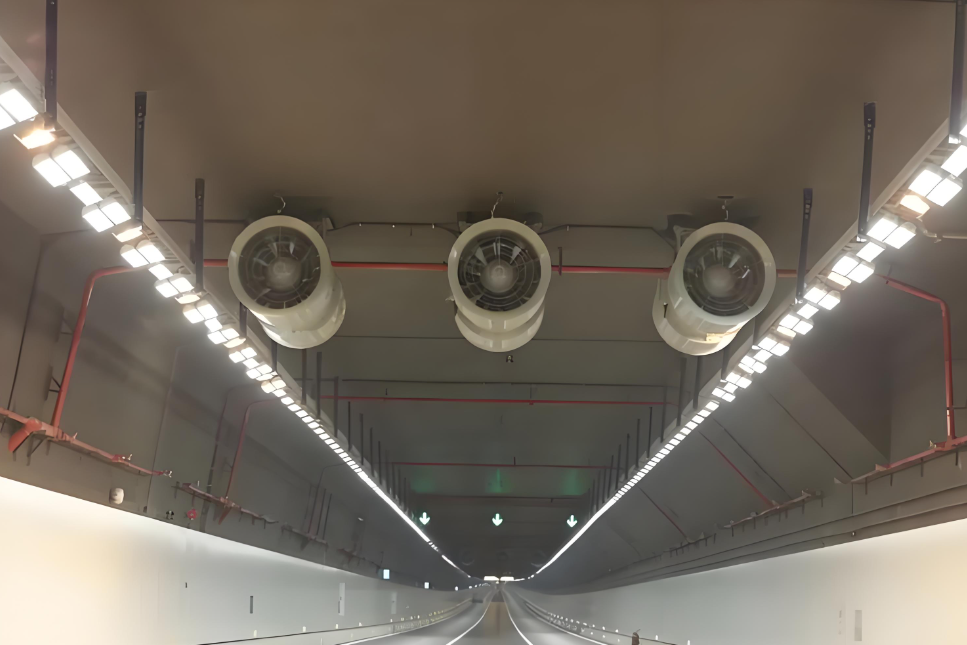
Longitudinal ventilation is one of the most commonly used ventilation methods for highway tunnels. The system uses jet fans to drive airflow longitudinally through the tunnel, pushing polluted air toward the tunnel portal.
This solution offers relatively flexible equipment installation and can be used for highway tunnels within an appropriate length range. During design, the number and location of jet fans should be determined according to tunnel length, cross-sectional dimensions, traffic volume, and fire conditions.
Transverse ventilation uses dedicated supply and exhaust ducts to organize airflow and exchange air in different sections of the tunnel. Semi-transverse systems use either supply or exhaust ducts according to project requirements.
For long tunnels, high-traffic tunnels, and projects with higher smoke extraction requirements, these systems can provide more precise airflow control. However, they also place higher requirements on ductwork, equipment, and construction conditions.
In actual projects, longitudinal ventilation can also be combined with other ventilation methods according to tunnel structure and operational requirements.
For example, a low-energy ventilation mode can be used during normal operation, while a high-capacity smoke extraction mode can be activated during fires or other emergencies. This approach helps balance daily air quality management with emergency safety requirements.
How to Design a Highway Tunnel Smoke Extraction and Ventilation System
Airflow is one of the key parameters in tunnel ventilation system design. Designers need to consider tunnel length, cross-sectional area, traffic volume, vehicle types, and pollutant emissions.
At the same time, smoke generation and movement under fire conditions should also be analyzed. Proper airflow design can meet smoke extraction requirements while avoiding unnecessary energy consumption caused by excessive ventilation capacity.
The location of jet fans has a direct influence on airflow distribution inside the tunnel. Installing too many fans may increase investment and operating costs, while installing too few may make it difficult to achieve sufficient longitudinal airflow.
Therefore, fan placement should be determined by considering tunnel cross-section, equipment spacing, airflow resistance, and emergency smoke extraction requirements.
For long tunnels, zonal control can also be adopted. The system can adjust equipment operation according to air quality conditions and the location of an emergency.
Ventilation Priorities for Different Tunnel Scenarios
| Tunnel Type | Main Requirements | Recommended Ventilation Method | Key Design Considerations |
|---|---|---|---|
| Short Highway Tunnel | Daily air exchange and pollutant removal | Longitudinal ventilation | Airflow and energy consumption |
| Long Highway Tunnel | Continuous ventilation and emergency smoke extraction | Longitudinal or combined ventilation | Zonal control |
| High-Traffic Tunnel | Exhaust and particulate control | Mechanical ventilation | Continuous ventilation capacity |
| Mountain Tunnel | Variable natural ventilation conditions | Mechanical + natural ventilation | Environmental adaptability |
| High-Risk Tunnel | Fire smoke control | Combined ventilation | Emergency response capability |
Application of PVC Ventilation Ducts in Tunnel Projects
In addition to jet fans and axial fans, ventilation ducts are also important components of tunnel ventilation systems. In tunnel construction, maintenance projects, and certain temporary ventilation applications, flexible ventilation ducts offer advantages such as easy installation, relatively low weight, convenient transportation, and flexible deployment.
PVC-coated fabric can be manufactured into flexible ventilation ducts with different diameters and lengths according to project requirements. These ducts can be used for air supply or exhaust. For projects with limited working space, short construction periods, or frequently changing ventilation routes, flexible ventilation ducts can provide good adaptability to changing site conditions.
When selecting tunnel ventilation ducts, factors such as airflow, air pressure, operating environment, abrasion resistance, connection method, and project length should be considered. For long-term applications, durability and maintenance costs should also be taken into account.
Improving Tunnel Ventilation Efficiency Through Intelligent Control Real-Time Air Quality Monitoring
Modern highway tunnel ventilation systems can integrate CO, visibility, particulate matter, and other monitoring devices to monitor the internal environment in real time.
When pollutant concentrations reach predefined levels, the system can automatically adjust fan operation. This allows ventilation capacity to better match actual environmental conditions while helping reduce unnecessary energy consumption.
When a fire occurs, the ventilation system needs to implement an appropriate emergency control strategy according to the fire location, smoke movement, and evacuation conditions.
By integrating the ventilation system with fire alarms, video monitoring, and tunnel control systems, response times can be reduced and the overall reliability of the smoke extraction system can be improved.
Building a Reliable Highway Tunnel Smoke Extraction and Ventilation Solution
A mature highway tunnel smoke extraction and ventilation solution should address not only daily air exchange but also fire smoke extraction, equipment operation, energy consumption, and long-term maintenance.
By selecting suitable longitudinal, transverse, or combined ventilation systems and integrating jet fans, flexible ventilation ducts, air quality monitoring equipment, and intelligent control systems, tunnel operators can establish a more stable and efficient air management system.
Different highway tunnels have different lengths, traffic volumes, structures, and operating environments. Therefore, ventilation systems should be customized according to actual project conditions. Selecting appropriate ventilation equipment and high-quality ventilation materials can help improve daily tunnel operation while providing important support for smoke control and emergency evacuation during unexpected incidents.
