
Hot Keywords:
- All
- Product Name
- Product Keyword
- Product Model
- Product Summary
- Product Description
- Multi Field Search
PVC coated fabric is a versatile material widely used in construction, agriculture, outdoor products, and other fields. Its strength and durability are closely related to the coating thickness.
PVC coated fabric is a composite material made by coating a polyester or polyamide fiber fabric base with polyvinyl chloride (PVC) resin through processes such as calendering and knife coating. It has waterproof, mildew-proof, and flame-retardant properties and is widely used in building membrane structures, agricultural greenhouses, outdoor tents, water park facilities, and other areas.
The thickness of the PVC coating directly affects the mechanical properties of the material. Generally, the thicker the coating, the stronger the tear and puncture resistance. For example, a PVC coated fabric with a thickness of 0.6mm can have a breaking strength of 2200-2500N, while a similar product with a thickness of less than 0.4mm may only have a breaking strength of around 1200N. In addition, a thicker coating can reduce damage to the base material from external environments (such as ultraviolet rays and chemical corrosion), extending its service life.
While increasing thickness can improve strength, an excessively thick coating may lead to a decrease in material flexibility. For example, PVC membrane materials commonly used in building membrane structures need to balance creep resistance (resistance to deformation under long-term stress) and ease of construction; therefore, the thickness is usually controlled between 0.5-1.5mm. In addition, the addition of surface coating processes (such as PVDF, PVF, etc.) can compensate for the shortcomings in weather resistance caused by insufficient thickness.
Membrane structure roofs: Require a balance between light transmittance (4%-15%) and wind pressure resistance. A thickness of 0.8-1.2mm and a strength level of Class III or higher are recommended. Waterproofing Engineering: For applications such as pool liners, the thickness should be ≥0.6mm, and a PVDF coating should be added to the surface to improve weather resistance.
Tents and Tarpaulins: A thickness of 0.4-0.6mm is sufficient to meet wind and rain protection requirements, but heat sealing is necessary to reduce the risk of leakage at the seams.
Inflatable Products: For items such as swimming rings and inflatable boats, 0.3-0.5mm thick PVC coated fabric is used, and airtightness testing is performed to ensure safety.
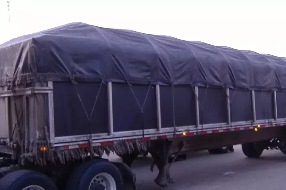
Truck Tarpaulins: Requires tear resistance and abrasion resistance; a thickness of 0.5-0.8mm is recommended, with a scratch-resistant surface treatment.
Liquid Storage Bags and Oil Booms: The thickness needs to be at least 1.0mm to withstand liquid pressure and chemical corrosion.
The thickness and strength of PVC coated fabrics are core indicators of their performance, and the selection should be balanced according to the specific application scenario. By optimizing the coating process, additive ratios, and substrate selection, the overall performance of the material can be significantly improved.
