
Hot Keywords:
- All
- Product Name
- Product Keyword
- Product Model
- Product Summary
- Product Description
- Multi Field Search
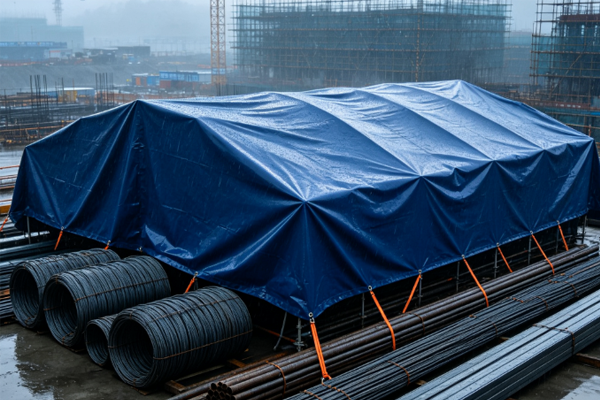
Steel sitting on a construction site may look fine on a sunny day, but after several days of rain, the problems start to show. Rebar can develop rust spots, water may collect around steel pipes, and the edges of steel plates can begin to corrode. The materials may not even be in use yet, but their storage condition is already being affected. This is especially common on projects with long construction periods, where steel may remain outdoors for weeks or even months. When it is not practical to move all construction steel into a warehouse, a properly sized, weather-resistant tarpaulin with reliable fixing can provide an effective rain protection solution and make material storage much easier.
Construction sites usually have large quantities of steel that are too heavy and numerous to store indoors. Temporary steel storage yards, fabrication areas, and project material zones often need to rely on outdoor storage. Rain protection is not simply a matter of throwing a sheet over the steel. The way the steel is stacked, how the tarpaulin is installed, and where rainwater drains all affect the final result. During the rainy season, several consecutive days of wet weather can leave steel surfaces and the bottom of material stacks damp. Proper covering and elevated storage can save a lot of work later.
Rebar is usually stored in bundles. Because the bundles are long and can be stacked at different heights, the tarpaulin should cover the main storage area without interfering with lifting operations.
Raise rebar off the ground to prevent direct contact with standing water.
Cover the top and both sides of the rebar bundles.
Leave enough hanging material on both sides for tying and securing.
Avoid creating obvious low points where rainwater can collect.
Cover the ends of the rebar instead of protecting only the middle section.
Steel pipes and structural sections are often stored in long bundles, leaving large exposed areas along the sides. A large tarpaulin can be selected according to the actual length of the material stack, with the edges secured properly to keep the cover stable.
Use full-size tarpaulins for long steel materials.
Pay attention to both ends of stored steel pipes.
Keep the top of structural steel stacks slightly sloped.
Leave enough space between material stacks for workers and equipment.
This setup helps prevent rain from falling directly onto a large area of steel while still allowing workers to uncover individual sections when forklifts or cranes need to move materials.
PVC and Canvas are both commonly used for steel covering applications. When purchasing, the key question is not simply which material is “better,” but how long the steel will be stored, how frequently it rains, and whether the tarpaulin needs to be removed every day. Choosing the right material can reduce replacement and maintenance work later.
Application | PVC Tarpaulin | Canvas Tarpaulin | Recommended Choice |
Long-term outdoor steel storage | Better suited for rain protection | Suitable for some applications | PVC |
Continuous rainy-season coverage | More suitable | Better for temporary coverage | PVC |
Temporary protection for small steel stacks | Suitable | Flexible to use | PVC / Canvas |
Frequent removal and movement | Suitable | Easier to handle | Canvas |
Large steel storage yards | Better for full-area coverage | Suitable for lighter coverage | PVC |
Short-term construction projects | Suitable | Flexible and practical | PVC / Canvas |
When construction steel needs to remain outdoors for an extended period, especially throughout the rainy season, PVC tarpaulin is often a practical choice.
Suitable for rebar, steel pipes, steel plates, and other materials.
Well suited to large steel storage yards.
A practical option where strong rain protection is required.
Relatively easy to clean when exposed to dust and mud.
Suitable for large-size covering applications.
For large construction projects, PVC tarpaulins can help reduce direct exposure of stored steel to rain over long periods.
Canvas tarpaulins can be useful for short-term steel protection and material areas where covers need to be moved frequently. If steel is delivered to a site and scheduled for use within a few days, easy handling can be more important than setting up a complex permanent covering system.
Suitable for short-term material coverage.
Practical for small steel storage areas.
Easy for workers to uncover frequently.
Useful for temporary protection during material transportation.
Buying a tarpaulin that is too small is a common problem on construction sites. After measuring the length, width, and height of a steel stack, additional material is still needed for the sides and fixing points. If the order is based only on the steel dimensions, the cover may fit over the top but leave too little material to secure the edges. The safest approach is to calculate the actual coverage area together with enough allowance for fixing.
Do not measure only the length. Record the following dimensions before placing an order:
Total length of the steel stack.
Maximum width.
Maximum stacking height.
Required drop length on both sides.
Required coverage at the front and rear.
Additional edge space needed for buckles, straps, or ropes.
For custom-made tarpaulins, providing photos of the actual steel stack together with its length, width, and height can also make communication with the supplier much easier.
Steel stacks have height, and the tarpaulin needs to extend from the top down toward both sides. If the cover is sized only according to the ground dimensions, it may cover the top but fail to provide enough material for securing the sides. For long-term storage, decide whether the tarpaulin will cover only the top or provide wider protection over the sides before calculating the final size.
The larger the tarpaulin, the more noticeable the effect of wind becomes. High-rise construction sites, open steel storage yards, and temporary material areas can experience strong and changing winds. If the tarpaulin is secured only at the four corners, the middle section may repeatedly lift and flap. A more practical setup uses several fixing points along the edges so the entire cover remains stable.
Secure all four corners firmly.
Add fixing points along the long edges.
Avoid relying on a single fixing point along each short edge.
Keep reasonable spacing between buckles or fixing points.
Check ropes regularly for looseness or damage.
Inspect all fixing points before strong winds or storms.
Construction sites sometimes use rebar pieces, scrap steel plates, or other metal objects to hold down tarpaulins. While this may seem convenient, sharp metal edges can easily damage the fabric.
Do not place sharp steel directly on the tarpaulin.
Keep metal edges away from the fabric surface.
Avoid repeated rope friction in the same location.
Repair small tears as soon as they are found.
Reduce direct contact between the tarpaulin and rough ground.
These small details are easy to overlook, but they can have a noticeable impact on how long the tarpaulin remains usable.
A tarpaulin helps prevent rain from falling directly onto the steel, but the way the steel is stored also matters. During the rainy season, water running off the tarpaulin can collect underneath the material if the steel is placed directly on the ground. Raising the steel, improving drainage, and checking the storage area after heavy rain can make the protection much more effective.
Use timber sleepers or suitable supports to raise the steel.
Avoid placing materials directly on muddy ground.
Improve drainage in low-lying storage areas.
Pay attention to standing water beneath steel plates.
Keep the tarpaulin edges away from areas where water collects.
Check whether water has collected on top of the tarpaulin.
Check whether corner fixings have become loose.
Check whether the long edges have lifted in the wind.
Inspect the tarpaulin for visible wear or tears.
Check for standing water beneath the steel.
Make sure nearby drainage channels are not blocked by mud or debris.
Spending a few minutes checking the storage area after heavy rain is much easier than discovering later that an entire stack of construction steel has been exposed to water.
Protecting construction steel from rain may look as simple as putting a tarpaulin over the materials, but real-world use depends on proper sizing, material selection, fixing methods, steel stacking, and drainage. PVC tarpaulins are well suited to long-term outdoor steel storage and rainy-season protection, while Canvas tarpaulins can be useful for temporary coverage and frequently moved materials. NEWSTAR PLASTIC INDUSTRY CO., LTD. supplies PVC and Canvas tarpaulins for protecting construction steel, rebar, steel pipes, steel plates, and other building materials, helping construction companies choose a practical covering solution for their job sites.
