
Hot Keywords:
- All
- Product Name
- Product Keyword
- Product Model
- Product Summary
- Product Description
- Multi Field Search
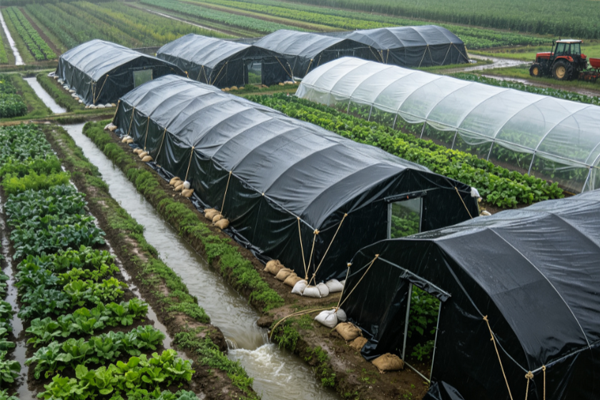
For an agricultural base, the biggest concern is often not a single rainstorm, but several consecutive days of rain. Crops in the field, freshly harvested produce, agricultural machinery, and temporary storage areas can all be affected by moisture. During the rainy season, weather can change quickly. Waiting until heavy rain arrives before moving or covering everything is often too late. For larger agricultural operations, rainy-season protection needs to cover more than one area. Planting areas, storage spaces, equipment parking zones, and temporary work areas all need to be considered. PVC and Canvas tarpaulins can be used for different agricultural covering and protection applications, giving farms an extra layer of protection during periods of heavy rainfall and reducing the hassle of emergency handling.
Rain can cause a chain of problems in agricultural operations. Once water accumulates on the ground, vehicles may have difficulty moving around the site. Moisture can affect harvested produce, while agricultural machinery exposed to rain for extended periods may require more cleaning and maintenance. Each issue may seem manageable on its own, but when several occur during the rainy season, they can interfere with the normal operation of the entire farm.
Not every agricultural base has enough permanent warehouse space. Fertilizer bags, transport containers, farming tools, and freshly harvested products may need to remain temporarily in semi-open areas. Without adequate overhead or side protection, rain can easily reach these materials.
Temporary storage areas should be covered promptly;
Harvested produce should be protected from direct rainfall;
Packaging materials should be kept as dry as possible;
Materials should be kept off the ground where possible.
Tarpaulin covering can solve part of the problem when there is not enough permanent storage space. However, simply throwing a tarp over everything is not enough. Edge fixing, drainage direction, and ground clearance all need to be considered to achieve more reliable protection.
Tractors, transport vehicles, planting equipment, and other agricultural machinery are often parked outdoors. Equipment may not fail immediately after getting wet, but prolonged exposure to rain and moisture can increase cleaning and maintenance requirements.
During periods of continuous rain, moving large machinery indoors every time is simply unrealistic. Setting up dedicated tarpaulin-covered areas can make equipment parking more convenient while reducing direct exposure to rainfall.
Harvesting season can become particularly challenging when it overlaps with the rainy season. Produce may be taken out of the fields but not immediately transported to a warehouse or delivery vehicle, leaving a period when it needs temporary protection.
If rain suddenly arrives during this window, workers have to act quickly. Having PVC or Canvas tarpaulins ready can provide temporary protection for harvesting and handling areas, reducing the need to search for emergency shelter every time it rains.
Agricultural covering requirements are not all the same. Some areas need long-term protection, while others need to be moved or dismantled frequently. Before selecting a tarpaulin, it is worth asking three basic questions: What needs to be covered? How long will it be covered? How often will it need to be moved?
PVC and Canvas tarpaulins can both be used for agricultural protection, but their practical applications can differ. Choosing the right material for the right area is more important than simply choosing one material for everything.
If an agricultural base has designated machinery parking areas, supply storage zones, or long-term temporary warehouses, PVC tarpaulins can be a suitable option. These areas usually do not need frequent dismantling and place greater emphasis on waterproofing and outdoor durability.
Can be used for agricultural machinery protection;
Suitable for long-term material covering;
Can provide overhead protection for temporary storage areas;
Relatively easy to clean during daily maintenance.
For agricultural bases with long rainy seasons, PVC tarpaulins can serve as part of a long-term protection system, reducing direct exposure of equipment and supplies to rain.
Agricultural operations change throughout the year. Planting, harvesting, and transportation schedules vary with the season. A temporary work area may need covering for several weeks and then move to another location. In these situations, easy handling and reuse become important.
Suitable for temporary work areas;
Can be used for short-term harvested crop protection;
Easy to move when site conditions change;
Suitable for repeated setup and use.
For areas with short-term or changing requirements, Canvas tarpaulins offer greater flexibility.
There is no need to use exactly the same tarpaulin throughout an entire agricultural base. Separating long-term protection areas from temporary work areas can make purchasing and daily management more practical.
Agricultural Area | Main Requirement | Possible Solution |
Machinery parking area | Rain and sun protection | PVC tarpaulin |
Agricultural supply storage | Rain and moisture protection | PVC tarpaulin |
Temporary harvesting area | Quick covering | Canvas tarpaulin |
Temporary work shelter | Flexible installation | Canvas or PVC tarpaulin |
This approach also makes it easier for workers to know which tarpaulin should be used in each area and when it should be deployed.
Agricultural tarpaulins are different from simple household rain covers. They are exposed to more demanding outdoor conditions and may be used to protect machinery, supplies, harvested crops, or temporary work areas. They may also be folded, moved, and installed repeatedly. Focusing only on price can result in products that are unsuitable for the farm's actual conditions.
Before purchasing, it is better to start with practical questions instead of simply asking, “How much does it cost?”
Even agricultural bases in the same region may face different rainy-season conditions. Some areas receive heavy rainfall, some experience strong winds, and others have long periods of intense sunlight.
Long-term outdoor use requires good weather resistance;
Areas exposed to strong wind need sufficient overall strength;
Frequently moved areas should prioritize handling convenience;
Long-term covering requires better durability.
Once the actual environment is clear, suppliers can recommend a tarpaulin that better matches the application.
Whether a tarpaulin works well depends heavily on its size and installation method. A cover that is too small leaves materials exposed, while an oversized tarp can drag on the ground, collect water, and become difficult to handle.
When measuring the covering area, consider not only length and width but also fixing points, support height, and drainage direction. For large covering areas, obvious water pockets should be avoided because they can become difficult to clean after rainfall.
Agricultural bases may use tarpaulins frequently, especially during the rainy season. How easy the material is to clean, store, and reuse can directly affect daily workload.
Choosing easy-to-maintain tarpaulins reduces repeated handling and makes it easier to clean and store them after the rainy season.
Effective rainy-season protection does not mean waiting for a weather forecast before looking for tarpaulins. The areas that need protection should be planned in advance. For larger agricultural bases, where machinery, supplies, and harvested produce may be spread across different locations, dealing with everything temporarily after every rainstorm can easily lead to missed areas.
Making tarpaulin use part of routine site management can actually make rainy-season work much easier.
Before continuous rainfall begins, it is worth checking all existing tarpaulins. Products with damage or worn fixing components should be repaired or replaced in advance instead of waiting until a storm exposes the problem.
Check edges and fixing points;
Look for obvious surface damage;
Clear debris around drainage areas;
Make sure enough spare tarpaulins are available.
A simple inspection before the rainy season can prevent unnecessary scrambling when sudden rain arrives.
Agricultural bases contain many different materials. If workers have to find a new covering location every time it rains, valuable time is easily wasted and some areas may be overlooked. Separate equipment, supply, and harvesting zones can make protection much more organized.
For frequently used areas, fixing the tarpaulin size and installation position in advance can make repeated operations much easier. Workers know which tarp is used for which area, making rainy-season management more straightforward.
After heavy rain, it is better not to remove the tarpaulin immediately and put it away. Check whether water has accumulated, whether fixing points have loosened, and whether moisture has reached the materials underneath. These checks take little time but can reveal problems early.
If the tarpaulin will continue to be used, clean away mud and debris from the surface. If it is being stored, allow it to dry thoroughly first. These small maintenance steps can help keep the tarpaulin in better condition for future use.
Rainy-season protection at an agricultural base is not simply about finding a sheet that blocks rain. The key is choosing a covering method that fits actual farming operations. PVC tarpaulins can be used for machinery, agricultural supplies, and long-term storage areas, while Canvas tarpaulins are more suitable for harvesting, temporary work, and frequently changing areas. NEWSTAR PLASTIC INDUSTRY CO., LTD. provides PVC and Canvas tarpaulins for outdoor covering and protection in agriculture, aquaculture, construction, and ventilation engineering.
