
Hot Keywords:
- All
- Product Name
- Product Keyword
- Product Model
- Product Summary
- Product Description
- Multi Field Search

In tunnel construction, mining projects, underground engineering, building construction, and large industrial projects, temporary work areas are constantly changing. As construction progresses, workers, equipment, and work faces may move frequently, making traditional fixed ventilation systems less practical. Long installation times, difficult duct relocation, and high transportation costs can all reduce ventilation efficiency.A rapid air supply solution for temporary construction areas can combine ventilation fans with flexible ventilation ducts to quickly establish an effective airflow path. This provides fresh air to construction workers and improves air circulation in enclosed or poorly ventilated areas.
NSTARP flexible ventilation ducts are designed with high-strength fabric and PVC-coated structures. They offer flexibility, lightweight construction, abrasion resistance, and waterproof performance. Different duct types and connection methods can be selected according to specific construction conditions. Combined with mechanical ventilation equipment, they can provide efficient and adaptable air supply for temporary construction areas.
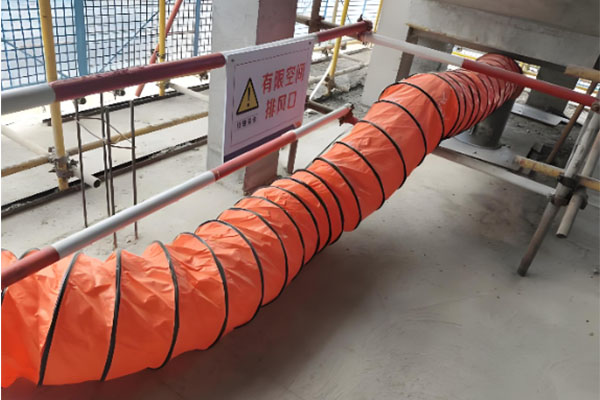
Unlike permanent buildings, temporary construction areas are constantly changing. As a project advances, the working face may move forward, requiring the ventilation route to be extended, shortened, or relocated.
Rigid ventilation ducts may require additional fittings and support structures when the route changes, increasing installation time and labor requirements.
Flexible ventilation ducts can be bent, extended, repositioned, and connected according to site conditions. This makes them particularly suitable for construction projects where ventilation requirements change along with the construction process.
Underground projects, tunnels, and enclosed construction spaces often have limited natural air circulation. Construction equipment, concentrated personnel, cutting, welding, and other operations can affect local air quality.
A mechanical air supply system can deliver fresh air toward remote working areas. By using ventilation fans and flexible ducts, fresh air can be transported closer to the work face, helping improve overall air circulation.
A temporary construction air supply system generally consists of a ventilation fan, flexible ventilation duct, connection components, and suspension or fixing equipment.
The fan provides the airflow power, while the flexible ventilation duct transports air to the designated working area. Depending on the required ventilation distance and site layout, different duct diameters and lengths can be selected and multiple duct sections can be connected to create a continuous air supply route.
Construction sites often contain scaffolding, machinery, support structures, temporary partitions, and other obstacles. Flexible ventilation ducts can be adjusted according to the actual site layout, helping reduce the limitations caused by complex spaces.
When the working face changes, workers can reposition or extend the duct so that the air outlet remains close to the main working area. This helps reduce unnecessary airflow distance and improve the practical efficiency of the ventilation system.
Temporary ventilation systems often need to be installed, removed, transported, and repositioned multiple times. Heavy ductwork can increase transportation and installation requirements.
NSTARP flexible ventilation ducts use flexible fabric construction and are lightweight compared with many conventional rigid duct systems. They can be rolled, transported, and deployed more easily, making them suitable for short-term projects and construction sites that require frequent relocation.
Construction sites may expose ventilation ducts to friction, pulling, contact, and accidental impact. Therefore, the duct material needs to provide suitable mechanical strength.
High-strength fabric combined with PVC coating can improve resistance to abrasion, tearing, and puncture, supporting reliable operation in demanding construction environments.
Underground construction areas often have high humidity and may encounter water or other challenging environmental conditions. Flexible ventilation ducts with waterproof, moisture-resistant, and corrosion-resistant properties can provide better adaptability for these applications.
| Construction Application | Main Ventilation Requirement | Advantages of Flexible Ventilation Ducts |
|---|---|---|
| Tunnel Construction | Deliver fresh air to the excavation face | Long-distance air supply and flexible installation |
| Underground Engineering | Improve air circulation in deep work areas | Lightweight and easy to reposition |
| Mining Construction | Supply fresh air to working personnel | High strength, abrasion resistance, optional flame-retardant properties |
| Building Construction | Provide temporary air circulation | Fast installation and easy removal |
| Underground Maintenance | Establish temporary air supply routes | Flexible, lightweight, and easy route adjustment |
Duct diameter, duct length, and fan performance can all affect the final air supply performance. During system design, the required airflow, ventilation distance, construction area, number of workers, and operating equipment should be considered when selecting suitable duct specifications.
An appropriately sized ventilation duct can help balance airflow requirements and system resistance.
Flexible ventilation ducts can adapt to curved routes, but excessive bending or sharp turns may increase airflow resistance. During installation, the duct route should therefore be planned as efficiently as possible.
Keeping the ventilation path reasonably straight and minimizing unnecessary bends can help improve airflow delivery efficiency.
One of the key advantages of a temporary ventilation system is its ability to adapt to changing construction conditions. When the working face moves, the ventilation duct should be extended, shortened, or repositioned as required.
Keeping the air outlet close to the active work area helps make better use of the supplied airflow and maintain effective ventilation coverage.
For tunnel, mining, underground engineering, and other temporary construction projects, a ventilation system needs more than sufficient airflow. It should also provide rapid installation, easy relocation, and adaptability to complex working environments.
NSTARP flexible ventilation ducts are available in different configurations, including Lay Flat, Oval, and Spiral types. Different connection methods can also be selected according to project requirements.
By combining flexible ventilation ducts with suitable ventilation fans, construction teams can quickly establish temporary air supply routes and adjust them as the project progresses.
The core of a rapid air supply solution for temporary construction areas is to establish a ventilation system that can be deployed quickly, relocated easily, and adapted to changing construction conditions.Flexible ventilation ducts offer advantages such as lightweight construction, flexibility, abrasion resistance, and convenient installation. These features make them a practical choice for overcoming the limitations of traditional rigid ducts in temporary construction environments.By selecting suitable ventilation fans, duct specifications, and installation methods, construction companies can establish reliable fresh-air supply routes for tunnels, mines, underground projects, and other temporary work areas, creating a more flexible and efficient mechanical ventilation solution.
