
Hot Keywords:
- All
- Product Name
- Product Keyword
- Product Model
- Product Summary
- Product Description
- Multi Field Search
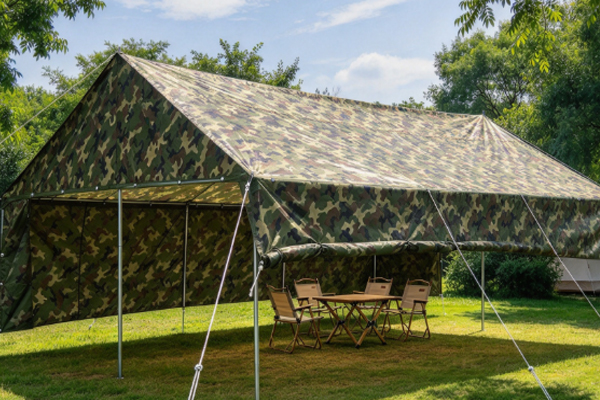
Setting up a shade shelter in a backyard, campsite, or outdoor work area may look simple, but there is more to it than just putting up a piece of fabric. If the tarp is too thin, sunlight can still come through. If the space is poorly ventilated, it can quickly become hot and stuffy underneath. So, are Camo Tarps suitable for outdoor shade shelters? If the only goal is blocking sunlight, there are plenty of options. But when rain protection, durability, and repeated outdoor use are also important, Camo Tarps are worth considering. The key is not simply the camouflage pattern, but the material, light-blocking performance, and installation method.
Yes. Camo Tarps can work well in outdoor areas where the shelter needs to be used regularly or for longer periods. Depending on the material, they can provide shade, water resistance, and good wear resistance. This means one tarp can help handle more than just strong sunlight, which is useful when outdoor weather changes quickly.
Good light blocking: An opaque Camo Tarp can reduce direct sunlight reaching the space underneath, making it more suitable for areas where stronger shade is needed.
Useful when light rain comes in: If the tarp has good waterproof performance, there is no need to immediately pack everything away when a quick shower arrives.
Built for outdoor handling: Setting up, taking down, folding, and stretching a tarp can put repeated stress on the material. A durable tarp is better suited to this kind of use.
A distinct outdoor look: The camouflage pattern works naturally with camping areas, yards, and outdoor activities, giving the shelter a more rugged appearance than a plain-colored tarp.
However, blocking sunlight does not automatically mean strong heat insulation. How comfortable the shelter feels in summer also depends heavily on its height and airflow.
This is a very practical question when choosing an outdoor shade shelter. Once the tarp blocks direct sunlight, the area underneath will generally feel better than standing in full sun. But if all four sides are enclosed and air cannot move freely, it can still get quite hot. Around midday, when sunlight is strongest, the tarp, ground, and support structure can all absorb heat, making the space feel stuffy.
For a more comfortable summer shelter, a few simple installation choices can make a noticeable difference:
Keep the roof high enough. Avoid installing the tarp too low. Extra space above the occupants gives warm air somewhere to rise.
Leave the sides open where possible. If the main purpose is shade, covering the top is often enough. Open sides allow air to move through the shelter.
Adjust the direction of the shelter. If sunlight enters from the side in the morning or afternoon, extending the tarp edge or adding partial side coverage can improve shade.
Think about the ground underneath. Concrete and dark-colored surfaces can stay hot for hours after strong sunlight. A tarp cannot make a hot surface feel like natural shade by itself.
So, Camo Tarps can be used for shade shelters, but shade and cooling are not exactly the same thing. If the goal is a more comfortable space in summer, good ventilation can be more useful than simply choosing a much thicker tarp.
When buying a tarp, it is easy to focus only on price and dimensions. Problems often appear after installation: the tarp is difficult to secure, too heavy, or simply does not provide enough coverage. It is better to think about how the shelter will actually be used before choosing the material.
Do not choose a size that is just barely enough. A Camo Tarp needs enough extra material for securing, tensioning, and creating proper edges. A tarp that is too small can be difficult to anchor, while an oversized tarp may be harder to install and store.
Pay attention to reinforced edges. Wind puts repeated stress on the edges and grommet areas. Stronger reinforcement in these locations can make repeated setup and removal much easier.
Match the material to the application. Occasional camping use and long-term outdoor coverage have different requirements. For occasional use, lighter materials may be more convenient. For extended outdoor use, weather resistance, waterproofing, and tear resistance become more important.
Do not overlook the tarp's weight. Larger and thicker tarps are usually heavier. Make sure the frame, ropes, poles, and anchor points can safely handle the load. A strong tarp is only useful if the supporting structure is strong enough too.
Camo Tarps are particularly useful in outdoor areas where flexible shelter is needed. At a campsite, they can cover tables and seating areas. In a backyard, they can create a temporary shaded space without installing a permanent roof. At outdoor events, they can also provide a quick covered area. For a shelter that will remain in one location for a long time, drainage and wind conditions should be considered in advance. The tarp should not simply be laid completely flat, as rainwater can collect on the surface. Creating a slight slope allows water to run off more easily and makes the shelter much more practical.
Different outdoor applications have different requirements. A tarp used occasionally for camping does not necessarily need the same specifications as one left outdoors for months.
Camping areas: Cover tables, outdoor kitchens, or seating areas to reduce direct sunlight during the day.
Backyard leisure areas: Create a temporary shaded space without building a permanent roof, then fold the tarp away when it is no longer needed.
Outdoor event spaces: Add temporary shade when extra covered space is needed.
Outdoor work areas: Reduce direct overhead sunlight while also providing some protection from light rain.
Temporary areas beside vehicles or equipment: Set up a simple covered space quickly when temporary shade or weather protection is needed.
Camo Tarps can be a practical choice for outdoor shade shelters, especially when the shelter needs to do more than simply block sunlight. They can also provide useful rain protection, wear resistance, and flexibility for repeated outdoor use. In summer, comfort depends on more than the tarp material itself. Roof height, ventilation, sun direction, and the ground underneath all make a difference. With the right Camo Tarp and a properly designed support system, an outdoor shade shelter can be easier to set up, more comfortable to use, and better suited to repeated outdoor use.
