
Hot Keywords:
- All
- Product Name
- Product Keyword
- Product Model
- Product Summary
- Product Description
- Multi Field Search

PVC tarpaulin can be used to make ventilation ducts, but it is important to clarify that not all PVC tarpaulin is suitable for direct use in ventilation duct manufacturing. PVC tarpaulin used for ordinary cargo covering, rain protection, and sun protection differs from PVC-coated fabrics specifically designed for ventilation duct manufacturing in terms of base fabric strength, PVC coating, thickness, temperature resistance, flame-retardant performance, and tear resistance. Professional ventilation ducts are usually made from PVC-coated polyester fabric, which is cut, heat-sealed, or sewn to form the duct body. Steel wires, support rings, straps, connection ports, and other structures can then be added according to the application conditions. At present, PVC-coated fabrics are used in industrial ventilation, mine ventilation, tunnel ventilation, temporary ventilation, and air transportation in factories. These products usually use high-strength polyester fabric as the supporting structure, while the PVC coating provides waterproofing, wear resistance, and air barrier properties. Flame-retardant, antistatic, and other functional grades can also be selected according to project requirements.
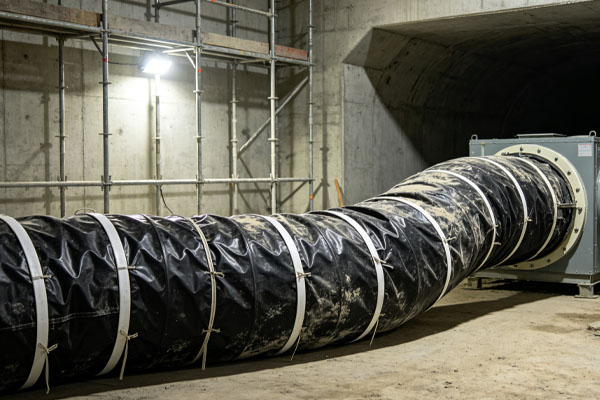
PVC tarpaulin is usually not simply a single layer of plastic material. It generally uses polyester fabric as the base and forms a composite material through coating or laminating processes. The polyester fabric provides the main tensile and tear resistance, while the PVC layer helps create a continuous air-barrier surface. This structure is relatively suitable for making flexible ducts. Ventilation duct materials commonly use PVC-coated polyester fabric, which is cut and heat-sealed to form round or other cross-sectional shapes. Compared with traditional metal air ducts, flexible PVC ducts are lighter and easier to transport, unfold, and install, especially in locations where temporary installation is required or duct routes change frequently.
PVC tarpaulin has a certain degree of flexibility and can be bent according to the duct route. In factories, construction areas, underground spaces, and temporary work areas, completely rigid metal ducts require more elbows and connectors during installation, while flexible PVC ducts can be adjusted according to the actual route. Some PVC flexible ducts are also equipped with spiral steel wires or support rings so that the duct can maintain its shape during operation. Especially when negative-pressure air extraction is required, a flexible fabric duct without reinforcement can easily collapse. Therefore, support structures need to be configured according to the direction of pressure.
Although PVC tarpaulin has properties such as flexibility, waterproofing, and wear resistance, material selection for ventilation ducts should not be based only on thickness or weight.
Tensile and Tear Resistance: Ventilation ducts need to withstand airflow, installation tension, and repeated bending for long periods, so the base fabric needs to have good mechanical strength.
Coating Bonding Strength: The PVC coating needs to maintain a stable bond with the polyester base fabric to prevent delamination after long-term bending or heat sealing.
Temperature Resistance: Different material grades are required for transporting normal-temperature air and hot air, so the actual operating temperature should be considered when selecting the material.
Flame-Retardant and Antistatic Performance: Mines, tunnels, industrial production areas, and other environments may have special safety requirements, so the corresponding functional grade should be selected according to project standards.
Some PVC ventilation duct materials can provide flame-retardant, antistatic, low-temperature-resistant, and UV-resistant properties. However, the specific grade needs to be confirmed according to the final application and testing standards.
Ventilation ducts made from PVC materials are not limited to one structure. Different working conditions require different duct forms.
Positive-pressure air supply is a common application for flexible PVC ducts. The fan sends air into the duct, creating positive pressure inside and causing the flexible duct body to expand and maintain its air-delivery shape. This structure can be used at construction sites, in factories, underground spaces, tunnels, and temporary ventilation areas. For ventilation equipment that needs to be moved frequently, flexible ducts also offer the advantages of easy rolling and a relatively small transportation volume.
If the fan is located at the end of the duct and removes smoke, dust, or other gases through suction, negative pressure may form inside the duct. In this situation, ordinary flexible PVC tarpaulin cannot simply be used to make the duct. The duct body needs to be reinforced with spiral steel wires, support rings, or other structures so that it can maintain a sufficient ventilation cross-section under negative pressure. Different reinforcement structures are also used in flexible duct products according to air intake and exhaust requirements.
In maintenance, construction, equipment servicing, or localized exhaust applications, PVC flexible ducts offer the advantage of relatively fast installation. The duct can be adjusted according to the available space and connected to fans through straps, flanges, clamps, or dedicated connection ports. This application is particularly suitable for locations where a ventilation route needs to be established for a short period and avoids the extensive on-site processing required for fixed metal ducts.
It can be processed, but it is not recommended to manufacture a duct according to ordinary tarpaulin applications and then use it directly in a formal ventilation system. The thickness, base fabric strength, heat-sealing performance, and temperature rating of ordinary tarpaulin may not meet ventilation duct requirements. If it is only used for temporary low-pressure air supply, it can be evaluated according to the actual conditions. For industrial exhaust, mine ventilation, or dusty environments, dedicated PVC-coated ventilation materials should be selected.
This depends on the specific material. Different PVC coating formulations and base fabric structures have different temperature ranges. Some common PVC ventilation materials may have a reference operating temperature range of approximately -30°C to 70°C, but this does not mean that all PVC tarpaulin is suitable for this range. If high-temperature gases need to be transported, the material's continuous operating temperature, short-term temperature resistance, and connection method should be confirmed separately.
Yes, but mines and tunnels are environments with relatively high requirements for duct performance. Materials with flame-retardant, antistatic, wear-resistant, and tear-resistant properties need to be selected according to project requirements. Some PVC-coated materials are already used to manufacture flexible ventilation ducts for mines and tunnels.
Not necessarily. Some flexible ducts used for positive-pressure air supply can use foldable structures, while products used for negative-pressure exhaust or applications where the duct needs to maintain its shape generally require spiral steel wires or support rings. The specific structure needs to be determined based on the duct diameter, air pressure, degree of bending, and installation method.
From the material to the finished ventilation duct, additional processes such as cutting, drum forming, heat sealing or sewing, and connection-port processing are required. PVC-coated fabric itself is only the basic material for the duct. The final performance also depends on seam strength, duct diameter, reinforcement structure, and connection method. For general low-pressure air supply, materials with good flexibility, a stable coating, and sufficient tensile strength can be prioritized. For industrial exhaust, wear resistance, tear resistance, and temperature resistance need to be further confirmed. For special environments such as mines and tunnels, functional materials with flame-retardant and antistatic properties should be selected according to project standards. Only when material performance and the finished duct structure work together can problems such as air leakage, duct collapse, and seam cracking be reduced, allowing the flexible duct to maintain stable ventilation performance. For projects requiring large-scale duct production, the PVC material's weight, thickness, width, color, flame-retardant grade, and antistatic requirements can also be determined in advance before sampling and mass production. This makes it easier to control finished product quality and application stability.
