
Hot Keywords:
- All
- Product Name
- Product Keyword
- Product Model
- Product Summary
- Product Description
- Multi Field Search

Commercial inflatable water platforms need to be in long-term contact with water, sunlight, and human activity. Therefore, the tarpaulin material must not only meet basic waterproofing requirements, but also provide wear resistance, tensile strength, weather resistance, and stability at connection points. Especially in commercial settings such as water parks, resorts, and outdoor entertainment projects, platforms may undergo repeated inflation, deflation, transportation, installation, and use every day. If the material is not properly selected, problems such as surface wear, seam cracking, air leakage, or aging after a period of use may occur. Therefore, the tarpaulin for commercial inflatable water platforms needs to be customized according to the platform size, frequency of use, load conditions, storage method, and local climate. PVC tarpaulin generally offers good waterproofing and weather resistance and is also convenient for heat-welding processing, making it one of the more common outer-layer materials for commercial inflatable water platforms. For products that need to be used for a long time, different weights, thicknesses, colors, surface treatments, and fabric substrates can be further selected according to actual requirements.
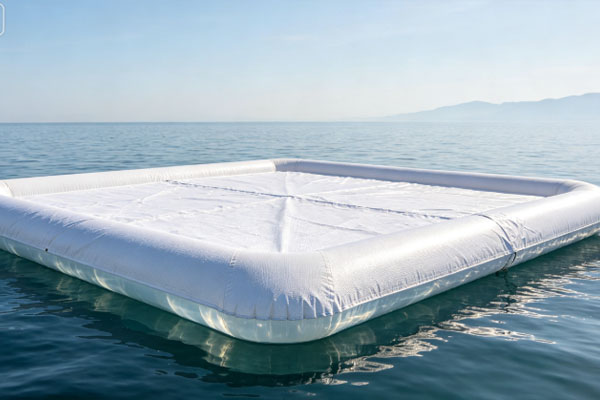
The operating environment of a commercial inflatable water platform determines the need for comprehensive material performance. Platforms remain in humid environments for long periods, and some products are used continuously outdoors. Therefore, material selection should not focus only on thickness and price, but should also consider the strength of the base fabric, the quality of the PVC coating, and the flexibility of the finished material.
PVC tarpaulin usually consists of a PVC coating applied to the surface of a fabric substrate, giving the material good waterproofing performance. Compared with ordinary PE tarps, PVC materials are generally thicker and more robust, while their wear resistance and tensile strength are also more suitable for the high-frequency use of commercial entertainment equipment. Inflatable water platforms need to withstand stepping, movement, friction, and repeated folding. Therefore, when purchasing, it is recommended to focus on the material weight, thickness, base fabric specifications, and tensile strength.
Canvas Tarp generally refers to canvas-type tarpaulin, which offers a good fabric texture and wear resistance, but the waterproofing performance varies significantly among different Canvas products. If a commercial inflatable water platform mainly requires waterproofing, moisture resistance, and long-term use on the water, greater attention should generally be paid to the waterproofing and weather resistance of the PVC Tarpaulin itself. If the customer has specific requirements regarding material feel, weight, or appearance, the selection can be further made according to the actual structure.
Different platform specifications do not have exactly the same material requirements. Small recreational platforms and large commercial platforms differ in terms of load, transportation, and frequency of use. Therefore, it is not recommended to use one fixed specification for all products.
Customized Item | |
Material Type | PVC Tarpaulin, PVC Tarp |
Thickness | Determined according to platform size, load, and frequency of use |
Weight | Affects material strength, weight, and ease of transportation |
Base Fabric | Affects overall tensile and tear resistance |
Surface | Can be selected according to color, feel, and cleaning requirements |
Waterproof Performance | Suitable for environments involving long-term contact with water |
Weather Resistance | Suitable for outdoor sunlight and temperature changes |
Processing Methods | Heat welding, cutting, edge binding, fasteners, etc. |
After the material specifications are determined, the structure also needs to be designed according to the specific platform dimensions. Only when material selection and structural design are carried out together can potential problems during later use be reduced.
Inflatable water platforms usually include the main body, edges, connection areas, straps, handles, and other installation structures, so the overall design needs to be determined in advance. Before customization, the number of users, load requirements, inflation method, number of connections, and installation environment should also be clarified, while the structure should be planned according to actual transportation, handling, and storage requirements. For commercial platforms that need to be used in combination, connection fasteners, fixing straps, and interface dimensions should also be standardized in advance to ensure stable connection between different modules and facilitate on-site installation, disassembly, and later maintenance.
Size is the basis of customization. Customers need to provide the platform length, width, thickness, or overall dimensions after inflation. If the platform has a special shape, CAD drawings, product sketches, or actual dimensions should also be provided. For bulk purchases, unified size standards can be established in advance. For example, maintaining the same width and connection method within the same product series can facilitate subsequent production, packaging, and on-site installation.
PVC tarpaulin can generally be joined through high-frequency heat welding or hot-air welding. The seams of an inflatable water platform not only affect its appearance, but also directly affect airtightness and overall stability. During design, unnecessary joints should be minimized, while areas subject to concentrated tensile forces over long periods should be avoided. If seams are necessary, corresponding reinforcement structures should be added according to the load conditions.
Platform edges are usually areas where people are active frequently and are also more likely to be subjected to pulling forces during transportation and fixing. Therefore, edge binding, reinforcement straps, or local reinforcement layers can be added to these areas according to the actual structure. For products that need to connect with other platforms, connection fasteners and fixing areas can also be designed in advance to make combined use more convenient.
Commercial inflatable water platforms usually have relatively strong visual identification requirements, so the color of the PVC tarpaulin can also be customized according to the brand or overall style of the project. Common options include single-color, two-color, or multi-color combinations, and surface printing can also be carried out according to customer requirements. It should be noted that color selection should consider not only appearance, but also outdoor sunlight, cleaning frequency, and long-term operating conditions.
After the material and structure are determined, production and processing quality will directly affect the final product. Since commercial platforms are usually designed for repeated use, production should not focus only on the initial installation effect, but should also consider long-term folding, transportation, and use.
PVC tarpaulin cutting needs to be carried out according to the design drawings. Excessive dimensional deviation may result in inaccurate heat-welding positions and affect the overall shape. For mass-produced products, it is recommended to establish unified cutting standards and use fixed dimensions and processing requirements for the same model, thereby reducing dimensional differences between different production batches.
Inflatable water platforms have relatively high airtightness requirements, making heat welding an important production process. The welding temperature, pressure, speed, and overlap width need to remain stable. If the parameters are not properly controlled, this may result in weak welding, material damage, or localized air leakage. After production, necessary airtightness inspections should also be carried out. For commercial bulk orders, inspection standards can be established according to product specifications, with particular attention paid to welded areas.
Handles, connection straps, fixing points, and corners usually withstand more tensile force than ordinary surfaces. Additional PVC material or fabric reinforcement layers can be added to these areas to improve local durability. This does not mean that the entire tarpaulin needs to be made infinitely thicker. Instead, targeted reinforcement should be applied according to actual stress locations to achieve a reasonable balance between durability and weight.
Before commercial PVC Tarpaulin products leave the factory, multiple aspects can be inspected, including dimensions, color, surface condition, heat-welded areas, connection points, and airtightness. For customers with long-term purchasing requirements, material standards, inspection methods, and packaging requirements can also be determined in advance to maintain consistency between different batches.
Even when a high-quality Heavy Duty Tarp is used, inadequate daily maintenance may shorten the actual service life of the product. Commercial inflatable water platforms are usually used repeatedly, so storage and cleaning are equally important.
After the platform is used, sand, dirt, and other attached materials can first be removed from the surface, followed by simple cleaning. Especially before folding the material, excessive dirt should be prevented from remaining on the surface for long periods. After cleaning, the platform should be thoroughly dried before storage.
Although PVC materials generally have good waterproofing performance, long-term storage in a damp condition is not ideal. If the platform is folded and packed immediately after being removed from the water, moisture may remain inside. After long-term storage, this may cause odors or affect the material condition. Therefore, commercial operators are advised to establish a regular cleaning and drying process.
Large inflatable water platforms can be relatively heavy. Dragging them directly across rough ground during transportation can easily cause wear on the PVC surface. Where conditions permit, multiple people can work together to move the platform or use appropriate auxiliary equipment. In particular, contact between the platform corners and sharp objects should be avoided as much as possible.
If the product needs to be stored for an extended period, it should be placed in a dry and well-ventilated location and kept away from prolonged direct sunlight as much as possible. When folding, extremely tight creases should not repeatedly form in the same location. If the product is large, a fixed folding method can be developed according to its actual dimensions to reduce repeated stress on the material during each storage cycle.
PVC tarpaulin offers good waterproofing, wear resistance, and weather resistance, while also allowing heat-welding processing, making it suitable for inflatable products that need to maintain airtightness. For commercial high-frequency use, different PVC material specifications can be selected according to the platform size and operating conditions.
Yes. PVC materials are generally available in a variety of colors and can also be matched according to the customer's product design. If there are requirements for brand logos or patterns, the printing solution can also be discussed in advance.
Yes. Commercial products generally need to be cut and processed according to the actual platform dimensions. Customers can provide the length, width, thickness, structural drawings, or samples, and the manufacturer can determine the material and processing solution according to the actual requirements.
It can be evaluated based on material weight, thickness, base fabric strength, surface condition, weather resistance, and heat-welding quality. For inflatable water platforms, special attention should also be paid to welded areas and airtightness.
The PVC tarpaulin used for water platforms needs to provide waterproofing while also withstanding daily stepping, transportation, folding, and long-term outdoor use. During customization, price should not be the only consideration. Material thickness, base fabric strength, seam method, edge reinforcement, and dimensional accuracy should all be considered together. If the platform is relatively large or used many times per day, these details need to be determined in advance. Selecting suitable PVC Tarpaulin can make the platform more durable while also facilitating later cleaning and maintenance. A suitable commercial inflatable water platform PVC tarpaulin solution means selecting the material according to the actual dimensions, designing seams and reinforcement according to stress locations, and finally ensuring performance through standardized production and daily maintenance.
If you have specific platform dimensions, sample images, design drawings, or purchase quantities, you can contact Newstar directly. Our professional team can provide customized recommendations according to your product requirements.
Email: tarp@newstarventilation.com
Phone: 0086-13921439224
