
Hot Keywords:
- All
- Product Name
- Product Keyword
- Product Model
- Product Summary
- Product Description
- Multi Field Search

During long-term navigation, docking, and daily maintenance, the deck areas of vessels are continuously exposed to seawater, rain, sunlight, salt spray, and complex weather conditions. Whether it is a fishing boat, workboat, yacht, or speedboat, the equipment, operating areas, and stored items on the deck require reliable protection measures. As a customized protective structure, marine deck canopies use waterproof, sun-resistant, and wear-resistant covering materials to effectively reduce the impact of external environments on vessel areas, improving convenience and safety during operation. Traditional marine deck protection usually relies on simple coverings or temporary shelters, but in actual use, problems such as unstable fixing, insufficient waterproof performance, and aging caused by long-term sun exposure can easily occur.
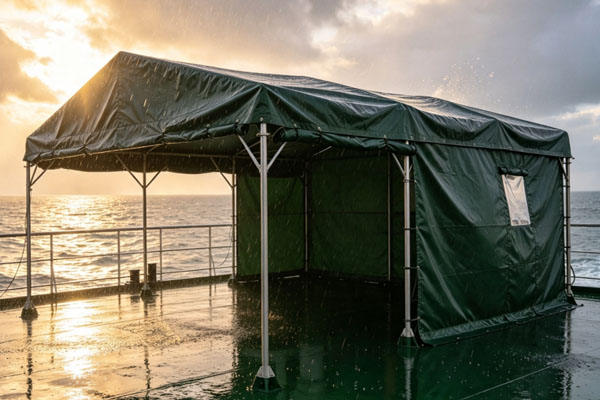
Therefore, more and more ship owners are choosing customized marine deck canopy solutions, designing suitable structures and materials according to vessel dimensions, application environments, and protection requirements. During the customization process of marine deck canopies, PVC Tarpaulin / PVC Tarp and PVC coated fabrics are common choices. These materials provide excellent waterproof performance, weather resistance, and tensile strength, making them suitable for long-term use in marine environments. At the same time, through customized sizing, reinforced edge processing, additional eyelets, and fixing systems, the canopy can better fit the vessel structure and improve overall service life.
Ship decks are exposed to open environments for long periods, which is different from ordinary indoor spaces. During navigation, decks may experience strong winds, rainfall, wave impacts, and ultraviolet radiation. Without effective coverage, equipment on the deck can be affected by moisture, metal components may corrode, and some precision equipment may experience operational problems due to water vapor entering internal structures. Marine deck canopies cover designated areas to create a stable protective space, reducing direct exposure and improving the protection of equipment and stored items.
Common areas requiring protection include:
Protection Area | Main Requirements |
Vessel operating areas | Block rainwater and strong sunlight, improving working comfort |
Deck equipment areas | Prevent equipment from long-term moisture and sun exposure |
Storage areas | Avoid damage caused by rainwater |
Bow and stern areas | Reduce the impact caused by wind and waves |
Different Vessel Types Require Different Designs
Different vessels have significant differences in deck structures. For example, small speedboats focus more on lightweight installation and aesthetic appearance, while fishing boats and workboats usually require stronger durability and wind resistance. Standard-size covering products are difficult to fully match vessel structures. Therefore, customized marine deck canopies can be cut according to actual dimensions and designed according to the vessel curvature, support positions, and fixing methods.
During customization, the following factors usually need to be considered: Actual deck length and width; Canopy installation location; Vessel structural characteristics; Wind strength and rainfall conditions in the operating environment; Removal and storage requirements.
Through early planning, size deviations after installation can be reduced, making the canopy more stable.
PVC Tarpaulin is an industrial fabric material treated with a PVC coating and is widely used in marine protection applications. Compared with ordinary covering materials, PVC Tarpaulin provides better waterproof performance while resisting long-term sunlight exposure. In coastal environments, materials need to withstand salt spray, moisture, and temperature changes. The PVC coating structure provides more stable protection.
Main features of PVC Tarpaulin:
Performance Feature | Description |
Waterproof performance | Reduces rainwater entering covered areas |
Weather resistance | Adapts to long-term outdoor environmental changes |
Tensile strength | Less likely to tear under pulling forces |
Easy cleaning | Surface stains are easier to remove |
Customizable | Supports different sizes and structural designs |
For vessels that remain docked for long periods or are frequently used, PVC Tarpaulin is usually a reliable choice.
Canvas Tarpaulin is also one of the commonly used material types for marine protection. Canvas provides good wear resistance and a natural texture, offering certain advantages in some vessel covering applications. After special treatment, canvas can improve waterproof performance while maintaining a certain level of breathability, reducing excessive moisture accumulation inside covered areas. However, when used in long-term humid environments, suitable treatment methods should be selected according to actual conditions to ensure the material meets marine protection requirements.
The first step in customizing a marine deck canopy is confirming vessel information. Manufacturers usually need to understand: Vessel type; Deck dimensions; Installation location; Usage duration; Expected protection area.
Accurate data helps create a canopy structure that better matches actual requirements.
According to the vessel’s operating environment, suitable materials are selected. For example: For long-term outdoor docking, high-strength PVC Tarpaulin can be selected; For frequent installation and removal, weight and fixing methods can be optimized; For marine environments, edges and connection points can be reinforced.
The fixing design also needs to be considered, including: Metal eyelets; Reinforced edge strips; Rope fixing systems; Quick-release devices.
A reasonable design can improve the stability of the canopy after installation.
During marine deck canopy production, processes such as cutting, heat sealing, sewing, and accessory installation are required.
High-quality products usually focus on:
Whether seams are strong;
Whether edges are reinforced;
Whether eyelets are securely installed;
Whether waterproof treatment is complete.
After production, dimensional inspection is also required to ensure the product meets actual vessel installation requirements.
Marine environments have high requirements for protective materials. Products need not only waterproof performance but also the ability to withstand long-term sunlight, wind, and humid conditions. Therefore, choosing a professional tarpaulin manufacturer can help customers obtain more reliable customized solutions. Newstar PVC Tarpaulin provides professional marine deck protection material solutions and can offer PVC Tarpaulin products with different specifications, thicknesses, and processing methods according to customer requirements. The products comply with European and American standards and have passed SGS certification. Currently, the products have been exported to more than 40 countries and regions.
For marine deck canopy requirements, Newstar can provide:
Customized size PVC Tarpaulin;
Different color and thickness options;
Reinforced edge processing;
Eyelet and fixing accessory design;
Support for mass production.
Through professional materials and customized processing methods, Newstar helps vessel users obtain protection solutions that better suit actual operating environments. If you are looking for stable and durable marine deck canopy materials, please contact the Newstar team. We can provide suitable PVC Tarpaulin customization recommendations based on your vessel type, dimensions, and application environment.
Common materials for marine deck canopies include PVC Tarpaulin and Canvas Tarpaulin. PVC Tarpaulin provides better waterproofing, sun resistance, and weather resistance, making it more suitable for long-term outdoor environments. The specific choice depends on vessel type, usage frequency, and local climate conditions.
Yes. Vessel structures usually vary, so deck canopies are generally customized according to actual dimensions. Customers can provide vessel dimensions, photos, or installation location information, and manufacturers can design solutions based on requirements.
All outdoor materials are affected by environmental conditions. However, high-quality PVC Tarpaulin with weather-resistant treatment can significantly improve UV resistance and extend service life. Actual lifespan also depends on application environment, maintenance methods, and fixing conditions.
Common fixing methods include eyelets, ropes, support frames, and specialized connectors. Different vessel types require different fixing solutions to ensure stability under wind and wave conditions.
Marine decks are exposed to complex environments for long periods. A suitable protective canopy can not only reduce the impact of rainwater and sunlight but also improve daily operating experience. Compared with simple covering methods, customized marine deck canopies can be designed according to vessel structures, making installation more convenient and providing better stability during use. When selecting marine deck canopies, material quality is a key factor. PVC Tarpaulin has become a commonly used material in many marine protection solutions due to its excellent waterproof performance, wear resistance, and weather resistance. At the same time, adjusting thickness, dimensions, and fixing methods according to different vessel requirements allows the canopy to provide better protection.
Newstar specializes in the research, development, and production of PVC fabrics, PVC Tarpaulin, and PVC Canvas. With extensive customization experience, the company can provide marine deck canopy material solutions based on customer requirements. From material selection to processing details, we focus on product performance in real-world environments. If you have customized marine deck canopy requirements, please contact the Newstar team. We will provide professional product recommendations and customized services based on your vessel type and application requirements.
Email: tarp@newstarventilation.com
Phone: 0086-13921439224
