
Hot Keywords:
- All
- Product Name
- Product Keyword
- Product Model
- Product Summary
- Product Description
- Multi Field Search

The width of a PVC tarpaulin roll does affect the finished product size during processing, but this does not mean that the finished product can only be as wide as the roll material. During actual production, the cutting method, joining process, welding equipment, edge allowance, and finished product structure also need to be considered. Common PVC-coated tarpaulin roll widths on the market are usually around 1.5 meters to 3.2 meters, while different materials and production equipment can provide different widths.
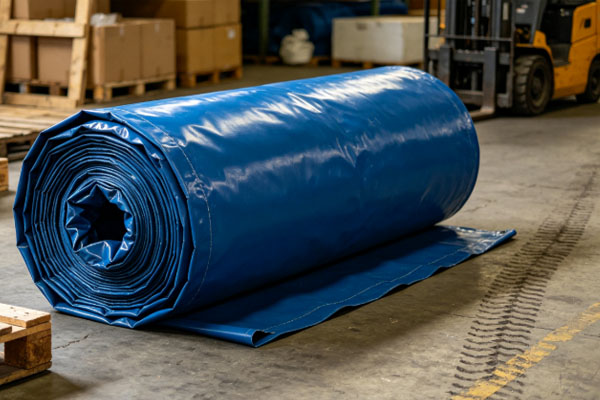
If the finished product width does not exceed the usable width of the roll material, a full-width piece of material can be used whenever possible to reduce intermediate seams. If the finished product is significantly wider than the roll width, multiple pieces of material usually need to be cut and then connected through heat welding, high-frequency welding, or other joining processes. Therefore, roll width mainly affects the production method, number of seams, material utilization, and processing cost of a single-piece finished product.
PVC tarpaulin rolls are manufactured to specific widths, such as 1.5 meters, 2 meters, 2.5 meters, 3 meters, or 3.2 meters. During processing, it is also necessary to consider whether the edges of the roll need to be trimmed and whether the width specified by the supplier refers to the nominal width or usable width. If a tarpaulin with a width of 2.8 meters needs to be produced while the usable width of the roll material is only 2 meters, a 2.8-meter-wide main body cannot be cut directly from a single piece of material, so additional joining areas are required. Some PVC-coated tarpaulin products can provide roll widths of up to approximately 3.2 meters, but the specific width still depends on the material structure, production line, and product specifications.
This is also a very common practice in actual production. For example:
If the roll width is 2 meters and the finished product needs to be 3 meters wide, two pieces of material can be joined together;
If the roll width is 3.2 meters and the finished product needs to be 4 meters wide, multiple pieces can also be cut and welded together;
Large cargo tarpaulins, construction protection tarpaulins, tent tarpaulins, and other large-sized products often require multiple pieces to be combined.
PVC materials can be connected through hot-air welding, high-frequency welding, and other processes according to product requirements. With proper design, the joined finished product can still meet waterproofing, fastening, and application requirements. Therefore, roll width limits the width of a single continuous piece of material, not the final width of the entire tarpaulin.
When the finished product requires joining, sufficient material needs to be reserved for the welding area. For example, if a 4-meter × 6-meter PVC tarpaulin needs to be produced while the available roll width is 2 meters, two or more pieces of material can be combined according to the cutting layout. The joining positions need to be planned according to the welding equipment, load direction, and subsequent installation method of the tarpaulin. Proper joining design can reduce material waste and prevent seams from being positioned in areas that experience frequent stress or are prone to water accumulation.
The overlapping dimensions of the welding area need to be determined according to the specific equipment and process, and the final finished dimensions must also be calculated based on the processed product. If the customer requires a 3-meter × 5-meter finished product, the supplier generally cannot simply cut the raw material to 3 meters × 5 meters. The cutting dimensions need to be calculated together with the edge hemming, welding, reinforcement strips, eyelets, and other structures.
When the finished product is large, roll width directly affects the number of joining lines. With a wider roll, some longitudinal seams can generally be reduced when the finished product structure allows. With a narrower roll, more pieces of material may need to be combined. As the number of seams increases, processing time, welding length, and material waste may also increase.
When manufacturing customized PVC tarpaulins, it is recommended to determine the finished product dimensions first and then work backward to select a suitable roll width and joining plan.
The Following Conditions Can Be Used for Confirmation
Finished product dimensions: Confirm the length, width, and whether there are side drops, curved sections, or special structures.
Usable roll width: Confirm whether the width provided by the supplier refers to the nominal width or the actual usable width during production.
Joining method: Determine whether hot-air welding, high-frequency welding, sewing, or a combination of processes will be used according to the material and equipment.
Edge structure: If hemming, reinforcement strips, eyelets, D-rings, or rope loops are required, the corresponding space should be reserved during the design stage.
For flat tarpaulins, if the finished width falls within the effective width of the roll material, one or more intermediate seams can usually be reduced. For large tarpaulins, proper layout can make the seam positions more evenly distributed while controlling material waste.
It is important to distinguish between “no joining” and “no seams.” Even when the main body is made from a single piece of material, additional processing may still be required for edge reinforcement, hemming, eyelet installation, or connecting strips.
Yes. Two or more pieces of material can usually be cut and then combined through welding or sewing to achieve the required dimensions. The specific layout needs to be determined according to the finished product dimensions, welding method, and equipment capabilities.
Not necessarily. A wider roll mainly helps reduce some joining requirements and may improve material utilization. Finished product quality is also related to PVC material thickness, base fabric structure, tensile strength, welding process, edge reinforcement, and installation method.
Not necessarily. It is necessary to confirm whether 3.2 meters refers to the nominal roll width or the effective usable width. Cutting, edge treatment, and the measurement method for the finished product also need to be considered. If the customer requires a final finished width of 3.2 meters, the supplier should confirm the actual achievable finished dimensions in advance.
Not necessarily, but if the finished product dimensions exceed the effective width of the available roll material, joining is usually required. Some special wide-width materials can reduce the number of seams, but their suitability still needs to be determined according to the material specifications, production equipment, and order quantity. Wider PVC materials are also available on the market, but the specific usable specifications need to be confirmed according to the product and production conditions.
The width of a PVC tarpaulin roll does limit the dimensions that can be directly cut from a single piece of material, but this limitation can be addressed through proper joining, welding, and layout planning. Therefore, when determining whether a PVC tarpaulin can be made to a specified size, it is not enough to consider the roll width alone. The finished product structure, effective material width, cutting method, and processing equipment also need to be considered.
When purchasing customized PVC tarpaulins, it is recommended to confirm the “roll specifications” and “finished product specifications” separately. Roll specifications are used to determine the raw material dimensions, while finished product specifications should clearly state the final delivered length and width. If the product includes hemming, reinforcement strips, eyelets, D-rings, or other fastening structures, their positions and dimensions should also be specified in advance. This can prevent the raw material cutting dimensions from being mistaken for the final finished product dimensions.
