
Hot Keywords:
- All
- Product Name
- Product Keyword
- Product Model
- Product Summary
- Product Description
- Multi Field Search

Emergency medical tents are used for triage, diagnosis and treatment, isolation, medical supply storage, and healthcare personnel support. Tent fabric should not be evaluated only for waterproofing and abrasion resistance. In actual operating environments, flame-retardant safety, tear resistance, weather resistance, disinfectant resistance, antibacterial and mildew resistance, antistatic properties, and airtight connections must also be considered. Only by configuring materials according to the tent’s application, structural span, and local regulations can a more reliable temporary medical space be established.
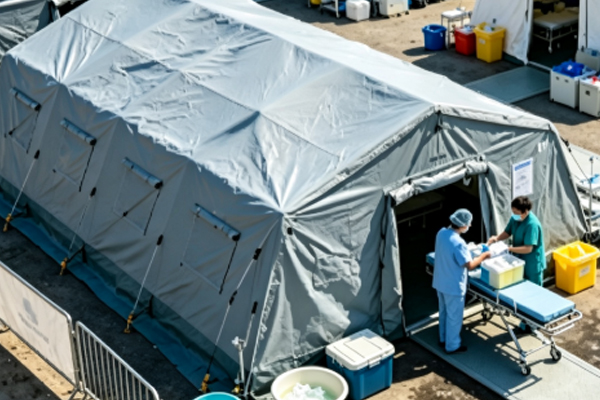
Medical tents must not only withstand wind and rain but also meet the requirements of medical use. Different performance characteristics can be achieved by adjusting the base fabric, coating, and processing technology.
Emergency medical tents are typically equipped with lighting, electrical, heating, cooling, and oxygen equipment, making flame-retardant performance particularly important. During procurement, the following points should be confirmed:
Local fire safety regulations and flame-retardant performance requirements;
Specific requirements for the roof, sidewalls, and partitions;
Whether testing by a designated laboratory is required;
Whether test reports or compliance documents must be provided;
Whether the material can maintain its flame-retardant performance after cleaning, weather exposure, and long-term use.
The applicable standards and compliance documents should be confirmed before selecting flame-retardant materials. Procurement decisions should not be based solely on price comparisons.
Medical tent fabric may come into contact with blood, bodily fluids, medicines, dust, and disinfectants. Therefore, it is not enough to consider whether the fabric is easy to wipe clean. Appropriate performance characteristics should also be selected according to the actual application and cleaning requirements. Materials generally need to provide waterproofing, flame retardancy, antibacterial and mildew resistance, disinfectant resistance, antistatic properties, tear resistance, and weather resistance, while the relevant testing standards and inspection reports should also be confirmed. Different medical tents do not have exactly the same requirements. Tents used for diagnosis and treatment, isolation, and medical supply storage should be equipped with suitable materials for their respective applications. Ordinary industrial materials should not be directly treated as medical-grade materials.
Material selection should not be based solely on fabric weight. The tent span, frame structure, local wind and rain conditions, assembly frequency, and the different loads borne by the roof and sidewalls all affect the selection of fabric specifications.
Triage, diagnosis and treatment, isolation, and medical supply storage areas serve different functions, so their material requirements should also be prioritized differently. Determining the tent’s application first and then matching the material specifications can help prevent insufficient configurations.
Tent Application | Main Requirements | Material Priorities | Design Considerations |
Triage Tent | Rapid patient flow management | Waterproof, flame-retardant, weather-resistant, easy to clean | Personnel movement |
Temporary Medical Tent | Examination and medical procedures | Flame-retardant, tear-resistant, easy to clean | Privacy and zoning |
Isolation Tent | Isolation and infection control | Flame-retardant, airtight, easy to clean | Pressure differential and sealing |
Negative/Positive Pressure Tent | Airflow control | Highly airtight enclosure material | Fresh air, exhaust, and pressure differential systems |
Medical Supply Tent | Storage of equipment and supplies | Waterproof, moisture-resistant, abrasion-resistant | Moisture protection and goods access |
Medical Staff Rest Tent | Personnel rest and support | Waterproof, sun-shading, weather-resistant | Comfort and ventilation |
For ordinary emergency tents, the main considerations are waterproofing, weather resistance, and rapid assembly. Isolation tents or tents with pressure-control requirements must also meet airtightness requirements.
“Higher fabric weight is always better” is not a complete material-selection principle. Large emergency medical tents intended for long-term use and repeated assembly should be equipped with suitable PVC materials based on structural span, wind load, frame spacing, fixing methods, and service life. Excessively lightweight materials may compromise tear resistance, abrasion resistance, and fatigue resistance. The roof generally needs higher waterproofing, weather resistance, and load-bearing stability than the sidewalls. A fabric weight of 650–900 g/m² or above may serve as a reference range for large heavy-duty tents, while material width, welding performance, doors, observation windows, partitions, and equipment interfaces should also be considered. The final selection should be confirmed according to the specific project and should not be based solely on thickness or weight.
Medical tents should not simply copy the ventilation methods used in ordinary outdoor tents. For isolation, negative-pressure, or positive-pressure tents, airflow direction and pressure control require an integrated design.
Ordinary triage, storage, or rest tents can be equipped with ventilation openings or ventilation equipment. Isolation, negative-pressure, and positive-pressure tents should not have doors or windows opened arbitrarily, as this may affect airflow and pressure differentials. These tents should focus on:
Sealing between the fabric, frame, ground, and doors;
Sealing around pipelines, air ducts, and equipment interfaces;
Coordination between fresh-air, exhaust, and filtration systems;
Proper separation of clean areas, buffer areas, and contaminated areas;
The impact of personnel and material entrances and exits on pressure differentials.
Ordinary medical tents can improve air circulation through ventilation openings. Tents used for infection control should adopt airtight enclosure systems, mechanical ventilation, and functional zoning.
If welded seams, edge binding, eyelets, or equipment interfaces are not properly processed, water leakage, air leakage, or tearing may occur. Therefore, the material and processing technology should be evaluated together.
Large-area joints should use stable heat-welding technology;
Edges around doors and frequently opened areas should be reinforced;
Eyelets and fixing points should receive localized reinforcement;
Ground connections should be designed to reduce water and air leakage;
Air ducts, cables, and equipment interfaces should be properly sealed;
Welded seams, connections, and fixing points should be inspected after assembly.
For tents that need to maintain a pressure differential, the airtightness of the material is only the foundation. The overall sealing performance is the key factor.
Emergency medical facilities often need to be deployed quickly, but this does not mean that long-term stability can be sacrificed. If materials are purchased based only on the price per square meter, subsequent repair, replacement, cleaning, and downtime costs may increase.
Repeated transportation and assembly expose tent fabric to folding, friction, stretching, and stress at the edges. Therefore, durability must be considered together with the cleaning requirements of medical environments.
Select abrasion-resistant and tear-resistant materials that match the intended service life;
Reinforce doors, edges, and high-frequency operating areas locally;
Confirm the material’s resistance to the specified cleaning agents according to the actual disinfection procedures;
Regularly inspect welded seams, eyelets, edge binding, and fixing areas;
Allow the fabric to dry thoroughly after cleaning before folding and storing it for extended periods;
Avoid direct friction between the tent fabric and sharp medical instruments or metal components;
During long-term outdoor use, inspect the surface for aging, hardening, and coating abnormalities.
Considering material durability, hygiene maintenance, and processing quality together can reduce the additional costs caused by frequent repairs and replacements.
For professional medical projects, purchasers should confirm the tent application, dimensions, span, service life, local fire safety requirements, flame-retardant reports, antibacterial and mildew-resistant requirements, antistatic requirements, disinfectant types, material weight and thickness, strength, welding and processing methods, and ventilation and airtightness requirements before placing an order. If negative pressure, positive pressure, or clean areas are involved, these requirements should also be specified in advance. Only when this information is clearly defined can the PVC tent fabric, tent structure, air-handling system, and actual application requirements be properly matched.
The selection of materials for emergency medical tents should be comprehensively evaluated according to the project application, structural loads, operating environment, and local compliance requirements. Newstar Plastic Industry Co.,Ltd. can provide PVC tent fabric and PVC-coated fabrics with different weights, widths, and performance configurations according to tent dimensions, service life, processing methods, and functional requirements, helping customers confirm material specifications and conduct sample testing.
