
Hot Keywords:
- All
- Product Name
- Product Keyword
- Product Model
- Product Summary
- Product Description
- Multi Field Search

Extra-large tarpaulins are commonly used for cargo yard covering, vessel covering, warehouse protection, construction work, and rain protection for large equipment. When the actual coverage area exceeds the production width or transport size of a single tarpaulin, a larger tarpaulin needs to be made through splicing. Splicing is not simply a matter of overlapping the edges of two pieces of tarpaulin. Instead, an appropriate processing method needs to be selected according to the tarpaulin material, operating environment, load conditions, and fixing method. Especially for PVC tarpaulins, improper treatment of the spliced area may lead to seam opening, water leakage, or edge tearing during subsequent use.
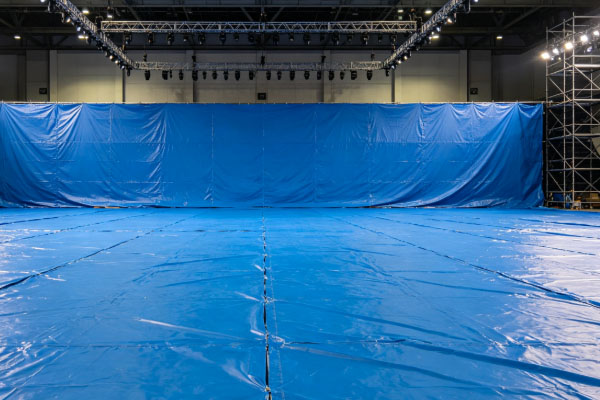
When designing an extra-large tarpaulin, the overall coverage dimensions are usually determined first, followed by section cutting according to the width of the raw material. For example, if a finished tarpaulin needs to be wider than the available width of standard PVC tarpaulin material, the tarpaulin can be divided into two or more sections and connected through high-frequency heat sealing, hot-air welding, or other methods. For tarpaulins that require waterproofing, the sealing performance of the spliced area is particularly important. For tarpaulins that are frequently exposed to tension, wind, or friction, the spliced areas also need to be reinforced. Properly arranging the splicing direction and seam positions can make extra-large tarpaulins flatter while also making subsequent installation and maintenance easier.
Tarpaulin raw materials usually have certain width limitations. If the finished product is wider than the effective width of the raw material, it cannot be completed by cutting a single sheet directly. For example, if a tarpaulin needs to be 8 meters wide while the available material has an effective width of only about 2 meters, multiple pieces of material need to be combined according to the designed dimensions. The number of splices depends on the raw material width, finished product dimensions, and the processing allowance that needs to be retained during cutting. When determining the splicing plan, unnecessary seams should also be minimized as much as possible. Too many seams will increase processing time and make subsequent loading and maintenance more difficult.
Extra-large tarpaulins should not be spliced at random locations. Seam positions should be planned in advance according to the actual application of the tarpaulin. If the tarpaulin is used outdoors for long periods, the seams should preferably be kept away from areas where water is likely to accumulate for extended periods. If the tarpaulin needs to withstand significant tension, the relationship between the seam direction and the main load direction should also be considered. For products such as vessel tarpaulins and truck tarpaulins that require frequent fastening, the main fastening hardware should also be kept away from the spliced seams whenever possible.
A common processing method for PVC-coated tarpaulins is heat sealing. The PVC material on the surface of the tarpaulin is heated until it reaches a suitable state for welding, and pressure is then applied to connect the two pieces of material. After heat sealing, the spliced area forms a continuous bonding layer with good waterproof performance. For extra-large PVC tarpaulins that need to be used outdoors for long periods, heat-sealed seams are generally more suitable than simple sewing for applications with high rain protection requirements. During processing, the heat-sealing temperature, pressure, speed, and seam width need to be controlled. Improper parameters may result in incomplete fusion of the seam or localized overheating of the material.
Some PVC tarpaulins can be connected using hot-air welding. Workers use hot-air equipment to heat the seam area while applying pressure, allowing the two pieces of tarpaulin to form a strong connection. This method is convenient for some large tarpaulins with relatively complex structures and is also suitable for repairing localized seams. If an extra-large tarpaulin develops a local tear during use, the damaged area can be removed according to the extent of the damage, followed by patch welding with the same or a compatible material.
Some canvas, polyester-coated fabrics, or special textile tarpaulins can be spliced using industrial sewing equipment. Stitching creates a mechanical connection, but conventional sewing produces needle holes in the material. Therefore, products with high waterproofing requirements require additional treatments such as seam taping, coating sealing, or other waterproofing methods. If the tarpaulin needs to withstand significant tension, reinforcement tape can be added to the seam area so that the load can be distributed over a larger area of material.
If the seam is too narrow, the connection area will be insufficient and may be easily affected by tension during use. If the seam is too wide, material consumption may increase. Therefore, an appropriate welding width or overlap width needs to be determined according to the material characteristics and equipment process during production. For large tarpaulins, the entire seam should remain as straight and continuous as possible, avoiding obvious variations in width.
Extra-large tarpaulins have a large surface area. If there are significant dimensional errors during cutting, wrinkles may appear after splicing. Before processing, the length and width of each piece of material should be checked, and positioning marks should be made. During splicing, the material should remain flat, and welding should be avoided while the material is under severe tension. Otherwise, after the tarpaulin returns to its normal state, shrinkage or deformation may occur near the seam.
When an extra-large tarpaulin is subjected to wind, the overall load is transferred through the edges and fastening points to the fabric surface. If a seam is located directly in a major load-bearing area, reinforcement is required. Reinforcement tape, reinforcement patches, or double-layer material can be added according to actual application requirements. Local reinforcement can also be added around fastening components such as grommets and D-rings to reduce damage to the tarpaulin itself caused by long-term pulling.
It can be used for some textile materials, but it is not suitable for all tarpaulins. For PVC tarpaulins that require long-term waterproofing, conventional sewing leaves needle holes that may affect waterproof performance. Therefore, heat sealing or welding is generally selected according to the material.
If a suitable heat-sealing or welding process is used for the material, and the seam width, temperature, pressure, and processing speed are properly controlled, the spliced area can maintain good sealing performance. If the processing quality is insufficient, water may seep through the seam, so the finished product needs to be inspected.
A balance usually needs to be maintained between reducing the number of seams and making reasonable use of the material. Too many seams will increase the processing area, but in order to ensure the finished dimensions, transportation, and installation requirements, unreasonable material combinations should not be used simply to reduce the number of seams.
This needs to be determined according to the actual structure. The edges usually need to be fitted with grommets, rope loops, or other fastening components. If the spliced seam is too close to a fastening component, localized stress concentration may occur. Therefore, for large tarpaulins, the seam and fastening positions generally need to be planned in advance.
The key points of splicing extra-large tarpaulins are material selection, seam design, and processing quality. Before production, the final length and width of the tarpaulin should be confirmed, and then the number of sections should be determined according to the effective width of the raw material. PVC tarpaulins can generally be connected by heat sealing or hot-air welding, while fabric tarpaulins can be industrially sewn according to their material characteristics and then sealed according to actual waterproofing requirements. For large outdoor tarpaulins, the seams need to be securely connected while also considering waterproofing and load-bearing performance. During processing, the seams should remain flat and continuous, avoiding obvious wrinkles, incomplete welding, or localized overheating. The edge binding, grommets, and reinforcement patches around the tarpaulin should also be coordinated with the seam positions in advance to prevent fastening points from being concentrated directly on the seams. During customization, it is recommended to provide the complete finished dimensions, material type, operating environment, and fastening method. If the tarpaulin is particularly large, a reasonable sectioning method can also be determined according to transportation, installation, and storage requirements.
