
Hot Keywords:
- All
- Product Name
- Product Keyword
- Product Model
- Product Summary
- Product Description
- Multi Field Search
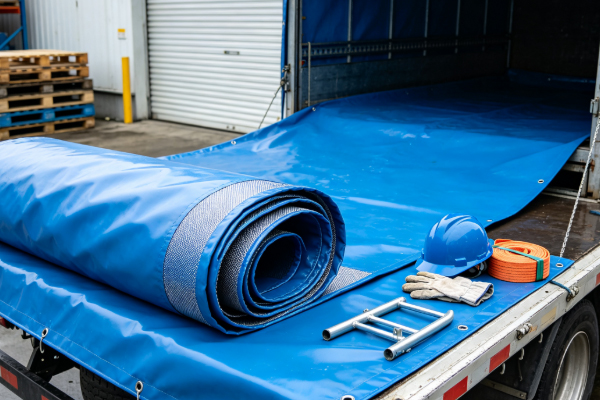
PVC tarpaulins are widely used for cargo transportation, vehicle covering, warehouse protection, outdoor shading, and temporary construction projects. Cutting design has a direct impact on production efficiency, material utilization, and overall product cost. For large tarpaulins, simply cutting the material according to the required covering dimensions can create considerable waste due to edge allowances, seam areas, eyelet positions, and irregular shapes. A well-planned cutting design should consider the finished dimensions, material width, cutting direction, seam positions, and reuse of leftover material. Through accurate measurement, optimized nesting, and reduced unnecessary cutting, PVC tarpaulins can maintain their required waterproofing, tensile strength, and abrasion resistance while making better use of raw materials and simplifying subsequent processing.
Before cutting a PVC tarpaulin, the finished dimensions and actual installation coverage should be clearly defined. Cutting the material strictly according to the required coverage size may leave insufficient space for hems, heat welding, eyelets, or connection structures. On the other hand, excessive allowances can increase unnecessary material consumption. The cutting dimensions should therefore be determined by combining the finished product size with the required manufacturing processes.
For rectangular PVC tarpaulins, the basic cutting dimensions can be calculated according to length, width, and hem allowances, followed by adjustments for eyelet positions, connection areas, and welding widths. When large tarpaulins require multiple panels, the dimensions of each panel should be established in advance, with similar panel sizes used whenever practical. This simplifies production nesting and reduces the accumulation of leftover material caused by frequently switching between different panel sizes. For vehicle tarpaulins and warehouse covers with standardized specifications, manufacturers can also create cutting dimension charts for common sizes, reducing repeated measurements and temporary modifications during production.
Material nesting is an important step in reducing cutting waste. If individual tarpaulin pieces are simply cut one after another from the same roll, long strips of unused material may remain along the edges. Optimized nesting arranges different product dimensions according to their length, width, and shape, allowing adjacent cutting areas to fit more closely while still leaving sufficient space for heat welding, hemming, and equipment operation.
The following methods can help improve cutting efficiency:
Group identical specifications: Cutting tarpaulins with the same dimensions in batches can reduce edge waste caused by frequent equipment adjustments.
Combine large and small sizes: Remaining areas from large products can sometimes accommodate smaller tarpaulins or auxiliary components.
Adjust the cutting direction: The cutting direction can be selected according to the fabric construction, load-bearing direction, and roll width while maintaining the required product strength.
Reduce unnecessary cutting gaps: Where equipment accuracy and welding requirements allow, the distance between adjacent cutting pieces can be controlled to minimize unused material.
Create standardized nesting templates: Fixed nesting layouts can be developed for commonly ordered tarpaulin sizes, reducing material waste caused by temporary layout planning.
Nesting should not simply aim to place every cutting piece as closely as possible. Sufficient space must remain for accurate cutting and subsequent processing. A practical nesting solution balances material utilization, manufacturing accuracy, and the structural requirements of the finished product.
Large PVC tarpaulins often require heat-welded seams because the available roll width may not be sufficient for the finished product. Poorly planned seam positions can increase the number of panels and create additional unusable scraps. During the design stage, seam layouts should be determined according to the available material width and the overall dimensions of the finished tarpaulin. Whenever possible, major panels should use complete strips or regular rectangular shapes to reduce complicated cutting.
For products requiring multiple panels, seam positions should also be coordinated with the load-bearing structure. For example, vehicle covers and large warehouse tarpaulins need reliable overall strength, so seams should not be randomly positioned in areas exposed to frequent abrasion or concentrated loads. By determining the required welding width before cutting, sufficient material can be reserved for heat welding without requiring additional trimming later. For wide products, different panel combinations can also be selected according to the roll width so that more of the raw material can be utilized. Proper seam planning reduces repeated processing while helping maintain stable finished dimensions.
Compared with standard rectangular tarpaulins, vehicle-specific covers, outdoor structure tarpaulins, and equipment protection covers may include sloped edges, rounded corners, openings, or curved sections. Irregular cutting can create considerable edge waste if the layout is not optimized during the design stage. Where installation requirements permit, unnecessary shape complexity can be reduced, while adjacent cutting pieces can be arranged according to their contours to improve material utilization.
For irregular PVC tarpaulins, the following design methods can be considered:
Use regular base shapes whenever possible: Complex outlines can be divided into basic rectangular or trapezoidal panels when this does not affect installation.
Make full use of edge scraps: Larger triangular or trapezoidal leftover pieces can be retained for reinforcement patches, flaps, connection pieces, or other auxiliary components.
Standardize similar curved dimensions: When several rounded or curved sections are required, using consistent dimensions makes batch nesting easier.
Define installation openings in advance: Openings for pipes, support frames, or equipment interfaces should be determined during design to prevent repeated trimming after production.
Preserve reusable leftover material: Relatively complete PVC remnants can be sorted and stored for future repairs and small components.
The objective of irregular-shape cutting is not to eliminate all leftover material, which is rarely practical, but to reduce unusable scraps and convert larger usable remnants into resources for later production.
Some leftover material is unavoidable during PVC tarpaulin production. A more practical approach is to increase the reuse rate of usable remnants. After production, leftover materials can be sorted according to dimensions, thickness, color, and material construction. Larger and more complete pieces can be used to produce equipment protection covers, reinforcement patches, tool bags, edge protectors, or small covering products, while smaller pieces can be reserved for localized repairs according to actual requirements.
For companies that manufacture PVC tarpaulins on a regular basis, a cutting database can also be established to record common product dimensions, raw material specifications, nesting layouts, and actual leftover quantities. As more production data is accumulated, manufacturers can select roll specifications that better match common orders, reducing waste caused by mismatched material dimensions. Standard cutting templates for frequently produced products can also reduce manual measurement errors and make material consumption more predictable.
The purpose of PVC tarpaulin cutting design is not simply to reduce the number of cuts. It is to create a practical relationship between finished dimensions, raw material specifications, nesting layouts, seam structures, and leftover material reuse. Accurate cutting calculations, optimized roll nesting, properly positioned seams, improved utilization of irregular areas, and systematic scrap management can significantly reduce unnecessary material consumption. For manufacturers handling regular production and customized PVC tarpaulins, this approach can improve production efficiency and material utilization while maintaining the waterproofing, abrasion resistance, tensile strength, and structural stability required for practical applications.
