
Hot Keywords:
- All
- Product Name
- Product Keyword
- Product Model
- Product Summary
- Product Description
- Multi Field Search

PVC tarpaulin ventilation ducts feature good flexibility, light weight, convenient transportation, and flexible processing dimensions. They are commonly used for factory exhaust, industrial equipment exhaust, welding fume collection, dust handling, temporary ventilation, and air delivery in large spaces. Unlike metal air ducts, PVC tarpaulin ventilation ducts have a flexible structure and are affected by internal airflow, changes in air pressure, fan vibration, and their own weight during operation. If the fixing structure is not properly designed during installation, the duct may move from side to side, shake up and down, sag in the middle, or shift at the connections. Slight movement can be a normal phenomenon during the operation of flexible ventilation ducts, but if the movement is excessive or a certain section repeatedly rubs against the fixing components, the installation method should be checked again.
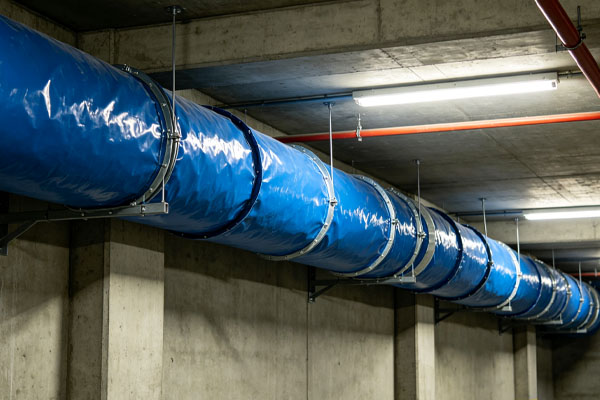
The fixing requirements are particularly strict for large-diameter PVC tarpaulin ducts, long horizontal ducts, and ducts installed near fans. Relying only on fixing at both ends makes it difficult to keep the entire duct stable. During actual installation, supports should be arranged according to the duct length, diameter, weight, working airflow, bending positions, and installation height. The key to reducing movement in PVC tarpaulin ventilation ducts is to provide continuous and even support while avoiding excessive compression of the tarpaulin by the fixing components. Support points should be distributed properly, while elbows, tees, and equipment connections require special attention. Vibration reduction should also be considered at the fan connection. Proper use of suspension straps, brackets, support rings, and connection structures can reduce duct movement while maintaining the ventilation cross-section.
PVC tarpaulin ventilation ducts do not have the rigid support structure found in stable metal air ducts. When the fan starts, air quickly enters the duct, and the flexible duct wall is affected by internal pressure. Changes in airflow, fan speed, and equipment start-up or shutdown may cause slight changes in the duct shape. If the duct is completely suspended without support, the force generated by the airflow can cause the duct body to move. The larger the diameter and the longer the duct, the more noticeable the effect may be in unsupported areas. Therefore, large-diameter and long PVC tarpaulin ventilation ducts require more reasonable support arrangements.
Although PVC tarpaulin is lighter than some metal duct materials, a long duct still has a certain amount of self-weight. If both ends are fixed while the middle has no support, the duct will sag under its own weight. During operation, airflow can cause the sagging section to move up and down, eventually creating noticeable wave-like movement. Therefore, installation should not only consider whether both ends of the duct are fixed, but also whether there are long unsupported sections in the middle. This is especially important for horizontal installation.
If the PVC tarpaulin ventilation duct is directly connected to the fan outlet, mechanical vibration generated during fan operation may be transmitted to the flexible duct through the connection. In this situation, the duct may continue to shake even when it has sufficient support. A suitable flexible connection should be installed at the fan connection, while the fan itself should remain independently and securely supported. The entire duct should not be used to carry the vibration or weight of the fan equipment.
Wide suspension straps are a common fixing method for PVC tarpaulin ventilation ducts. The strap supports the duct from underneath and connects it to the overhead fixing structure, distributing the duct weight across multiple locations. Compared with thin steel wire or narrow metal lines, wide straps provide a larger contact area with the tarpaulin, reducing localized pressure and making concentrated wear less likely during operation and vibration.
Long horizontal ducts should have multiple support points to prevent large unsupported spans in the middle.
Suspension straps should remain as flat as possible to avoid creating sharp localized pressure points when folded.
Suspension straps should mainly provide support and should not be tightened excessively.
The contact area between the duct and suspension straps should remain smooth to prevent long-term friction from damaging the tarpaulin.
The support spacing should be determined according to the duct diameter, material thickness, duct weight, and airflow. Some flexible duct installation guidelines recommend relatively short support spacing for horizontal installation to reduce sagging and deformation. Actual projects should prioritize the installation requirements provided by the duct manufacturer.
Straight sections of PVC tarpaulin ventilation ducts are generally easier to keep stable, while elbows, tees, and connection points are more likely to move. An elbow changes the direction of airflow, and the airflow generates additional forces after passing through the bend. If both ends of an elbow lack support, the duct may swing. Tees also involve airflow distribution, so excessive movement at the connection should be avoided. Equipment connections require separate treatment as well. After the duct is connected to equipment, the connection should not carry the weight of the entire duct. Long PVC tarpaulin ducts should have independent support near the connection so that the connection mainly provides sealing and air transmission rather than carrying the entire duct system.
For large-diameter PVC tarpaulin ventilation ducts, suspension straps alone may still allow noticeable movement. In such cases, curved brackets, semicircular support rings, or continuous brackets can be added according to the site structure. The bracket should fit the outer shape of the duct as closely as possible while avoiding sharp contact points. A larger support area can reduce pressure per unit area and provide more stable support while allowing the duct to maintain a round cross-section. This installation method is suitable for large factories, equipment exhaust systems, large-diameter industrial ventilation ducts, and exhaust ducts that need to operate for extended periods.
The area near the fan is one of the positions where PVC tarpaulin ventilation ducts are more likely to move. If a rigid connection is used between the fan and duct, vibration generated by the equipment can be directly transmitted to the tarpaulin duct. A more suitable installation method is to support the fan equipment independently, provide independent support for the duct, and maintain an appropriate flexible connection section at the equipment interface. This can reduce the direct transmission of mechanical vibration to long-distance ducts. It should be noted that flexible connections are mainly used to reduce vibration transmission and cannot replace load-bearing structures such as suspension straps and brackets. Long PVC tarpaulin ventilation ducts still require multiple support points according to actual conditions.
When installing PVC tarpaulin ventilation ducts, excessive extra length should not be reserved simply for construction convenience. An overly long duct may develop folds, sagging, and bends. A suitable length allows the duct to remain naturally extended after installation while reducing irregular movement caused by airflow. If some additional length must be retained, it should be supported properly rather than allowed to hang freely.
A common mistake when fixing ducts is assuming that tighter fastening always provides greater stability. PVC tarpaulin has a certain degree of flexibility, and excessive tightening may cause obvious deformation. If the strap squeezes the duct into an oval shape, the effective internal ventilation area will be reduced, affecting airflow. The tarpaulin may also remain under localized pressure for a long period. Therefore, the fixing components should have sufficient contact width. After fixing, the main purpose should be to support the duct while preserving the cross-sectional space required for normal operation.
PVC tarpaulin ventilation ducts may experience slight vibration during long-term operation. If metal buckles, steel wires, bolt edges, or other sharp components directly contact the tarpaulin, prolonged friction may cause scratches. The wear rate may be even higher near fans with frequent vibration. Therefore, the fixing structure should be as smooth as possible. When necessary, a protective layer or flexible connection material can be added.
If support points are concentrated in only a few locations, the duct may experience significant differences in load distribution. Some sections may be tightly compressed while the middle section remains completely unsupported. A reasonable installation method should provide relatively even support along the length of the duct. If a certain section moves noticeably, check the support spacing before simply increasing the fastening force.
Not necessarily. PVC tarpaulin ventilation ducts are flexible by design, and slight movement does not mean that the product is unsuitable for use. If the movement is excessive, first check the support spacing, strap width, duct length, elbow structure, and fan vibration. If the duct still cannot remain stable after adding supports, adjusting the duct length, and improving the connection structure, then the working environment can be evaluated to determine whether a rigid-flexible combined duct structure is required.
There is no single fixed value suitable for every application. The actual spacing should be determined according to the duct diameter, length, material thickness, installation direction, and working airflow. Small-diameter short ducts may use relatively simple support, while large-diameter long ducts require more support points. For long-term industrial ventilation projects, it is recommended to provide the duct diameter, length, fan parameters, and installation method before ordering so that the manufacturer can determine the appropriate suspension straps, support rings, and connection structures according to actual conditions.
The main reason is usually a large unsupported span in the middle. PVC tarpaulin is flexible, so fixing both ends can limit movement at the ends but cannot completely restrict movement in the middle of the duct. The usual solution is to add intermediate supports and check whether the duct is excessively long, sagging, or bent. For large-diameter ducts, brackets or support rings can be used to further improve stability.
Increasing the number of support points can reduce large unsupported areas, but more support is not always better. If supports are too close together and apply excessive pressure to the duct, the cross-section may be affected. A reasonable fixing method should maintain a balance between stability and ventilation area. Support positions should be adjusted according to the actual operating condition of the duct.
The stability of a PVC tarpaulin ventilation duct depends not only on site installation but also on product design and manufacturing. The duct diameter, tarpaulin thickness, reinforcement materials, connection type, suspension positions, and length design can all affect the final fixing performance. For ducts that need to operate for long periods, it is recommended to specify the application during the purchasing stage, such as industrial exhaust, equipment exhaust, welding fume collection, dust conveying, or temporary ventilation, and provide the actual duct diameter, length, airflow, fan model, and installation environment. The manufacturer can determine the appropriate PVC tarpaulin specifications based on these parameters and reserve suitable connection structures and fixing positions. For ventilation ducts that need to be frequently installed and removed, special attention can also be given to the combination of suspension straps, zippers, clamps, flanges, and quick connection structures. For permanent installations, a stable suspension method and wear-resistant connection structure are more suitable. Different working environments require different fixing designs, and the same installation method should not simply be applied to every project.
The key to reducing movement in PVC tarpaulin ventilation ducts is proper support rather than simply tightening the fixing components. Long ducts require continuous support, large-diameter ducts require additional load-bearing support, elbows and connections require special fixing, and vibration transmission needs to be addressed near the fan. At the same time, suspension straps and brackets should not excessively compress the tarpaulin and should preserve the original duct cross-section as much as possible. If you are customizing PVC tarpaulin ventilation ducts, you can provide the duct diameter, length, fan airflow, operating temperature, installation height, and connected equipment before placing an order. The manufacturer can then determine the tarpaulin specifications, reinforcement method, connection type, and suspension structure according to the actual application conditions. This can reduce installation difficulties during the product design and manufacturing stage, improve duct stability during actual operation, and help reduce the risk of long-term friction, deformation, and connection damage.
