
Hot Keywords:
- All
- Product Name
- Product Keyword
- Product Model
- Product Summary
- Product Description
- Multi Field Search
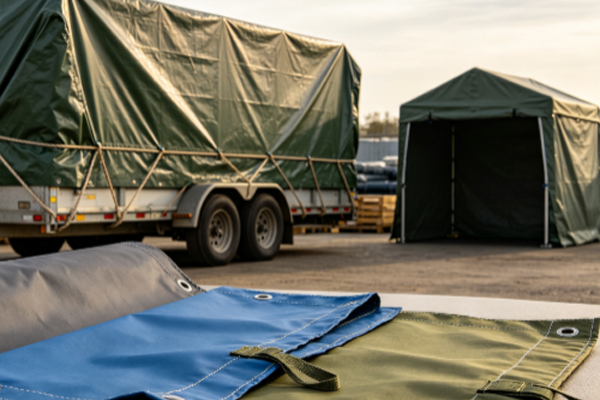
PVC tarpaulins used outdoors need to withstand more complex conditions than products used indoors. Rain, sunlight, wind, dust, temperature fluctuations, humidity, and frequent handling can all affect material performance and structural stability. Simply increasing the thickness of PVC fabric cannot solve every outdoor application challenge. The dimensions, surface treatment, edge structure, fastening method, drainage design, and maintenance features of a tarpaulin can all influence its practical performance. Proper design allows tarpaulins to adapt to different weather conditions and installation environments while reducing material wear and maintenance requirements. For logistics transportation, agricultural covering, outdoor storage, industrial equipment protection, and temporary structures, PVC tarpaulins with good environmental adaptability can provide more stable protection and support longer repeated use.
Outdoor tarpaulins are exposed to sunlight, rain, and temperature changes for extended periods, so the performance of PVC fabric directly affects product stability. PVC tarpaulins intended for outdoor applications generally need good waterproofing, wear resistance, tensile strength, and weather resistance. Different working conditions require different material thicknesses and fabric structures. Lightweight materials may be suitable for temporary covering, while long-term outdoor applications require greater attention to tensile strength and weather resistance.
PVC coatings provide the base fabric with waterproof protection while reducing moisture penetration. For products exposed to outdoor conditions for long periods, materials with suitable UV resistance can be selected according to the application requirements to reduce aging caused by prolonged sunlight. Flexibility is also important. If a tarpaulin needs to be rolled, folded, and unfolded frequently, the fabric should combine sufficient strength with suitable flexibility to reduce the risk of cracking caused by repeated bending.
Material selection should also reflect local environmental conditions. Areas with frequent rainfall require greater attention to waterproofing and seam sealing. Locations with strong winds require higher tensile strength and more reliable fastening systems. High-temperature environments require materials that can remain stable under prolonged sunlight exposure, while cold environments require PVC fabrics that maintain suitable flexibility at low temperatures. Matching PVC fabric characteristics with the actual outdoor environment provides a reliable foundation for long-term use.
Outdoor tarpaulins frequently experience continuous wind and rain, so structural design should consider more than static coverage. If the fabric remains too loose after installation, rainwater may collect in low areas. If the edges do not have enough fastening points, strong winds may cause movement and concentrate stress around connection points. A suitable structural design can improve tension distribution and help the tarpaulin maintain stable coverage during changing weather conditions.
For large PVC tarpaulins, an appropriate slope can be incorporated according to the supporting structure so that rainwater flows naturally toward designated drainage areas. Reinforced hems, reinforcement straps, and high-strength fastening rings can be added around the edges to increase load-bearing capacity in tension areas. For vehicle covers, warehouse tarpaulins, and outdoor equipment covers, additional intermediate fastening points can be used when necessary to prevent excessive sagging across large surfaces.
Structural design should also reduce areas that are likely to collect water or dust. For specially shaped equipment, the tarpaulin can be cut according to the equipment profile to achieve a closer fit and reduce the chance of strong wind entering beneath the covering. For permanently installed outdoor tarpaulins, frames, support poles, and tensioning systems can be combined with the fabric to maintain appropriate surface tension. A stable structure reduces the impact of changing weather and helps the tarpaulin provide more reliable protection outdoors.
Outdoor tarpaulins may need to provide more than rain protection. They can also help with sun protection, heat reduction, and moisture control. These functions need to be coordinated through appropriate design. For example, a completely sealed covering structure can reduce the entry of rain and dust, but it may also restrict airflow and increase internal heat during hot weather. For certain applications, adjustable ventilation areas can therefore be incorporated to allow controlled airflow when required.
Drainage design is particularly important for long-term outdoor use. Large tarpaulins should maintain appropriate surface tension after installation and work together with supporting structures to create natural drainage paths. For warehouse shelters, vehicle covers, and equipment protection, the direction of water flow should be determined according to site conditions so that water does not remain on the fabric for extended periods. Fastening holes and reinforcement areas should also be positioned carefully to avoid creating areas where water can accumulate and to reduce the impact of prolonged moisture on connection components.
In regions with strong sunlight, PVC tarpaulins can also improve sun protection through material selection, color selection, and covering structure. Agricultural applications, outdoor work areas, and temporary shelters may benefit from designs that reduce direct solar radiation entering the covered space. Some applications can also use local ventilation windows or adjustable openings so that the tarpaulin can be adapted to changing weather conditions. Properly combining drainage, sun protection, and ventilation features can make tarpaulins more suitable for long-term outdoor applications.
Tarpaulin edges are often subject to concentrated stress. In strong winds, continuous pulling forces can act on the fabric and fastening components. If the edge structure is not strong enough, fastening holes, lifting rings, and hems may become deformed or damaged. Outdoor PVC tarpaulins therefore require targeted reinforcement around the edges and suitable connection systems according to the installation environment.
Common outdoor reinforcement solutions include the following:
Reinforced hems: Increasing the thickness of the edge can improve tensile and abrasion resistance and reduce damage during long-term use.
Reinforcement straps: Adding straps around fastening holes can distribute the pulling force from ropes and buckles and reduce localized stress.
High-strength lifting rings: A suitable number of lifting rings should be positioned according to the tarpaulin dimensions to distribute fastening forces more evenly.
Double-layer connection areas: For windy environments or applications involving frequent installation and removal, key connection points can be reinforced with multiple fabric layers.
Corrosion-resistant accessories: Outdoor tarpaulins are frequently exposed to rain and humidity, so metal fasteners and other components should have suitable corrosion resistance.
The connection system should also remain convenient to operate. If fastening procedures are too complicated, workers may find it difficult to install or remove the tarpaulin quickly during bad weather. Depending on the usage frequency, ropes, elastic straps, buckles, hooks, or other fastening systems can be selected. Permanently installed tarpaulins should place greater emphasis on connection strength, while frequently opened and removed products need to balance durability with operating speed. Properly combining reinforcement structures and fastening systems can reduce the risk of damage caused by wind and rain.
Outdoor environments are not all the same. Logistics transportation, agricultural production, outdoor storage, and industrial equipment protection involve different weather conditions and operating requirements. Therefore, tarpaulin design should be based on the specific application when determining material, dimensions, structure, and functional configuration. Only when the product matches its actual environment can PVC fabric provide its intended protective performance.
When customizing an outdoor PVC tarpaulin, the following design process can be considered:
Identify the application area: Determine whether the tarpaulin will be used for vehicles, cargo, equipment, buildings, or temporary spaces, and establish the installation location and coverage requirements.
Evaluate local climate conditions: Consider typical rainfall, sunlight exposure, wind conditions, temperature, and humidity to select suitable PVC fabric.
Determine the covering dimensions: Measure the length, width, and height while reserving enough space for fastening, tensioning, and drainage.
Design the load-bearing structure: Position reinforcement straps, fastening holes, and lifting rings according to tarpaulin size and wind conditions to achieve better stress distribution.
Plan the drainage path: Use the supporting structure and installation direction to establish a suitable slope and reduce water accumulation on the surface.
Configure auxiliary functions: Add ventilation openings, observation windows, roll-up structures, inspection openings, or quick-connect systems according to actual requirements.
Develop a maintenance plan: Clean surface contaminants regularly and inspect edges, seams, fastening holes, and accessories. Damaged areas should be repaired promptly.
For PVC tarpaulins intended for long-term outdoor use, transportation and storage should also be considered during the design stage. The product should be easy to roll or fold without causing excessive bending or pressure on the fabric and accessories during storage. Logistics tarpaulins that need to be moved frequently can be equipped with lifting straps or storage features to reduce dragging damage during handling. Proper storage methods can also help preserve the condition of PVC fabric over time.
The outdoor adaptability of a tarpaulin comes from the coordinated performance of its material, structure, and functional design. Suitable PVC fabric provides basic protection, structural design improves wind resistance and drainage, reinforced edges and connection systems increase durability, while ventilation, sun protection, and storage features can further improve the practical user experience. For PVC tarpaulin suppliers, providing customized designs according to local climate conditions and application scenarios can help products adapt to complex outdoor environments more effectively. This allows tarpaulins to provide stable and durable covering protection for logistics transportation, agricultural production, industrial equipment, and outdoor facilities.
