
Hot Keywords:
- All
- Product Name
- Product Keyword
- Product Model
- Product Summary
- Product Description
- Multi Field Search
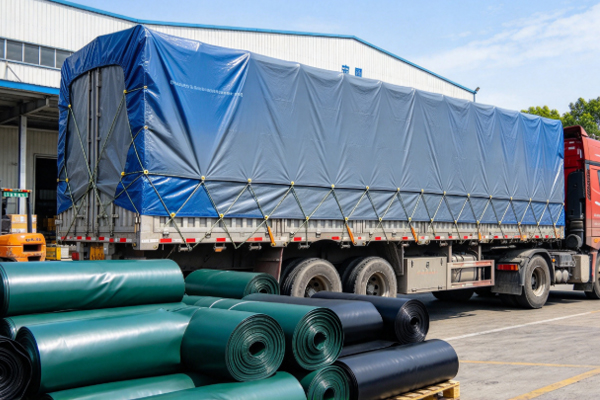
Waterproof tarpaulins are widely used for cargo transportation, warehouse covering, vehicle protection, outdoor equipment protection, and temporary construction applications. In practical use, effective rainwater protection depends not only on the waterproof properties of the material but also on the overall structural design. A waterproof coating alone cannot completely prevent water accumulation and leakage in complex outdoor conditions. If the tarpaulin has insufficient slope, poorly designed seams, or loose edges, rainwater may collect or flow back into the covered area. A well-designed waterproof tarpaulin should coordinate the material surface, overall shape, drainage route, seam structure, and edge treatment. This allows rainwater to leave the covered area efficiently and reduces the risk of leakage during long-term use.
The surface condition of a waterproof tarpaulin directly affects how efficiently rainwater flows away. A properly tensioned covering surface allows water to follow a planned drainage route, while local depressions can easily become water-collecting areas. For large PVC tarpaulins and outdoor covers, an appropriate slope can be incorporated into the installation structure so that rainwater naturally flows toward lower drainage points. Vehicle tarpaulins can be designed according to the shape of the cargo body, while warehouse covers can use the height differences of support frames to create suitable drainage slopes.
For large tarpaulins, relying only on the natural tension of the material may not be sufficient to maintain a flat surface. Support points, tensioning systems, and frame height differences may also be needed to establish a stable drainage route. A suitable slope reduces the time rainwater remains on the tarpaulin surface and can also reduce the additional load caused by accumulated water. For waterproof tarpaulins intended for long-term outdoor use, the design should consider local rainfall conditions and the supporting structure to prevent low areas from continuously collecting water.
Large waterproof tarpaulins often require multiple panels because the available material width may not be sufficient for the finished product. Seam areas can therefore become critical locations in the waterproof design. Simple overlapping joints may allow water to enter the gap after prolonged exposure to rain and wind. PVC tarpaulins can generally use heat welding to create a continuous connection between panels, forming a more effective sealed area. Welding width, temperature, pressure, and processing speed should be matched to the material specifications to prevent incomplete welding or localized material damage.
For long-term waterproof tarpaulin applications, seams should also be positioned away from areas where water is likely to remain. Where the structure allows, seams can be arranged in the same general direction as water drainage, reducing direct transverse water pressure on the joint. Openings, curtains, and movable connection areas require suitable sealing structures to maintain water protection after repeated operation. Proper seam routing combined with controlled heat-welding processes can improve the overall rainwater resistance of the tarpaulin.
Tarpaulin edges are areas where rainwater can easily enter, especially during windy and rainy weather. Water may be driven inward along loose edges, while sagging sections can change the intended drainage direction. Proper hemming, reinforcement, and drainage design help maintain better edge stability.
The following edge protection methods can be considered:
Use reinforced hems: PVC material or webbing can be added along the edges to improve structural stability.
Create suitable drainage points: Where the structure permits, rainwater can be directed toward designated low points to reduce water accumulation.
Reinforce the corners: Tarpaulin corners commonly carry connection and tension loads, so reinforcement patches can improve local strength.
Reduce edge wrinkles: Appropriate tension helps keep the edges relatively smooth and reduces opportunities for water to enter folded areas.
Coordinate with the installation structure: Hems, eyelets, webbing, and support frames should be properly matched to avoid creating potential water-entry paths.
Edge design affects both waterproof performance and stability in windy and rainy conditions. A properly reinforced edge allows rainwater to follow a more predictable drainage route while helping the tarpaulin maintain its shape.
Large-area waterproof structures used for warehouses, vehicles, and temporary buildings may require several tarpaulin sections to work together. In such applications, the waterproof performance of each individual sheet is not enough; the overlap relationship between adjacent sheets must also be considered. If the overlap direction is opposite to the natural flow of rainwater, wind-driven rain may enter the joint. A suitable overlap design places the upper sheet on the upstream side and allows the lower sheet to receive and direct the water away, creating a continuous downward drainage path.
For multi-panel tarpaulin systems, the main drainage direction should be planned before installation, and the overlap sequence should follow this route. Large covering structures can also use intermediate supports to create controlled height differences between adjacent sections and prevent low points from forming near joints. Vehicle roof tarpaulins can direct rainwater toward the sides of the vehicle, while warehouse coverings can use roof supports to create continuous slopes. This structural arrangement reduces the time water remains around joints and improves the overall waterproof performance.
The long-term rainwater protection of a waterproof tarpaulin depends not only on the original design but also on installation and maintenance conditions. Outdoor tarpaulins may be exposed to UV radiation, wind, temperature changes, dust, and repeated rainfall. Over time, these conditions can affect material surfaces and connection areas. The PVC material should therefore be selected according to the actual environment, while locations exposed to repeated water flow should receive suitable reinforcement.
Application | Waterproof Design Focus | Recommended Structure |
Cargo transportation | Prevent water entry through edges and seams | Heat-welded seams, reinforced hems, proper overlaps |
Vehicle covering | Rapid drainage and reduced wind-driven rain | Sloped surface, reinforced edges, sealed connections |
Warehouse protection | Continuous waterproof coverage over large areas | Multi-panel welding, continuous drainage slope, reinforced joints |
Outdoor facilities | Resistance to long-term rain and wind | Weather-resistant material, reinforced corners, stable tension |
Temporary construction | Quick installation with reliable rain protection | Regular overlaps, secure connections, defined drainage direction |
During use, drainage routes should remain clear, and leaves, dirt, mud, and other debris should be removed from the tarpaulin surface. If seams, edges, or connection points become loose, they should be inspected and repaired promptly. For long-term waterproof tarpaulin applications, tension and support structures can also be adjusted according to actual conditions so that the tarpaulin maintains an effective drainage shape.
Improving rainwater protection through waterproof tarpaulin design requires the material and structural system to work together. Suitable slopes, optimized heat-welded seams, reinforced edges and corners, correctly planned overlap directions, and application-specific material selection can reduce the effects of water accumulation and wind-driven rain. For PVC waterproof tarpaulins, maintaining a stable drainage route is equally important. When rainwater can leave the covered area efficiently, the inherent waterproof properties of the material can be used more effectively, making the product suitable for cargo transportation, warehousing, vehicle covering, and long-term outdoor protection.
