
Hot Keywords:
- All
- Product Name
- Product Keyword
- Product Model
- Product Summary
- Product Description
- Multi Field Search
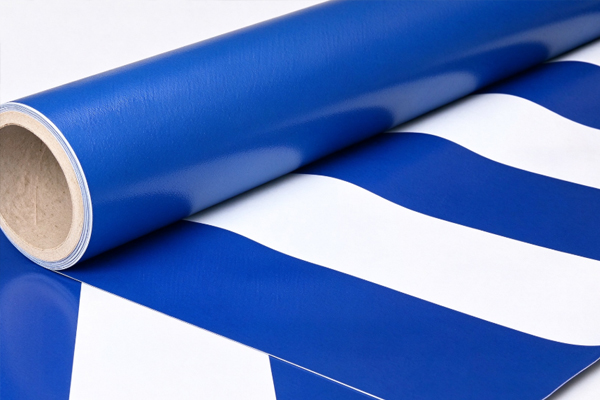
The printing performance of PVC tarpaulin is closely related to the printing surface, material structure, and continuous production conditions. Although the polyester base fabric does not directly contact the ink, it affects the tarpaulin’s flatness, dimensional stability, and feeding performance, while the PVC forming process and surface treatment determine the condition of the actual printing surface. For products requiring high-definition graphics, fine text, or large-format continuous printing, the material needs to be matched from the base fabric through to the surface system.
PVC tarpaulin generally uses polyester fabric as a reinforcement layer and is then formed through PVC coating or PVC film lamination. The base fabric mainly provides mechanical support and dimensional stability, and changes in its structure can further affect subsequent processing and printing.
Polyester yarn specifications, warp and weft density, and weaving methods can change the mechanical properties of the base fabric. A uniformly structured and dimensionally stable base fabric can provide a more stable foundation for PVC forming and continuous printing. When purchasing, the following factors can be considered:
Whether the warp and weft yarns are arranged uniformly;
Whether the base fabric has undergone sufficient heat setting;
Whether the finished material has obvious surface texture fluctuations;
The level of surface detail required by the printed content.
Base fabric parameters should be selected according to the actual application, as higher density does not necessarily mean better printing performance.
Polyester base fabric needs tension control and heat setting during production to reduce subsequent shrinkage. If dimensional stability is insufficient, long rolls of tarpaulin may change in length or width after feeding, tensioning, and curing, affecting graphic positioning and panel-to-panel alignment. Continuous roll printing should therefore pay particular attention to dimensional stability.
Material thermal shrinkage;
Dimensional changes at different temperatures;
Graphic positioning after long-distance feeding;
Dimensional consistency during multi-panel splicing.
A stable base fabric can reduce interference from material movement with continuous printing accuracy.
The base fabric is only one part of the tarpaulin structure. The PVC forming process also affects the final printing surface. Lamination and knife coating use different material-forming methods, so purchasing decisions should be based on graphic precision and the intended application.
PVC laminated tarpaulin is generally produced by combining pre-formed PVC film with polyester fabric through processes such as heat and pressure lamination. The final surface condition can be affected by film thickness, bonding pressure, base-fabric structure, and production control, and some materials may show more noticeable base-fabric texture. When the printed content includes:
Small text;
Fine lines;
High-definition images;
Large areas of uniform color.
It is recommended to conduct sample testing with the target material to evaluate the actual impact of surface texture on graphic details and color-block uniformity.
Knife coating applies PVC plastisol directly onto the polyester base fabric and forms a continuous PVC layer through controlled thermal processing. Its surface condition is related to the formulation, coating thickness, thermal treatment, and subsequent surface treatment. Knife coating does not automatically mean that the material is a high-precision printing fabric. Actual printing performance still needs to be evaluated together with surface flatness, PVC formulation, surface treatment, and ink compatibility. During purchasing, it is more appropriate to evaluate the actual sample and technical specifications rather than selecting material solely according to the production process name.
The ink actually contacts the PVC surface, so whether tarpaulin is suitable for printing depends not only on the internal base-fabric structure but also on surface energy, wetting behavior, and the type of surface treatment.
Some PVC tarpaulins use Acrylic, PVDF, or other surface treatments according to requirements for weather resistance, stain resistance, cleanability, and surface protection. These treatments may change surface wettability and ink bonding. When purchasing, it is recommended to confirm:
Whether an Acrylic, PVDF, or other protective layer is present;
Whether the surface is classified as printable;
The recommended compatible ink system;
Whether a dedicated printing coating or pretreatment is required;
Actual wiping and adhesion test results.
Not every surface treatment causes adhesion problems, and not every material requires Primer. The specific solution should be determined through material, ink, and actual sample testing.
Even when the polyester base fabric is the same, differences in PVC formulation, coating, and surface treatment can lead to different printing results. In addition to Denier and GSM, buyers should confirm whether the material has been surface-adapted for digital printing. Actual sample testing can focus on:
Whether ink wetting is uniform;
Whether graphic edges remain clear;
Whether ink-layer adhesion remains stable;
Whether ink loss occurs after wiping;
Whether the printed layer shows abnormalities after bending.
After the printing performance of the surface has been confirmed, the formal production process can be established more effectively.
Large-format continuous printing is also affected by feeding tension, material temperature, rewinding, and post-processing. The dimensional stability of the base fabric needs to be considered together with equipment operation and finished-product processing.
During continuous UV printing, LED-UV or other curing systems can cause some temperature rise in the material. If the polyester base fabric has insufficient heat setting or poor thermal stability, dimensional changes may occur and affect continuous graphics and multi-panel splicing. Before batch production, the following factors can be checked:
Material thermal shrinkage;
Dimensional changes under different temperature conditions;
Unwinding and rewinding tension;
Graphic positioning after long-distance printing;
Material misalignment during continuous production.
For large-format advertising graphics and spliced images, verifying thermal stability in advance can help reduce dimensional deviations.
After printing, tarpaulin commonly undergoes cutting, heat welding, edge binding, punching, or folding. Stretching, heat, and friction during post-processing may affect the printed layer, so graphic layout should be planned together with the finished-product structure. Important text and logos should be kept away from cutting lines, welding lines, and punched areas. Products that require frequent folding or rewinding should also undergo bending and abrasion testing to confirm that the printed layer continues to meet actual application requirements.
Tarpaulin printability needs to be evaluated through a combination of base-fabric structure, heat setting, PVC forming process, surface treatment, ink compatibility, and continuous production conditions. For high-definition advertising, fine text, and large-format digital printing projects, buyers should prioritize testing the actual material and determine the final specification according to printing results and post-processing requirements. Newstar Plastic Industry Co.,Ltd. can provide customized PVC tarpaulin solutions based on customer graphics, application environments, base-fabric specifications, GSM, PVC forming processes, and post-processing requirements, helping match material structures to specific applications.
