
Hot Keywords:
- All
- Product Name
- Product Keyword
- Product Model
- Product Summary
- Product Description
- Multi Field Search

Tarpaulin Sizes cannot be calculated only according to the actual length and width of the covered object. Whether it is a truck tarpaulin, waterproof tarpaulin for a cargo yard, or PVC tarpaulin used to cover equipment, building materials, and outdoor items, a certain amount of space needs to be reserved according to the installation method. Insufficient allowance may prevent the Tarpaulin from fully covering the edges and may also cause excessive tension or difficulty connecting fasteners during installation; excessive allowance may cause edge stacking, water accumulation, looseness, or significant movement under wind.
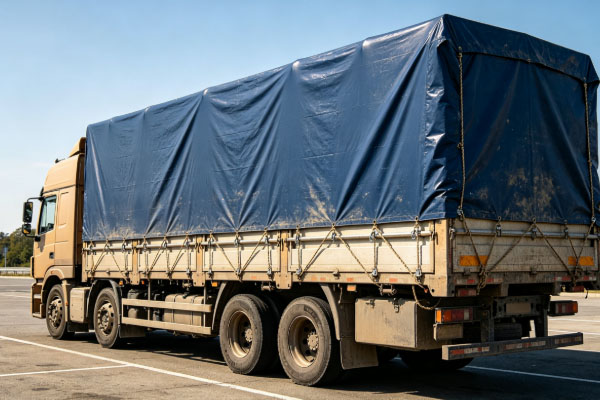
Therefore, when determining Tarpaulin Sizes, the coverage dimensions, hanging length, fastening positions, and changes in cargo height should all be considered. Whether the Tarpaulin is laid flat or hangs down around the sides, whether the vehicle has side panels, whether the cargo height is fixed, and whether ropes, fasteners, or elastic bands are used for fastening will all affect the final dimensions. For customized PVC Tarpaulin, the processing areas for hemming, eyelets, reinforced corners, and other structures should also be considered. A practical approach is to first measure the actual coverage area and then add the necessary reserved dimensions according to the installation method.
The actual finished dimensions of a Tarpaulin usually need to be larger than the top dimensions of the covered object. This is because the Tarpaulin must not only cover the top but also cover the edges and provide space for fastening. For example, if the top of the cargo is 2.4 meters wide and the Tarpaulin is made to exactly 2.4 meters wide, it can only lie flat on the top, leaving insufficient material on both sides to hang down. This makes it difficult to install hooks, rope loops, or other fastening components.
Therefore, when calculating Tarpaulin Sizes, the following formula can be used:
Finished Size = Actual Coverage Size + Necessary Reserved Size
The "reserved space" does not simply mean adding length. It should be determined according to the installation structure and the areas where the Tarpaulin needs to extend.
Different fastening methods require different edge dimensions. When ropes are used for fastening, space needs to be reserved along the edge for threading or installing rope loops; when fasteners, D-rings, or similar structures are used, the fastening points must be positioned accurately so that they correspond with the vehicle or support frame. If the Tarpaulin requires hemming, additional space must also be reserved along the edges for processing. For areas subject to greater tension, reinforcement patches may also be required to improve the load-bearing capacity around the fasteners.
If the Tarpaulin is mainly used to cover the top of cargo, timber, equipment, or stored materials, and only needs to extend slightly around the edges, a certain amount of edge allowance can be added according to the actual coverage area. In general, about 10–30 cm can be used as a basic reference for each edge. However, if the Tarpaulin needs to be tucked under the cargo or secured with heavy objects along the edges, additional size may be required. If the covered object is tall, the Tarpaulin cannot be calculated directly according to the top dimensions. For example, if the cargo has a piled structure and the Tarpaulin needs to extend from the top down the sides, the side height must also be included in the calculation.
Truck Tarpaulins are a typical product that requires reserved dimensions. Assuming the cargo compartment is 2.4 meters wide and the Tarpaulin needs to hang down 0.8 meters on both sides, the basic width can be calculated as:
2.4 meters + 0.8 meters + 0.8 meters = 4 meters
This is only the basic coverage dimension. Whether additional allowance is required depends on the bottom fastening method. If the truck Tarpaulin needs to cover high side panels, cargo, or side barriers, the actual height should also be included in the calculation. The front and rear ends should likewise be measured according to the required hanging or covering length.
For vehicles equipped with curved support frames, sliding rails, or roll-tarp structures, the dimensions cannot be determined simply by adding extra length and width to the cargo compartment. The Tarpaulin needs to form a curved surface along the support frames, so the actual expanded length is usually longer than the straight-line distance across the top of the vehicle. In this case, the highest point of the support frame, the connection positions on both sides, and the front and rear fastening positions should be measured before determining the expanded Tarpaulin size. If the size is too small, the Tarpaulin cannot be fully pulled to the fastening points; if it is too large, wrinkles and looseness may occur.
When the Tarpaulin is too small, the most obvious problem is insufficient coverage. The edges of the cargo may remain exposed, allowing rain, dust, and sand to enter through the gaps. For truck Tarpaulins, an undersized product may also prevent the fasteners from reaching the fastening rings on the vehicle. Forcing the Tarpaulin into position can place excessive tension on the eyelets and edge areas, which may cause deformation or damage after long-term use.
Many people assume that a larger Tarpaulin will provide easier coverage, but an oversized Tarpaulin can also affect use. Excess material may form piles along the edges if there are no suitable fastening positions. During rain, loose areas may collect water; when a vehicle is traveling at high speed, excessively long edges can be affected by airflow and move significantly. Therefore, Tarpaulin Sizes should be based on the main requirement of "complete coverage and proper fastening" rather than simply choosing a larger size.
Before placing a custom order, the following information can be recorded clearly:
Actual coverage length and width
Height that needs to hang down or be covered
Distance that needs to extend at the front, rear, left, and right sides
Distance between fastening points and fastening method
These measurements can help the manufacturer determine the final cutting dimensions and the positions of eyelets, rope loops, and reinforced areas.
Not necessarily. Different areas serve different purposes. For example, the top is mainly used for coverage, the sides may need to hang down, and the bottom may be used for fastening. Therefore, the reserved dimensions can vary around the four sides.
This should be determined according to the cargo compartment height and fastening method. If the Tarpaulin needs to completely cover high side panels or the sides of the cargo, the actual height should be used for calculation rather than applying a fixed dimension. For common small trucks, a hanging length of several tens of centimeters can be used as an initial measurement reference and then adjusted according to the fastening positions.
There is no universal standard. For simple flat coverage, an additional 10–30 cm can be used as a reference for edge allowance; if the Tarpaulin needs to cover the sides, be secured underneath, or cover high side panels, the hanging length should be calculated separately.
This should be confirmed according to the processing method. Hemming, eyelets, D-rings, reinforcement patches, and other structures all require a certain amount of edge space. Therefore, when placing an order, the actual coverage dimensions and installation requirements should be provided, and the manufacturer can determine the final dimensions according to the finished-product process.
Flat coverage with a Tarpaulin usually requires only a small amount of edge allowance, while truck Tarpaulins, high-sided truck Tarpaulins, and Tarpaulins with support frames require the hanging height, top structure, and fastening positions to be calculated together. For large PVC Tarpaulins, even a few centimeters of dimensional error may affect the alignment of fasteners, so measurements should be as accurate as possible. Before customization, first determine exactly where the Tarpaulin needs to cover, then measure how far it needs to extend on each side. A reasonable allowance should meet three requirements: complete coverage, proper edge fastening, and no obvious looseness or excessive tension after installation. If the actual structure is complex, it is recommended to provide photos of the vehicle or installation area together with the dimensions and explain the specific application and fastening method of the Tarpaulin. This can reduce dimensional deviations caused by customization based only on length and width, while also making it easier to determine the hemming, eyelet, and reinforcement requirements for the PVC Tarpaulin.
