
Hot Keywords:
- All
- Product Name
- Product Keyword
- Product Model
- Product Summary
- Product Description
- Multi Field Search

PVC tarpaulin ventilation ducts are flexible air ducts, and there is no fixed wind pressure value that applies to all products. The actual pressure-bearing capacity is related to the thickness of the PVC tarpaulin, base fabric strength, coating structure, duct diameter, seam processing, support method, and whether the duct is operating in air supply or exhaust conditions. In addition, positive-pressure air supply and negative-pressure exhaust have different requirements for flexible air ducts. Under positive pressure, airflow causes the duct body to expand outward. Under negative pressure, external air pressure pushes the duct body inward, making deformation or even duct collapse more likely.
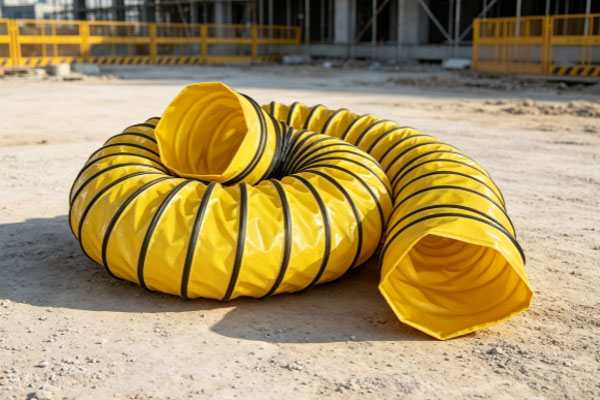
PVC-coated fabric flexible air ducts are commonly used for industrial ventilation, tunnel ventilation, mine ventilation, air supply in construction areas, and temporary exhaust. Some product specifications provide parameters such as static pressure, working pressure, or maximum pressure, but these data only apply to specific materials and structures and cannot be directly applied to ordinary PVC tarpaulin. For projects requiring continuous operation, relatively high wind pressure, or negative-pressure exhaust, the specific pressure range should also be confirmed through sample testing or product test data.
PVC tarpaulin itself has a certain level of tensile and tear resistance, but the pressure acting on a ventilation duct is actually distributed across the entire duct body. The larger the duct diameter, the more significant the force acting on the duct wall is generally under the same pressure. As the duct length increases, suspension and support conditions also affect overall stability. For low-pressure air supply, flexible PVC ducts can rely on internal airflow to keep the duct body expanded. When the working pressure increases, a higher-strength base fabric, stable PVC coating, and reliable seam structure are required.
Positive-pressure air ducts mainly withstand air pressure from inside the duct. When the duct is pressurized, it expands outward, so the tensile strength of the material, seam strength, and stability of connection points are important. Negative-pressure air ducts are different. When a fan extracts air, the pressure inside the duct is lower than the external pressure, and the PVC tarpaulin is subjected to inward pressure. If the duct does not have sufficient support, local contraction can easily occur. Therefore, a duct made from the same PVC tarpaulin may have different allowable working pressures under positive- and negative-pressure conditions.
PVC ventilation ducts generally use polyester fiber fabric as the base material, followed by a PVC coating to form a composite material. The base fabric provides the main tensile strength, tear resistance, and dimensional stability, while the PVC coating provides sealing, waterproofing, and protection. If the duct needs to withstand relatively high pressure, PVC-coated fabric with higher strength and better dimensional stability is generally required. Simply increasing the thickness of the PVC coating cannot completely solve the structural strength requirements of a high-pressure environment.
Under the same material and pressure conditions, large-diameter air ducts require more stable structural support. Therefore, for larger diameters, longer ducts, or negative-pressure exhaust applications, spiral steel wire, steel rings, or other support structures can be added to maintain a circular cross-section and reduce inward deformation.
Small-diameter flexible air ducts: Usually easier to maintain their shape and suitable for ordinary air supply and exhaust.
Large-diameter flexible air ducts: Require greater attention to wall strength, suspension distance, and support structures.
Negative-pressure air ducts: Need particular attention to resistance to duct collapse, with steel wire or support rings added when necessary.
High-pressure air ducts: Pressure testing should be carried out based on material test data and the actual structure rather than determining pressure capacity solely from experience.
When PVC tarpaulin is used to make air ducts, heat sealing, welding, or sewing is generally required. Even if the tarpaulin itself has high tensile strength, insufficient seam strength can still cause cracking under continuous wind pressure. In many cases, the duct body itself may show no obvious damage, while air leakage occurs at the connection points, which can still affect the operating performance of the entire ventilation system.
When purchasing PVC tarpaulin for ventilation ducts, it is recommended to first provide the equipment's airflow volume, air pressure, duct diameter, length, and operating environment. For example, if the equipment requires the air duct to withstand relatively high static pressure for extended periods, PVC-coated fabric with the corresponding pressure rating should be selected. If the duct is only used for ordinary temporary air supply, high-strength heavy-duty material may not be necessary. It is important to distinguish between rated working pressure and ultimate pressure. Rated working pressure refers to the pressure range at which the product can operate continuously under normal conditions, while ultimate pressure generally represents the pressure level at which failure occurs after specific testing. In actual engineering applications, ultimate pressure should not be directly used as the long-term working pressure.
Some PVC flexible air duct products found online are marked with pressure values of several dozen Pa, several hundred Pa, or even higher. However, the materials, duct diameters, and structures corresponding to these parameters are different. For example, a negative-pressure duct reinforced with spiral steel wire and an ordinary flexible air supply duct without support cannot be directly compared even if both use PVC-coated fabric.
If the project requirements are clearly defined, the manufacturer can be asked to provide:
Thickness, fabric weight, and base fabric specifications of the PVC-coated fabric;
Positive- and negative-pressure test data and testing conditions;
Seam strength and airtightness data;
Recommended working temperature and applicable environment;
Recommended maximum working pressure of the air duct.
The data obtained in this way is more suitable for actual product selection.
This cannot be determined solely from the term "PVC tarpaulin." Whether 500Pa is suitable needs to be confirmed based on tarpaulin strength, duct diameter, seam method, support structure, and operating condition. If the duct needs to operate continuously at 500Pa, it is recommended to select professional ventilation duct material with clearly defined pressure test data.
Not necessarily. Increasing material thickness generally helps improve abrasion resistance and certain mechanical properties, but flexibility, base fabric structure, coating adhesion, and seam quality are also important. Excessively thick material may also increase weight, making installation and rolling more difficult.
Under negative pressure, the pressure inside the duct is lower than the external air pressure, so external pressure pushes the flexible duct wall inward. If the duct body does not have sufficient resistance to compression, local contraction may occur. Adding spiral steel wire or support rings is a common method for improving this problem.
It is generally not recommended for direct use. Ordinary waterproof tarpaulin is mainly designed for covering, rain protection, and weather resistance, and may not have the pressure-bearing capacity, airtightness, and seam strength required for ventilation ducts. Professional PVC-coated ventilation duct material should be selected for high-wind-pressure applications.
The wind pressure that PVC tarpaulin ventilation ducts can withstand needs to be determined by considering both the material and the finished duct structure. There is no fixed wind pressure value that applies to all PVC tarpaulin products. Flexible PVC-coated fabric can be used for ordinary low-pressure air supply. As the wind pressure increases, the base fabric strength, PVC coating adhesion, seam strength, and connection structure need to be further checked. For negative-pressure exhaust, sufficient support is also required to prevent the duct body from contracting. Before purchasing or customizing the product, the equipment's airflow volume, static pressure, duct diameter, length, operating temperature, and installation method can be provided to the PVC tarpaulin manufacturer. The manufacturer can then select suitable PVC-coated fabric based on these parameters and determine whether steel wire, support rings, straps, or reinforced interfaces are required. For projects with higher pressure requirements, it is preferable to request actual test data rather than estimating pressure capacity based only on the material name or thickness.
