
Hot Keywords:
- All
- Product Name
- Product Keyword
- Product Model
- Product Summary
- Product Description
- Multi Field Search
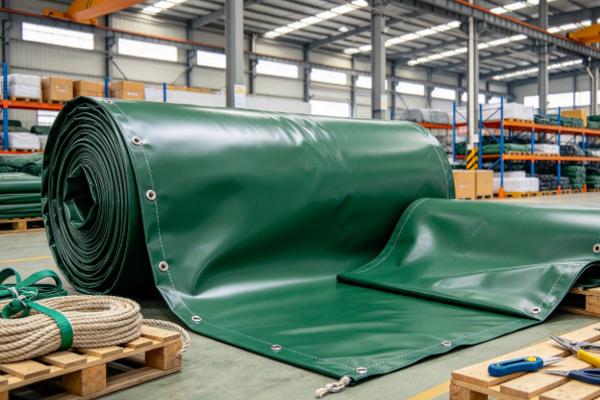
Rainproof tarpaulins are widely used for cargo transportation, warehouse covering, vehicle protection, outdoor shelters, and temporary construction projects where they may need to withstand rainfall for extended periods. Although tarpaulin materials can provide strong waterproof performance, proper installation is still essential for maintaining effective rain protection. If the fabric surface is too flat, rainwater can remain in the central area. If the slope is excessive, the load on edge fasteners, straps, and support structures may increase. A proper slope structure needs to balance drainage efficiency, fabric tension, installation stability, and available operating space. By planning the high and low points, controlling support heights, selecting suitable drainage directions, and adjusting the structure according to tarpaulin dimensions and application conditions, water accumulation and fabric sagging can be reduced while improving rain protection during continuous rainfall.
The slope of a rainproof tarpaulin should not be determined simply by how steep the surface looks. The covering area, span, length, width, and expected rainfall should all be considered during the design process. Small tarpaulins can usually achieve effective drainage through a simple difference in support heights. Large tarpaulins with longer spans, however, may still sag in the middle even when there is a certain height difference between the two sides. When designing a large tarpaulin, the length and width of the covered area should be determined first, followed by the height difference between the highest support point and the lowest drainage edge. Long covering areas can use a continuous sloped surface or several separate drainage zones so that rainwater is distributed toward different outlets. For vehicle tarpaulins, the slope should follow the roof or cargo-body structure without reducing available loading space. Fixed warehouse tarpaulins can use different support heights to create a stable sloping surface. A suitable slope does not simply mean a larger slope; it should allow rainwater to flow efficiently while keeping the tarpaulin under stable structural loads.
Tarpaulin is a flexible material, so it cannot maintain a rigid shape in the same way as hard roofing materials. The slope structure therefore usually depends on the supporting system. Different-height posts, crossbeams, central supports, and top support points can be used to create a continuous inclined surface. For a double-slope structure, the center can be positioned higher so that rainwater flows toward both sides. For a single-slope structure, one side can serve as the high point while the opposite side becomes the drainage edge. Large tarpaulin structures also require appropriate support spacing to prevent excessive sagging between two support points. If the span is large, additional supports can divide the fabric into several smaller drainage zones. The contact points between the tarpaulin and support structure should also be protected to reduce long-term friction and localized wear. A stable height difference combined with appropriate support spacing helps maintain the designed slope during extended use.
Once the slope structure has been established, the tension of the tarpaulin has a direct influence on drainage performance. Even when the support heights are properly designed, insufficient tension along the edges can cause the fabric to sag and form depressions where rainwater accumulates. Tensioning should be adjusted according to the tarpaulin material, dimensions, fastening method, and support structure rather than simply applying maximum tension to every fastening point. The following methods can improve the stability of the sloped surface:
Set edge tension points properly: Distribute fastening points evenly around the perimeter so that the edges remain stable and local looseness is minimized.
Reinforce central load-bearing areas: For large-span tarpaulins, central supports or auxiliary straps can help reduce sagging in the middle.
Balance tension in different directions: Longitudinal and transverse tension should remain coordinated to prevent excessive tension on one side from creating wrinkles on another.
Protect high-load fastening positions: Eyelets, D-rings, strap connections, and similar points can receive localized reinforcement to reduce wear caused by long-term tension.
Allow room for installation adjustments: PVC materials can respond to temperature changes and long-term use, so the fastening system should allow appropriate tension adjustments when necessary.
A well-designed tensioning system helps the tarpaulin maintain its intended slope, allowing rainwater to move along the planned drainage route while reducing the effects of localized water accumulation.
A slope is not simply a height difference between two points. The high point, sloped surface, low point, and drainage outlet should form a complete water-flow route. If the lowest point does not have a suitable outlet, rainwater may still accumulate along the edge. During design, the low edge should be positioned according to the actual installation environment so that water can enter a drainage channel, downpipe, gutter, collection system, or designated discharge area. For cargo transportation tarpaulins, the low edge should preferably be positioned away from cargo openings to prevent water from flowing into the interior. Warehouse covering tarpaulins can connect the low edge with the building's drainage system so that rainwater can leave the roof efficiently. For outdoor shelters, the tarpaulin edge can extend outward to create a drip zone and reduce water flowing inward along the support structure. For large tarpaulins, several drainage routes should not converge in a narrow area, as concentrated rainfall may cause water-flow restrictions during heavy rain. Matching the end of the slope with the actual drainage equipment creates a continuous and practical rainwater drainage system.
Different applications have different requirements for rainproof tarpaulin slope structures. Tarpaulins used for vehicle transportation are frequently installed and removed, so the slope design needs to support quick fastening while maintaining loading and unloading convenience. Warehouse tarpaulins generally cover larger areas and require a stable drainage slope for long-term use. Outdoor rain shelters need to consider usable activity space and the position of dripping water. Equipment protection tarpaulins should follow the shape of the equipment and establish suitable high and low points. Temporary construction tarpaulins usually have a short installation period, so their support structures should be easy to adjust on site. Practical options include:
Application | Recommended Slope Structure | Main Design Requirement |
Cargo transportation | Single slope or localized inclined surface | Prevent rainwater from entering the cargo area |
Warehouse covering | Single-slope or double-slope structure | Maintain continuous drainage across large areas |
Vehicle protection | Sloped surface following vehicle contours | Reduce water accumulation on the roof |
Outdoor rain shelters | Arched or sloped structure | Control the position of dripping water |
Equipment covering | Local slope based on equipment height | Prevent water from flowing toward equipment |
Temporary construction | Adjustable supports forming a sloped surface | Allow fast installation and adjustment |
During actual installation, the slope should be checked under real rainfall conditions whenever possible. Observe whether rainwater leaves the fabric surface efficiently, check whether water accumulates at low points, and inspect whether edge fasteners, support poles, and straps show excessive deformation. If a particular area repeatedly collects water, the local support height can be increased, strap tension can be adjusted, or the low-edge position can be redesigned. For long-term PVC rainproof tarpaulin applications, it is recommended to determine the covering dimensions, support heights, drainage direction, fastening positions, and edge structure during the customization stage. This allows tarpaulin manufacturing and installation requirements to work together effectively. A properly designed slope structure reduces the time that rainwater remains on the fabric, lowers the additional load caused by water accumulation, and helps the rainproof tarpaulin maintain stable coverage and long-term durability.
