
Hot Keywords:
- All
- Product Name
- Product Keyword
- Product Model
- Product Summary
- Product Description
- Multi Field Search
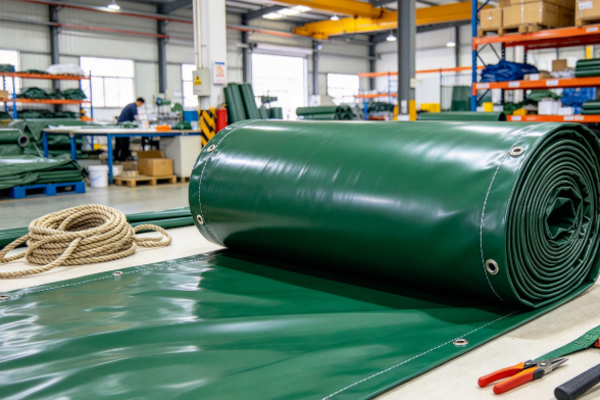
Tarpaulins are widely used for cargo transportation, warehouse covering, vehicle protection, outdoor shelters, and temporary construction projects where protection from rain is required. In practical applications, rain protection depends not only on the waterproof properties of the tarpaulin material but also on the overall structural design. A large covering surface may sag under its own weight, creating low areas where rainwater can accumulate. Poorly designed edges may allow water to flow back toward the protected area, while exposed joints between multiple tarpaulin sections can become vulnerable to wind-driven rain. A properly designed rainproof structure should establish a clear drainage route and coordinate the top surface, edges, seams, and support system. This allows rainwater to leave the covered area quickly while reducing additional pressure caused by standing water.
The top structure is a key part of rainproof tarpaulin design. A flat covering surface may be easy to manufacture, but large tarpaulins can sag after installation because of their own weight, wind loads, and the spacing of support points. Once a low area forms, rainwater can accumulate. The structure can be designed with an arched profile, sloped surface, or controlled height difference so that rainwater flows toward the sides or designated drainage locations. For vehicle tarpaulins, the top structure can follow the shape of the cargo body. For warehouse and outdoor shelters, differences in frame height can create a stable drainage slope.
The drainage route should also be determined according to the size of the covered area. A smaller covering may only require one clear drainage direction, while a large structure can use several drainage zones to prevent excessive water from concentrating at one location. Proper spacing between support points also helps reduce sagging in the middle of the tarpaulin. With this type of design, continuous rainfall can be directed along stable routes instead of forming heavy pools in the center of the covering.
After rainwater flows from the top surface toward the edge, it needs a clear route to leave the covering area. If the edge hangs directly over the cargo or equipment, water may flow along the underside of the tarpaulin and return toward the protected area. Excessively loose edges can also create folds and localized water accumulation. A suitable edge design should allow rainwater to fall outward while keeping the protected contents away from the drainage path.
Different structural methods can be considered for various tarpaulin applications:
Extend the tarpaulin edge outward: Allow the edge to project beyond the protected area so that falling water remains away from the cargo or equipment.
Create designated drainage zones: Large covering structures can use specific low-edge drainage areas to control water flow more effectively.
Adjust edge height: The support structure can control the height of the tarpaulin edge and prevent water from falling directly onto protected items.
Maintain edge tension: Webbing, fastening components, or auxiliary tensioning systems can help maintain edge shape and reduce sagging.
Coordinate with drainage equipment: Warehouse shelters and large temporary structures can integrate tarpaulin edges with gutters, guide plates, or other drainage components.
Effective edge drainage separates rainwater from the protected area and creates a continuous water path from the top surface toward the outside.
Large tarpaulins often require multiple panels to achieve a wider coverage area, making seam positioning an important part of rainproof design. When two pieces of tarpaulin are simply overlapped, an unsuitable overlap direction may allow rainwater to enter the joint. The upper and lower panel relationship should follow the primary drainage direction so that water flows from the upper panel onto the lower panel rather than directly into the seam.
For PVC tarpaulins, different panels can be connected through heat welding to create a more continuous structure. Seam positions should not be placed randomly in areas where water is likely to accumulate, and heavily tensioned areas should also be carefully considered. For tarpaulins with movable openings, doors, or curtains, suitable overlapping, zipper, or fastening structures can be incorporated while maintaining sufficient coverage when closed. Coordinating seam placement with the roof slope and drainage direction reduces the amount of time water remains around connection areas.
Tarpaulin material has a certain degree of flexibility, so large coverings can deform easily without a stable support system. Rainproof design should therefore consider the relationship between the tarpaulin, support frames, crossbeams, posts, and tensioning components. Support point positions directly influence the height and shape of the covering surface. Excessive spacing can cause central sagging, while excessive supports may make installation more complicated.
For vehicles, warehouses, and outdoor shelters, different support configurations can be selected according to the coverage area. Vehicle tarpaulins can use the vehicle frame, roof supports, and side fastening points to create a stable curved or sloped surface. Warehouse tarpaulins can use steel structures or other frames to create continuous roof slopes. Temporary outdoor structures can use arch poles and tension ropes to maintain the desired shape and tension.
After the support system has been established, the actual drainage path should also be checked. If a beam, connector, or raised section causes water to collect in a particular location, the support height or tarpaulin profile may need to be adjusted.
Different applications have different rain protection requirements. Cargo transportation needs to handle rain and airflow during vehicle movement, while warehouse tarpaulins need stable drainage during long-term coverage. Outdoor shelters may need to handle both rainfall and wind. The structural design can be selected according to the actual application, with suitable inspection and maintenance access included where necessary.
Application | Rainproof Structure | Key Areas to Control |
Cargo transportation | Sloped top, extended edges, proper overlaps | Vehicle roof and side edges |
Warehouse covering | Continuous slope, designated drainage, stable supports | Roof and edges |
Vehicle protection | Contoured structure, guided edge drainage | Top and vehicle sides |
Outdoor shelters | Arched structure, tension system, external drainage | Top, corners, and edges |
Temporary construction | Quick installation, defined drainage direction | Seams and low areas |
After installation, the actual water flow should be observed during rainfall. If standing water, edge backflow, or seam leakage is found, the support height, tarpaulin tension, or overlap relationship should be adjusted. Long-term tarpaulin installations should also be cleaned regularly to remove leaves, mud, and other debris that could block drainage routes. Products that are frequently removed and reinstalled should receive regular inspections around edges, seams, and support connections.
A rainproof tarpaulin structure should be planned as an integrated system involving the top profile, edge drainage, seam arrangement, support structure, and application environment. A clear drainage route reduces water accumulation, a properly designed edge prevents water from returning toward the protected area, and a stable support system helps maintain the desired drainage shape. For PVC tarpaulins and other rainproof covering products, combining material performance with structural design can provide more stable rain protection for cargo transportation, warehouse covering, vehicle protection, and outdoor applications.
