
Hot Keywords:
- All
- Product Name
- Product Keyword
- Product Model
- Product Summary
- Product Description
- Multi Field Search

Marine tarpaulins are mainly used for ship holds, cargo holds, deck cargo, and other areas that require covering. Accurate measurement directly affects the coverage area, fastening effect, and stability of the tarpaulin after installation. If the tarpaulin is too small, it may not fully cover the cargo or hatch, and the edges may also be subject to excessive pulling. If it is too large, it can cover the target area, but excess material may cause water accumulation, movement, or insecure fastening. Therefore, before customizing a marine tarpaulin, it is necessary to identify the actual coverage area first and then determine the final dimensions according to the fastening method, drainage requirements, and required edge allowance. When measuring a marine tarpaulin, it is not enough to measure only the length and width of the ship hold opening. The hatch edge structure, support height, fastening point locations, and areas where the tarpaulin needs to extend should also be recorded.
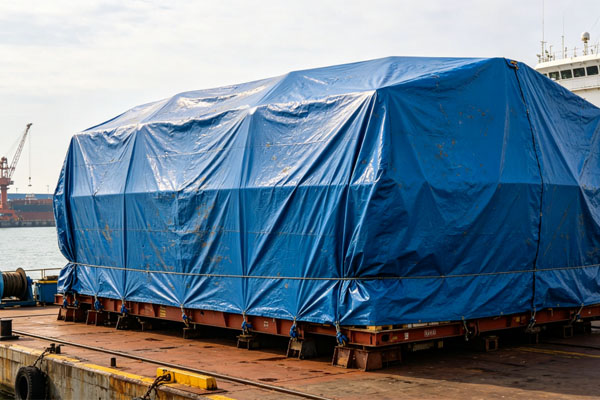
Deck structures vary between different types of ships. Some tarpaulins need to cover flat cargo, some need to span cargo hold openings and form a certain slope, while others need to work with ropes, fasteners, battens, or other fastening devices. Therefore, the measurement data should include not only length and width, but also height, edge allowance, and fastening positions. If an old tarpaulin is being replaced, the existing tarpaulin can be used as a reference, but it is not recommended to manufacture the new tarpaulin entirely according to the old dimensions. PVC tarpaulins or other marine covering materials that have been used for a long time may experience shrinkage, stretching, wear, and deformation, so their actual dimensions may differ from the original design dimensions. It is better to remeasure the installation area on the ship and confirm the final dimensions according to the actual requirements.
During measurement, it is necessary to determine the actual area that the tarpaulin needs to cover. For rectangular cargo holds or hatches, the length and width can be measured separately. If the coverage area has an irregular shape, it is recommended to divide it into several regular sections, record their dimensions, and then determine the tarpaulin pattern according to the actual structure.
Length: Measure the distance between the front and rear ends of the coverage area.
Width: Measure the areas that need to be covered on the left and right sides.
Height: If the tarpaulin needs to pass over cargo, supports, or raised structures, measure the height difference between the highest point and the installation surface.
Edge dimensions: Record the distance that the tarpaulin needs to extend beyond the edge of the ship hold or fastening structure.
For tarpaulins used on ship hatches, it is also necessary to confirm whether the tarpaulin needs to cover the hatch frame. If ropes, fasteners, or battens are used for fastening, sufficient installation space needs to be reserved along the edges. The finished dimensions generally cannot simply equal the hatch dimensions, otherwise effective fastening may not be possible after installation.
After completing the dimensional measurements, it is also necessary to determine how the tarpaulin will be fastened. Different fastening methods affect the required edge allowance and eyelet positions. For example, when ropes are used, the locations where the ropes pass through should be recorded. When fasteners are used, the spacing between fasteners needs to be determined. If battens, clamps, or similar structures are used, the width and installation position of the fastening area should also be measured. These details help the manufacturer determine the cutting dimensions, hem width, and eyelet positions of the tarpaulin, reducing dimensional mismatch during installation.
Structures such as frames, drainage channels, guardrails, and other equipment may be present around ship decks and cargo holds. Therefore, measurements should be recorded according to the actual installation conditions rather than measuring only a flat surface.
The tarpaulin needs to be fastened through its edge area, so an appropriate coverage allowance should be added after measuring the hatch dimensions. The required allowance depends on the ship hold structure, fastening method, and whether the tarpaulin needs to extend downward over the sides. If the tarpaulin needs to cover the hatch frame and extend to the side for fastening, the side extension should be included in the final dimensions. If the tarpaulin only covers a flat area, there is no need to add a large allowance in the same way.
When a marine tarpaulin is exposed to outdoor conditions for long periods, water can easily accumulate if the tarpaulin is laid completely flat over a large area. Therefore, when drainage is required, an appropriate drainage slope usually needs to be created according to the ship structure and support method. During measurement, the height difference between the highest support point and the lowest edge should be recorded. This helps determine the actual coverage dimensions of the tarpaulin and facilitates the subsequent design of fastening positions and drainage directions.
For areas with curved edges, angled sides, or raised equipment, direct estimation is not recommended. A measuring tape can be used to record the length, width, height, and dimensions of special areas separately, followed by the creation of a dimensional sketch based on the measurements. If possible, photos of the ship hold structure can also be taken and the measured dimensions marked on the photos. The dimensional drawing should also indicate the unit, fastening points, eyelet positions, and special structures to reduce errors during production communication.
It is generally not recommended to manufacture it directly according to the length and width of the cargo hold. Cargo hold dimensions can only serve as basic data. The final tarpaulin dimensions also need to account for edge fastening, coverage range, eyelet positions, and drainage requirements. If the tarpaulin needs to extend below the cargo hold edge, the corresponding additional coverage needs to be included.
Yes, it can be used as a reference, but it is not recommended to directly copy the dimensions of the old tarpaulin. A tarpaulin that has been used for a long time may experience stretching, shrinkage, wear, or edge deformation. Remeasuring the installation area and then adjusting the dimensions according to the actual coverage of the old tarpaulin is more suitable for new tarpaulin customization.
Common tools include a steel measuring tape, laser distance meter, marker, and measurement record sheet. For large cargo holds, a laser distance meter can improve measurement efficiency, while a measuring tape can be used to check edges and fastening areas. It is recommended to record all measurements consistently in centimeters or millimeters to avoid unit conversion errors during production.
Measuring marine tarpaulin dimensions requires comprehensive consideration of the actual installation position, coverage area, fastening method, edge allowance, and drainage requirements. For regular rectangular cargo holds, the length, width, height, and edge allowance can be measured in sequence. For ships with angled edges, curved sections, raised equipment, or complex fastening structures, additional local dimensions should be recorded and confirmed with a dimensional sketch. When customizing PVC marine tarpaulins, accurate measurement data also helps manufacturers determine cutting dimensions, hem structures, eyelet positions, and reinforcement areas. This is particularly important for large tarpaulins. If the finished dimensions have a significant deviation, on-site modification can be difficult and may increase the time required for remanufacturing and installation. Therefore, providing complete dimensions, application locations, and fastening requirements before placing an order can help reduce subsequent adjustments.
If the customer cannot determine the final dimensions, they can also provide the cargo hold opening dimensions, site photos, fastening method, and areas that need to be covered. The tarpaulin supplier can then further confirm the dimensions according to the actual structure. For marine tarpaulins that require bulk customization or long-term use, it is recommended to maintain standardized measurement records so that original data can be checked directly for future repeat orders, reducing errors caused by repeated measurements. When selecting a marine tarpaulin, dimensions are only the basic parameters of the customization process. Material thickness, tensile strength, weather resistance, edge reinforcement, eyelet configuration, and fastening methods also need to be determined according to the actual operating environment. After confirming accurate dimensions, further confirmation of material specifications and processing requirements can make the finished product more suitable for cargo hold covering, deck protection, and cargo covering applications.
