
Hot Keywords:
- All
- Product Name
- Product Keyword
- Product Model
- Product Summary
- Product Description
- Multi Field Search
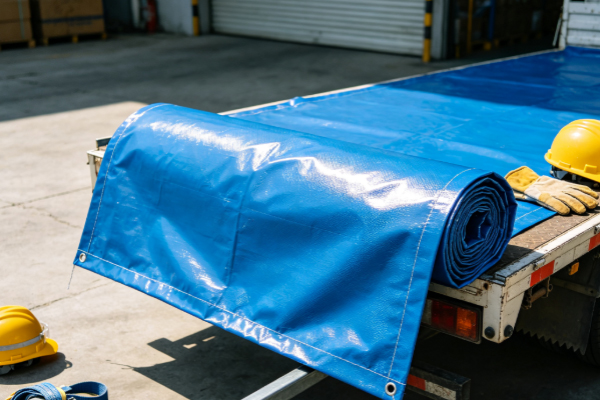
PVC tarpaulins are widely used for cargo transportation, warehouse covering, outdoor protection, vehicle protection, construction projects, and temporary structures. During actual use, tarpaulins need not only good waterproofing, weather resistance, and tensile strength, but also a stable connection with the installation structure through a properly designed fastening system. An unsuitable fastening method may cause the tarpaulin to become loose, edge tearing, fastener failure, localized water accumulation, or repeated flapping under wind pressure. A practical PVC tarpaulin fastening design should consider product dimensions, installation structure, frequency of use, load conditions, and removal requirements. Properly selected eyelets, webbing, D-rings, ropes, quick-release buckles, and auxiliary connection structures can help PVC tarpaulins maintain stable coverage in different applications.
Fastening-point layout is an important part of PVC tarpaulin design. Small tarpaulins may only require basic fastening points along the edges, while large tarpaulins need additional connection points based on their overall size and supporting structure. If the spacing between fastening points is too large, the edges may become loose and the central area may move under wind pressure. If fastening points are installed too closely together, production costs and installation work may increase without necessarily providing better practical performance.
When planning fastening points, the length, width, and supporting structure of the tarpaulin should be considered together. For rectangular tarpaulins, eyelets or webbing can be distributed along all four edges, with different spacing arrangements used for long and short sides according to the product dimensions. For oversized tarpaulins, intermediate fastening points can be added to distribute tension more evenly. Fastening points should not be positioned solely according to equal spacing. Cutting corners, openings, and areas with structural changes should also be considered so that the tarpaulin can maintain stable tension after installation.
For PVC tarpaulins intended for long-term fixed installation, a suitable number of fastening points can improve overall stability. For products that require frequent removal, the number and positions of fastening points can be optimized to make installation faster and easier. Coordinating tarpaulin dimensions with fastening-point placement helps reduce slack and localized stress after installation.
Different fastening components provide different installation characteristics and operating methods. PVC tarpaulins can use metal eyelets, D-rings, webbing, ropes, elastic cords, quick-release buckles, and other specialized connectors according to the application. Fastening components do more than simply connect the tarpaulin to the supporting structure. They also directly affect how external forces are transferred through the material. Selection should therefore consider load requirements, installation frequency, environmental conditions, and operating convenience.
Common fastening structures can be selected according to their intended use:
Metal eyelets: Suitable for ropes, hooks, or elastic cords and widely used for transportation tarpaulins, warehouse covers, and outdoor protection.
Webbing reinforcement: Provides a larger load-bearing contact area and is suitable for large PVC tarpaulins that need to withstand continuous tension.
D-ring connections: Easy to combine with straps, ropes, or hooks and suitable for tarpaulins that require frequent removal.
Quick-release buckles: Allow fast operation and are suitable for vehicle tarpaulins, temporary structures, and covers that need to be opened frequently.
Elastic cord connections: Provide a certain degree of flexibility and can reduce sudden tension caused by wind, making them suitable for outdoor covering applications.
Fastening components should not simply be added in large quantities. They need to be selected and combined according to the tarpaulin structure and installation requirements. A properly configured fastening system can provide a practical balance between stability, durability, and operating efficiency.
During installation, external tension is transferred through eyelets, D-rings, webbing, and other connection areas. If these areas are not properly reinforced, even a PVC tarpaulin with good overall strength may tear because of localized stress concentration. Fastening design should therefore include reinforcement around connection points so that loads can gradually spread into a larger area of material.
Reinforcement patches or additional PVC layers can be added around eyelets to improve resistance to tearing. For webbing structures, continuous webbing can be positioned along the edge of the tarpaulin so that tension is not concentrated at a single point. Large tarpaulins can also receive additional reinforcement at the corners because corners often experience tension from several directions simultaneously. For vehicle tarpaulins and products used outdoors for extended periods, wear-resistant materials can be added around fastening points to reduce damage caused by long-term friction between connectors and metal components.
Reinforcing fastening areas does not mean increasing the thickness of the entire tarpaulin. Localized reinforcement based on actual load paths can improve connection stability while keeping product weight under control. It also makes maintenance easier, allowing worn fastening components or localized material to be repaired or replaced without affecting the entire tarpaulin.
PVC tarpaulin fastening design should always be connected to the actual installation structure. Tarpaulins installed on vehicles, steel frames, warehouses, fences, or temporary supports have different fastening positions and load conditions. A practical design should allow tension to transfer from the tarpaulin through the connectors into stable support structures instead of forcing individual fastening points to carry excessive loads for long periods.
For vehicle tarpaulins, fastening points can be positioned according to the vehicle frame so that the tarpaulin edge forms a continuous connection with the body. For warehouse covers, D-rings, webbing, or specialized connectors can be arranged according to the positions of steel beams and columns. For outdoor shelters, intermediate fastening points can be added according to support-post spacing to prevent excessive sagging in the central area. Large covering structures can also use sectional fastening so that different areas carry their corresponding loads, reducing localized stress across the entire structure.
Drainage should also be considered when designing fastening structures. If a PVC tarpaulin is installed across a roof as a completely flat surface, rainwater may accumulate in low areas. Fastening points can be coordinated with support heights and tarpaulin slopes so that rainwater naturally flows toward designated drainage areas. Combining stable load paths with suitable drainage structures can reduce the additional pressure caused by standing water.
Different PVC tarpaulins are used in different ways. Transportation tarpaulins may be installed and removed every day, warehouse covers may remain fixed for long periods, and outdoor temporary structures may be installed or removed according to weather conditions or event schedules. A single fastening structure cannot meet every requirement, so fastening systems should be adjusted according to operating frequency and environmental conditions.
Products that require frequent installation and removal should use convenient connection structures while keeping the number of fastening points practical. For example, vehicle tarpaulins can combine quick-release buckles, elastic cords, and D-rings to allow workers to secure and open the cover efficiently. Warehouse tarpaulins intended for long-term installation can use stronger eyelets, webbing, and metal connectors to improve long-term stability. Outdoor products should use fastening components with suitable weather resistance while reinforcing edges and eyelet areas.
Application | Recommended Fastening Structure | Key Design Focus |
Cargo transportation | Eyelets, ropes, elastic cords | Quick fastening, tensile strength, wind resistance |
Vehicle covering | D-rings, quick-release buckles, webbing | Easy removal, connection stability |
Warehouse covering | Eyelets, webbing, metal connectors | Long-term fastening, weather resistance |
Outdoor structures | D-rings, elastic cords, webbing | Wind buffering, abrasion resistance |
Construction protection | Reinforced eyelets, webbing, auxiliary connectors | Tear resistance, localized reinforcement |
A practical fastening system should also make future inspection easier. After long-term use, eyelets, webbing, and connectors may experience wear, so replacement access should be considered during the design stage. Incorporating installation, operation, removal, and maintenance requirements creates a more complete PVC tarpaulin fastening solution.
Proper PVC tarpaulin fastening design requires coordination between fastening-point layout, connector selection, localized reinforcement, load paths, and actual operating habits. Planning fastening positions according to tarpaulin dimensions can reduce slack and stress concentration. Proper combinations of eyelets, D-rings, webbing, elastic cords, and quick-release buckles can meet different installation requirements, while targeted reinforcement around corners, edges, and fastening holes can improve connection stability. Adjusting the fastening solution for transportation, warehousing, vehicle covering, outdoor structures, and construction protection allows PVC tarpaulins to maintain reliable and convenient installation while preserving their waterproofing and weather-resistant performance.
