
Hot Keywords:
- All
- Product Name
- Product Keyword
- Product Model
- Product Summary
- Product Description
- Multi Field Search

PVC tarpaulin ventilation ducts are used in factories, warehouses, construction areas, tunnels, mines, and temporary ventilation locations. Air continuously passes through the ducts, so dust, particles, oil stains, and other contaminants can easily accumulate on the inner walls. If they are not cleaned for a long time, the buildup will gradually increase, affecting airflow inside the duct and potentially increasing local resistance, which can reduce ventilation performance. For exhaust ducts that transport dust-laden air, dust accumulation is usually more noticeable. Although PVC tarpaulin has properties such as water resistance, wear resistance, and easy cleaning, the cleaning process still requires appropriate force and cleaning methods to avoid scratching the PVC coating or damaging heat-sealed seams.
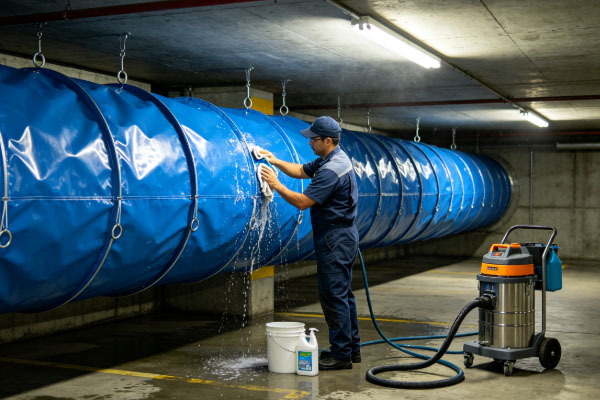
Cleaning PVC flexible air ducts usually needs to be carried out according to the duct length, diameter, installation location, and degree of contamination. The duct can first be removed, and larger amounts of dust and debris can be cleared from the inside. Soft brushes, clean water, or neutral cleaners suitable for PVC materials can then be used for further cleaning. For light dust, dry cleaning is usually sufficient. If there are oil stains or more noticeable deposits, wet cleaning can be used, but the duct needs to be thoroughly dried before reinstallation. For ducts that continuously transport dust, oil mist, or special gases, the appropriate cleaning method should also be selected according to the nature of the contaminants. When cleaning PVC tarpaulin ventilation ducts, the focus is not on using strong cleaning agents, but on minimizing material damage while effectively removing contaminants. In particular, PVC ventilation materials with flame-retardant, anti-static, or other functional coatings should be cleaned according to the requirements provided by the material supplier.
Before cleaning, turn off the fan and equipment connected to the ventilation duct, and confirm that there is no continuous airflow inside the duct. For flexible air ducts installed at a high position, suitable lifting equipment or removal methods should also be used to avoid directly pulling the duct body. If the air duct can be removed, take it down and unfold it before cleaning. This makes it easier to inspect the internal contamination and identify cracks, wear, delamination, or seam damage on the PVC tarpaulin.
The following can be prepared before cleaning:
Soft brushes or soft cloths for removing attached dust.
Clean water and neutral cleaners for treating more noticeable stains.
Vacuum equipment for removing dry dust.
A dry area for naturally drying the air duct after cleaning.
Choose the Cleaning Method According to the Degree of Contamination
If there is only a small amount of loose dust inside the PVC tarpaulin, a vacuum cleaner or soft brush can be used, without frequent water washing. If the duct wall has mud, oil stains, or thick dust deposits, dry cleaning can be performed first, followed by treatment with a damp cloth or low-pressure clean water. For relatively stubborn stains, a small amount of neutral cleaner can be used for local cleaning, followed by wiping with clean water. This graded cleaning method can reduce the contact time between PVC materials and cleaning agents or water, while also reducing the impact of the cleaning process on seams and coatings.
For ventilation ducts mainly affected by dust, dry cleaning can be used first. After removing and completely unfolding the air duct, use vacuum equipment to remove dust from the duct wall, and then use a soft brush to remove remaining particles. Do not use hard steel brushes or sharp tools to scrape off attached contaminants during cleaning. Scratches on the PVC coating may make the material more susceptible to wear or local damage during subsequent use. If there is a large amount of dust inside the duct, clean it gradually from one end to the other to prevent large amounts of dust from spreading back into areas that have already been cleaned.
For oil stains, mud, or contaminants that cannot be removed effectively by vacuuming, wet cleaning can be used. It is recommended to use a gentle water flow together with a soft cloth or soft brush rather than using excessively high water pressure. Although a high-pressure water gun can remove dirt quickly, a strong water stream may affect the PVC coating, seams, and local connection areas. After cleaning, use clean water to remove any remaining cleaning agent. If there is noticeable standing water inside the PVC tarpaulin, it should be removed promptly to prevent water from remaining for a long time in folded areas and seams.
If the ventilation duct is used for a long time to exhaust oily air, an oil film may form on the inside. In this case, clean water alone may not effectively remove the oil, so a neutral cleaner suitable for PVC materials may be required. Before use, it is best to perform a small-area test in an inconspicuous location to confirm that there is no coating discoloration, stickiness, whitening, or surface damage before cleaning a larger area. Strong acids, strong alkalis, strong solvents, or cleaning products with obvious corrosive properties should not be used without confirmation. Different PVC formulations and functional coatings have different levels of chemical resistance, so the technical information provided by the material supplier should be followed.
Although PVC tarpaulin has good flexibility, repeatedly pulling, twisting, or folding it with excessive force during cleaning may increase stress on the material and seams. In particular, the two ends of the air duct, heat-sealed seams, and areas near installation straps should be protected from concentrated tension. When unfolding and moving the air duct, several people can work together to handle long or large ducts, avoiding dragging the duct body across rough ground.
After wet cleaning, the PVC air duct should not be folded for storage or reinstalled immediately. If residual water remains in folded areas for a long time, it can create a damp environment and may also cause dust to adhere again. After cleaning, the duct can be completely unfolded and placed in a well-ventilated, dry location to air dry naturally. If faster drying is required, a gentle airflow can be used as assistance, but the PVC tarpaulin should not be directly heated or baked at excessively high temperatures. After confirming that both the inner and outer surfaces are completely dry, the duct can be folded, packaged, or reinstalled.
Cleaning is not only for removing dust but also provides an opportunity to check the air duct for wear and damage. After cleaning, inspect the following:
Check whether the PVC coating has cracks, wear, or delamination.
Check whether the heat-sealed seams have cracks or potential air leakage.
Check whether the duct connections are deformed or loose.
Check whether the straps, support rings, and clamps are damaged.
If damage is found, repair or replacement should be carried out according to the severity of the damage. An obviously damaged duct should not be put directly back into service.
Clean water can be used for cleaning, but the water pressure needs to be controlled. For ordinary dust and stains, low-pressure water can be used together with a soft cloth or soft brush. After cleaning, the water should be removed promptly and the duct should be thoroughly dried.
It is not recommended to use a high-pressure water gun without confirmation. Excessive water pressure may damage the PVC coating, heat-sealed seams, and connection areas. If the product manufacturer specifically allows high-pressure cleaning, the specified pressure and distance should be followed.
There is no single fixed cleaning interval. The frequency should be determined according to the operating environment. Ordinary clean-air supply ducts can have relatively longer cleaning intervals, while ducts continuously transporting dust, oil mist, or other particles require more frequent inspection and cleaning. When noticeable dust accumulation is found on the inner wall, or when airflow decreases or resistance increases, cleaning and inspection should be arranged.
It is not recommended to use it without confirmation. Laundry detergent and other household cleaning products may contain different additives, and compatibility with all PVC coatings cannot be guaranteed. A safer approach is to use a neutral cleaning product recommended by the material supplier and perform a small-area test first.
Cleaning PVC tarpaulin ventilation ducts requires an appropriate method according to the actual level of contamination. Ordinary loose dust can be removed with a vacuum cleaner and soft brush. Mud and more noticeable deposits can be cleaned with clean water and a soft cloth. When oil stains are present, a neutral cleaner compatible with the PVC material should be selected. Regardless of the method used, hard brushes, sharp objects, and excessively high-pressure water should be avoided. After cleaning, if a large amount of water remains inside the air duct, a damp environment may form after folding, so the duct needs to be completely unfolded and naturally dried. Before reinstallation, the PVC tarpaulin surface, heat-sealed seams, connections, and support structures can also be inspected to identify damage that may have occurred during use.
Proper cleaning methods can reduce the impact of dust and oil buildup on airflow while minimizing unnecessary material wear. For operating environments with heavier contamination, such as industrial production facilities, mines, and tunnels, a cleaning schedule should also be established according to the transported medium. If the duct comes into contact with special chemicals, cleaning should be carried out according to the chemical resistance of the PVC material and the manufacturer's cleaning requirements. Maintaining moderate cleaning force, using compatible cleaning agents, ensuring thorough drying, and checking damaged areas promptly can help PVC flexible air ducts maintain good airtightness and operating condition.
