
Hot Keywords:
- All
- Product Name
- Product Keyword
- Product Model
- Product Summary
- Product Description
- Multi Field Search

Marine covering tarpaulins are mainly used to cover hulls, deck equipment, cabins, cargo, and outdoor storage areas. They can reduce the effects of rainwater, sea wind, salt spray, dust, and sunlight on covered items. Since the shape of a vessel is usually not a regular rectangular box, the bow and stern may have curved or inclined structures, while the deck may also have protruding parts such as railings, equipment, brackets, and hatches. Therefore, tarpaulin dimensions cannot simply be calculated by multiplying the vessel length by its width. Especially when customizing PVC tarpaulin, unreasonable size allowances may result in incomplete coverage, mismatched fixing points, or excessively long edges.
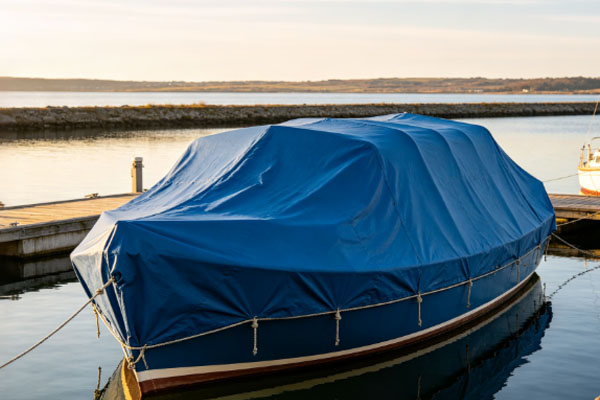
When calculating the size of a vessel covering tarpaulin, the actual coverage area should first be determined. Additional allowance should then be added according to the hull height, tarpaulin drop length, fixing method, and edge processing requirements. If the tarpaulin only covers a flat deck, the calculation is relatively simple. If it needs to extend downward from the top of the gunwale, the height on both sides needs to be included. If the hull has obvious curves, the curved surface length also needs to be measured instead of directly using the horizontal projected dimensions. Accurate measurement helps determine the length and width of the tarpaulin, as well as the positions of eyelets, rope loops, and other fixing structures, making the finished product more suitable for actual installation.
The dimensions of a vessel tarpaulin should be calculated based on the area that actually needs to be covered. Before measuring, it is necessary to clarify whether the tarpaulin will cover the entire vessel or only the deck, cockpit, cabin, or a specific section of equipment. If it only covers the deck, first measure the actual length and width of the deck, then add an allowance according to the edge fixing method. If the tarpaulin needs to cover both sides of the vessel, the downward extension length also needs to be included.
Finished Tarpaulin Size = Coverage Area Dimensions + Allowance at Both Ends or Sides
The allowance should be determined according to the actual fixing method, as not all vessels use the same dimensions.
The vessel length should be measured according to the actual front and rear positions that the tarpaulin needs to cover. If the bow is relatively pointed, the tarpaulin should not simply be cut according to the maximum hull length. It is also necessary to confirm whether the tarpaulin needs to completely cover the bow. The width measurement should also take the gunwale structure into consideration. If the tarpaulin needs to cover from port to starboard, the distance between the actual coverage positions should be measured rather than relying only on the vessel's maximum beam. For smaller vessels, a tape measure can be used. For large vessels, measurements can be taken in sections according to the deck structure and then checked against each other.
If the tarpaulin is only used to cover a flat deck, a certain amount of extra length is usually required around the edges for hemming, tying, or installing fasteners. As a basic reference, an additional 10–30 cm on each side can generally be considered, but the actual dimensions should be adjusted according to the fixing method. If the tarpaulin needs to extend below the deck edge, the allowance needs to be increased. If ropes are used for fixing, sufficient space should be reserved along the tarpaulin edge for installing rope loops or eyelets. If buckles, D-rings, or similar structures are used, the positions of the fixing points should be determined in advance.
Downward Extension Needs to Be Included When Covering the Gunwale
When the tarpaulin needs to extend downward from the top of the deck to the sides of the vessel, the vessel length and width alone are not sufficient for the calculation. For example, if the deck coverage width is 3 meters and the tarpaulin needs to drop 0.8 meters on each side, the basic calculation in the width direction can be written as: 3 meters + 0.8 meters + 0.8 meters = 4.6 meters
If the bottom also needs to be tied or secured, the necessary installation allowance should be added. Similarly, if the bow and stern need to be covered downward, the actual drop height should be measured and included in the length calculation.
Some vessel decks or cabin roofs are not flat but have curved surfaces. In this case, the actual coverage length cannot be replaced directly by the straight-line distance between two points. For example, if the top of a cabin extends from the left side through the highest point to the right side, and the tarpaulin needs to fully follow the top structure, the actual curve length should be measured. A flexible measuring tape can be used along the surface of the structure, followed by the addition of the required edge fixing allowance. This measurement method can reduce the risk of undersized tarpaulin and also prevent excessive looseness in the finished product.
Vessel tarpaulins are generally installed using ropes, eyelets, buckles, D-rings, or other fixing structures. After determining the tarpaulin dimensions, the positions of these fixing points also need to be determined.
It is recommended to record:
The distance between the actual fixing points around the hull.
The distance from the tarpaulin edge to the center of each eyelet.
The positions of the fixing points at the bow and stern.
The positions of fixing rings or hooks on both sides of the vessel.
Even if the tarpaulin dimensions are accurate, installation can still be difficult if the eyelet positions do not correspond to the fixing points on the vessel.
Vessel decks usually contain hatches, ventilation equipment, railings, winches, pipes, or other protruding structures. If the tarpaulin needs to pass over these structures, their height and positions should be measured in advance. For tarpaulins intended for long-term covering, reinforced treatment can also be added to areas that come into contact with equipment to reduce wear caused by friction. If the tarpaulin needs to be frequently removed and installed, sufficient operating space should be reserved to avoid excessive stretching or folding during each installation.
No. Vessel length and width can only serve as basic dimensions. If the tarpaulin needs to cover the gunwale, bow, stern, or equipment, additional dimensions for downward extension, coverage, and fixing are also required.
There is no fixed value that applies to all vessels. For simple flat coverage, a basic edge allowance of 10–30 cm on each side can be considered. When the tarpaulin needs to extend downward or cover the hull, the allowance should be calculated according to the actual height.
When the bow has an irregular shape, the actual coverage line should be measured. First determine the specific position that the tarpaulin needs to cover at the bow, then measure the distance from the highest coverage point on the deck to the bow edge and add an allowance according to the fixing method.
PVC-coated tarpaulin has properties such as water resistance, abrasion resistance, and easy cleaning, making it suitable for vessel covering applications. The specific material selection should also be based on the operating environment, tarpaulin dimensions, frequency of use, and fixing method.
The key to determining the dimensions of a vessel covering tarpaulin is to ensure that the tarpaulin can completely cover the area that needs protection while leaving sufficient space for fixing after installation. During measurement, first confirm the coverage area, then record the actual hull length, width, top height, and downward drop dimensions on both sides. If the bow, stern, or deck has curved structures, the actual coverage route should be measured rather than relying entirely on straight-line distances. When customizing PVC vessel tarpaulin, it is recommended to provide the length and width while also explaining the specific coverage area, fixing method, whether edge hemming is required, and whether curved or protruding structures are present. For large vessels or hulls with complex shapes, measurements can be taken in sections, with clear dimension markings, and then checked again.
