
Hot Keywords:
- All
- Product Name
- Product Keyword
- Product Model
- Product Summary
- Product Description
- Multi Field Search

When PVC tarpaulin ventilation ducts operate under negative pressure, the pressure inside the duct is lower than the surrounding environmental pressure, and the surrounding air continuously applies inward pressure to the flexible duct wall. Although PVC tarpaulin itself has good flexibility, the duct may experience local contraction, flattening, wrinkling, or even obvious collapse if it does not have sufficient support. Minor deformation may only affect appearance, but if the duct cross-sectional area continues to decrease, it will increase airflow resistance, reduce the actual air volume, and may also change the fan load. For PVC tarpaulin ventilation ducts used for dust collection, welding fume extraction, equipment exhaust, and industrial air suction, stability under negative pressure is particularly important. Therefore, preventing collapse cannot rely only on increasing the tarpaulin thickness. Comprehensive design is also required based on material stiffness, duct diameter, reinforcement structure, support method, and negative pressure level. A properly designed duct structure should maintain sufficient negative-pressure resistance while retaining flexibility, allowing the duct to maintain a relatively stable effective ventilation cross-section after the fan starts operating.
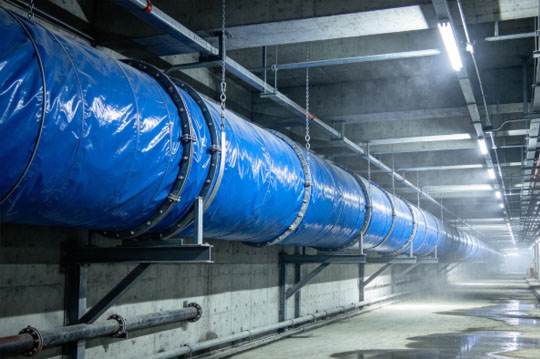
PVC tarpaulin is a flexible material with good bending capability and convenient storage, but its flexibility also means that the material can deform easily when subjected to external pressure. During positive-pressure air delivery, the airflow inside the duct can provide outward support to the duct wall. During negative-pressure operation, the direction of force changes, and the external air pressure pushes the duct wall inward. If the duct diameter is large, the duct is long, or the negative pressure is high, the pressure acting on the duct wall becomes more significant.
Under the same material conditions, large-diameter flexible ducts generally need to withstand more obvious radial deformation. If the duct is long and lacks intermediate support, local contraction can easily occur after negative-pressure operation begins. The higher the negative pressure, the greater the pressure difference acting on the duct wall. Therefore, the material and reinforcement structure should be determined according to the actual fan parameters during design, rather than selecting PVC tarpaulin only based on the outer diameter of the duct.
Thicker PVC tarpaulin generally provides better structural stability, but increasing thickness alone cannot completely solve the problem of negative-pressure collapse. The PVC coating, base fabric strength, material elasticity, and overall duct structure all affect deformation resistance. For ducts that need to operate under relatively high negative pressure, reinforcement ribs, spiral supports, or other structures are generally required to improve the stability of the duct wall.
Flexible ventilation ducts operating under negative pressure need to maintain a stable internal passage through proper structural design. Common methods include adding spiral steel wire, spring steel wire, support rings, or other reinforcement structures so that the flexible tarpaulin does not have to rely entirely on its own material to resist external pressure. The purpose of the reinforcement structure is not to turn the duct into a completely rigid air duct, but to provide continuous support for the duct wall while retaining a certain level of flexibility.
Negative-Pressure Resistance Design Includes:
Reinforcement structure: Adding spiral steel wire, support rings, or similar components inside the PVC tarpaulin or within the material structure can improve the duct's resistance to radial contraction, especially for flexible ducts that need to operate continuously under negative pressure.
Material structure: PVC tarpaulin with suitable thickness and base fabric strength should be selected according to the negative pressure, duct diameter, and operating environment. Suitability for negative-pressure applications should not be judged only by the surface softness of the material.
Support spacing: Long ventilation ducts require reasonable hanging straps and support points to reduce local sagging caused by the duct's own weight and prevent sagging areas from contracting further under negative pressure.
Negative-pressure control: The actual operating pressure should remain within the allowable design range of the duct. If the negative pressure generated by the fan exceeds the capacity of the material and reinforcement structure, obvious collapse may occur even when the duct is installed correctly.
The spacing of the reinforcement structure also needs to be designed according to the duct diameter and negative pressure level. If the supports are too far apart, local deformation can easily occur. If they are too close together, the weight and installation cost may increase, and the bending convenience of the flexible duct may also be reduced. Therefore, reasonable configuration should be selected according to the actual operating parameters during manufacturing.
Even when a PVC tarpaulin ventilation duct uses a reinforcement structure, improper installation can still cause collapse during negative-pressure operation. After installation, the flexible duct should remain naturally extended and should not be excessively bent, twisted, or compressed. If one section of the duct remains in contact with a wall or equipment surface for a long period, local stress concentration can easily occur during negative-pressure operation, causing that section to contract inward first.
During installation, excessive stretching should be avoided, and the duct should not form obvious folded areas. For long horizontal ducts, hanging straps or support structures should be arranged reasonably according to the duct weight and length. The hanging straps should not be tightened excessively, as this may compress the duct wall. They should also not be too loose, as this can create excessive sagging.
After the fan starts, negative pressure inside the duct forms rapidly. If the negative pressure generated by the selected fan exceeds the duct's design range, the PVC tarpaulin may show obvious inward suction. In this situation, the problem should not be solved simply by adding external binding. Instead, the fan parameters, duct specifications, and reinforcement structure should be checked for compatibility. If the duct suddenly collapses, it is also necessary to check whether there is a clogged filter, blocked air inlet or outlet, or a sudden increase in system resistance.
Slight deformation of a flexible PVC ventilation duct under a certain level of negative pressure does not necessarily indicate a failure. However, if the duct cross-section continues to decrease, a local section becomes completely flattened, or obvious wrinkles appear, the negative pressure and duct structure should be checked. A properly designed duct should maintain a basically stable ventilation cross-section within its operating pressure range.
No. Increasing material thickness can improve structural stability to a certain extent, but resistance to negative-pressure collapse is also related to the duct diameter, base fabric strength, reinforcement structure, and negative pressure level. For relatively high negative-pressure conditions, reinforcement ribs, spiral supports, and other structures are generally needed together to improve deformation resistance.
Reinforcement ribs can provide continuous or spaced support for the flexible duct wall, reducing inward contraction caused by external pressure. Especially for large-diameter, long-distance flexible ducts, reinforcement structures can help maintain the duct cross-section and make the airflow passage more stable.
If there is only minor local deformation, the cause of the deformation can be checked first. If obvious flattening, wrinkles, material damage, or deformation of the reinforcement structure has occurred, continued operation under the original negative-pressure conditions is not recommended. The fan pressure, duct specifications, and support structure should be checked, and the duct should be repaired or replaced according to the extent of the damage.
During actual use, whether PVC tarpaulin ventilation ducts can maintain stable ventilation performance is directly related to material properties, duct structure, connection methods, and installation conditions. Especially under negative-pressure operating conditions, the pressure inside the duct is lower than the surrounding environmental pressure, so the flexible duct wall is easily affected by external pressure. If the duct diameter is large, the duct is long, or there is insufficient reinforcement, local contraction, deformation, or even collapse may occur. Therefore, PVC tarpaulin ventilation ducts should not focus only on tarpaulin thickness. The actual negative pressure, duct diameter, length, reinforcement configuration, and support spacing also need to be considered in the overall design.
During production and installation, the PVC tarpaulin material should have good tensile strength, wear resistance, and bending resistance. Spiral steel wire, support rings, and other reinforcement structures should also be configured according to the operating pressure to reduce inward contraction of the duct wall during operation. During installation, the duct should remain naturally expanded, while excessive bending, compression, or overly tight binding should be avoided. During operation, if the ventilation cross-section becomes significantly smaller, the air volume decreases, abnormal vibration occurs, or local collapse appears, the fan negative pressure, filter components, duct connections, and support structures should be checked promptly. Proper material and structural selection, combined with appropriate installation and operating inspections, can improve the negative-pressure resistance and long-term operating stability of PVC tarpaulin ventilation ducts.
