
Hot Keywords:
- All
- Product Name
- Product Keyword
- Product Model
- Product Summary
- Product Description
- Multi Field Search

PVC tarpaulin ventilation ducts have good waterproof performance, with the actual effect mainly depending on the PVC coating, base fabric structure, processing methods, and connection treatment. The PVC coating itself can reduce the possibility of moisture entering the material, and PVC-coated fabrics are also commonly used for covering materials that require waterproofing or reduced liquid penetration. Therefore, when the material specifications and processing quality meet the required standards, PVC tarpaulin ventilation ducts can withstand general humid environments, short-term outdoor use, and contact with rainwater.
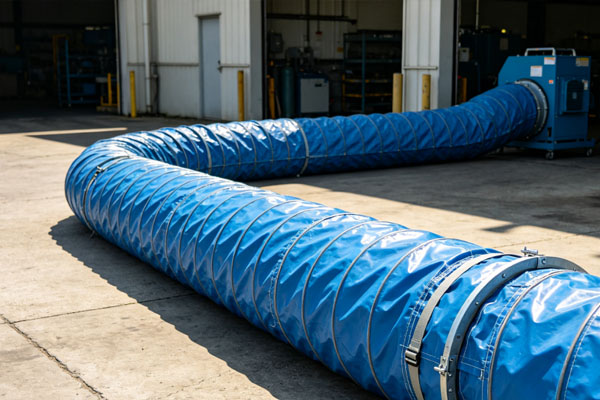
However, the waterproof performance of a ventilation duct cannot be determined solely by the tarpaulin material itself. During the manufacturing process, the duct may have seams, end interfaces, clamp positions, and areas where equipment is connected. These areas can all become pathways for water to enter. If the material itself is waterproof but the connections are not properly sealed, water leakage may still occur during actual use. Therefore, when customizing PVC tarpaulin ventilation ducts, it is necessary to confirm the material's waterproof performance, joining method, connection structure, and site installation conditions at the same time. For outdoor ventilation equipment that needs to be exposed to rainwater for long periods, drainage, fixing, and prevention of water accumulation should also be considered during use.
PVC tarpaulin is generally manufactured by forming a PVC coating on the surface of a fabric base, giving the material good waterproof and moisture-resistant properties. The coating structure can reduce the direct penetration of rainwater or water droplets into the fabric, making it more suitable for ventilation applications in humid environments than ordinary uncoated fabrics. For indoor humid areas, underground spaces, construction sites, and temporary outdoor ventilation, PVC tarpaulin ventilation ducts can reduce the entry of moisture into the duct to a certain extent. If the duct is exposed only to a small amount of water mist, splashing water, or short-term rainfall, obvious water penetration caused by the material itself is generally unlikely to occur immediately.
PVC tarpaulin ventilation ducts generally need to be joined to form a complete duct body. For PVC tarpaulin processed through heat sealing or welding, seam quality directly affects whether water can enter through the connection points. Proper welding can reduce the pinholes produced by traditional sewing and help maintain good sealing performance at the seams. The welded structure of coated fabrics is also commonly used to improve the waterproof integrity of finished products.
PVC tarpaulin itself provides a good foundation for waterproofing, but actual performance is also affected by installation methods, wear, ambient temperature, water pressure, and other conditions. Long-term outdoor use is particularly demanding because the duct may need to withstand rain, wind, friction, and repeated folding and unfolding at the same time.
If PVC tarpaulin ventilation ducts are used for outdoor exhaust or air supply, long-term accumulation of water on the duct surface should be avoided. Although the PVC coating can block moisture, if the middle section of the duct sags significantly, rainwater may accumulate at low points. The weight of the water may increase the load on the material and fixing structure over time. During installation, a reasonable slope can be maintained according to the site support conditions, while recessed areas that are prone to water accumulation should be minimized. For permanently installed ducts, the stability of suspension points, support straps, and connection areas should also be checked.
PVC tarpaulin ventilation ducts may be scratched by sharp objects, rubbed against equipment, or damaged by repeated folding during transportation, installation, and use. If obvious cracks or damage appear on the PVC surface, water may enter the base fabric through the damaged area. Therefore, the duct surface should be inspected regularly during use, especially in areas that frequently come into contact with supports, walls, or equipment edges. If damage is found, an appropriate repair method for PVC tarpaulin should be applied promptly to prevent the damaged area from expanding.
The two ends of a ventilation duct generally need to be connected to fans, exhaust equipment, or other ducts. Connection areas are not covered by a continuous tarpaulin surface, so their waterproof performance mainly depends on the connection structure and sealing method. If the duct is intended for outdoor use, it should be specified in advance whether the connection areas will be directly exposed to rainwater. For connections that are easily exposed to rainfall, additional sealing structures can be added or the connection direction can be adjusted according to site conditions to reduce the possibility of rainwater entering the duct directly.
When PVC tarpaulin ventilation ducts are used indoors, waterproof performance is usually not the primary purchasing requirement. For example, in underground workshops, humid factories, or cleaning areas, the main concern is preventing water vapor, water mist, and occasional water droplets from entering the duct. In such cases, attention can be focused on the waterproof performance of the material itself and the sealing of the connections. Outdoor use requires consideration of rainfall, ultraviolet exposure, wind, and temperature changes.
In humid factories, cleaning areas, or underground spaces, PVC tarpaulin ventilation ducts can be used for air conveying and localized exhaust. Such environments generally contain a large amount of water vapor but are not continuously exposed to heavy rainfall. During use, the inside of the duct should be kept clean, and long-term water accumulation should be avoided. If condensation forms inside the duct and produces water droplets, the duct routing and drainage conditions should also be checked to prevent moisture from accumulating at low points.
Construction sites, temporary work areas, and equipment maintenance areas may require movable ventilation ducts. PVC tarpaulin is relatively lightweight, making it convenient to move and store, while the material surface also provides good waterproof performance, allowing it to adapt to certain outdoor applications. If continuous rainfall occurs, suitable shielding and drainage measures should still be taken according to actual operating conditions. In particular, the fan connection and duct end should be protected from direct entry of rainwater into the equipment or ventilation line.
PVC tarpaulin itself has good waterproof performance and can withstand general contact with rainwater, but whether the finished product can provide complete long-term rain protection also depends on the seams, connections, damage, and installation method. For long-term outdoor use, the complete structure needs to be considered.
If the material coating is intact, the seams are properly processed, and the connections are securely fixed, water entering the duct can generally be reduced. However, heavy rain, prolonged downpours, or damage to the duct may affect waterproof performance. Therefore, when used outdoors, proper duct support, connection protection, and drainage measures are still required.
Seams are areas that require particular attention. Using suitable heat-sealing or welding processes for PVC materials can reduce the impact of traditional sewing pinholes on sealing performance. The actual result also depends on processing temperature, pressure, welding width, and production quality.
Not necessarily. Water droplets may come from external water penetration, or they may be caused by condensation when moisture in the air inside the duct encounters a cooler duct wall. When determining the cause, the outer surface, seams, and connections of the duct should be inspected, together with the temperature and humidity conditions of the operating environment.
PVC tarpaulin ventilation ducts provide a good foundation for waterproofing. The PVC coating can reduce moisture penetration into the fabric, making these ducts suitable for certain humid environments and temporary outdoor ventilation applications. Relevant textile material information also classifies PVC-coated fabrics as materials that can be used for waterproofing or reducing liquid penetration. However, the waterproof performance of a finished product cannot be determined solely by the material name. The duct seams, end interfaces, connection structures, and surface integrity also need to be checked. For indoor humid areas, attention can be focused on material waterproof performance, connection sealing, and condensation management. For outdoor environments, rainfall, standing water, ultraviolet exposure, wind, and material changes caused by long-term exposure also need to be considered. For ventilation ducts that need to be moved frequently, attention should also be paid to scratches caused by folding, dragging, and handling to avoid damaging the PVC coating.
When customizing PVC tarpaulin ventilation ducts, information such as the installation location, indoor or outdoor environment, duct length, diameter, operating temperature, and connection type can be provided in advance. If the product needs to be exposed to rainwater for long periods, the waterproofing requirements should also be clearly specified so that production personnel can confirm the appropriate material and processing method according to the actual operating conditions. Only when the material, seams, connections, and installation conditions are all properly addressed can PVC tarpaulin ventilation ducts maintain relatively stable performance in humid or rainy environments.
