
Hot Keywords:
- All
- Product Name
- Product Keyword
- Product Model
- Product Summary
- Product Description
- Multi Field Search

The mine ventilation system is a core infrastructure ensuring underground operational safety and production efficiency. The selection of ventilation ducts directly affects air circulation quality and dust discharge performance. In complex mining environments, where dust concentration is high, space is narrow, and humidity fluctuates significantly, ventilation ducts are required to meet higher performance standards. PVC ventilation ducts, with their lightweight structure, wear resistance, anti-static properties, and flame-retardant performance, have become one of the most widely used flexible duct materials in modern mine ventilation engineering. Proper system design and material selection can significantly improve overall mine ventilation efficiency and safety levels.
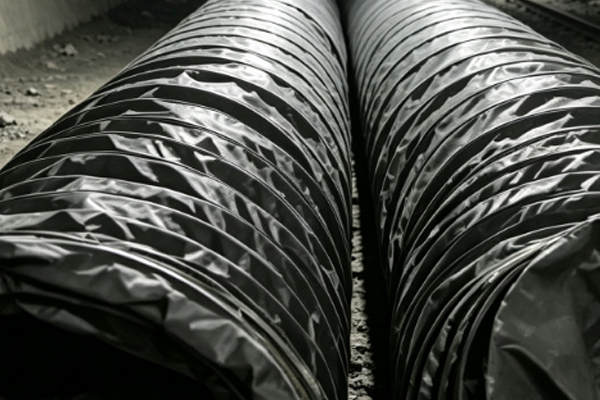
Mining environments are complex and variable, requiring ventilation systems with strong stability and adaptability. PVC ventilation ducts are widely used precisely because they meet these demands.
Underground mining spaces are enclosed, and poor air circulation can easily create safety hazards.
Ventilation ducts must continuously deliver fresh air to reduce gas and dust concentration.
PVC flexible structures adapt to complex tunnel layouts and reduce airflow loss.
Stable air supply capacity is directly related to worker safety.
Ventilation efficiency is the primary indicator in mine system design.
Mine tunnels contain large amounts of dust particles with strong mobility, causing severe material abrasion.
Ordinary ducts are easily damaged by long-term dust erosion.
PVC-coated structures provide strong wear resistance.
Effectively extends service life and reduces replacement frequency.
Good wear resistance is a key factor in reducing operational costs.
Mining is a high-risk working environment with extremely strict safety requirements.
Flame-retardant performance reduces fire spread risks.
Anti-static design prevents dust explosion hazards.
Complies with mine safety production regulations.
Safety performance is the fundamental requirement in ventilation duct selection.
Different types of mines have significantly different ventilation requirements, requiring targeted system design solutions.
Scenario | Key Characteristics | Key Requirements | Solution Approach |
Coal mine | Highest safety demand | Gas removal + low leakage | Optimize system layout and airflow stability |
Metal/non-metal mines | Varying dust conditions | Wear resistance / ventilation efficiency | Flexible PVC ducts for adaptability |
Deep shaft/long distance | Long airflow distance | Sectional pressurization + stable connection | Reduce leakage and improve pressure efficiency |
Through differentiated selection and system configuration based on mining conditions, ventilation efficiency and safety can be significantly improved, achieving more stable and energy-efficient mine ventilation operation.
PVC ventilation ducts have become a mainstream choice due to their comprehensive performance advantages.
Material structure determines adaptability.
Outer PVC coating provides tear resistance.
Internal fabric reinforcement enhances overall strength.
Flexible bending adapts to complex tunnel environments.
This structure balances strength and flexibility.
Mining environments feature significant humidity and temperature variations. PVC ducts are not prone to brittleness or cracking during long-term use and also offer good UV resistance, making them suitable for surface and shaft entrance areas. This effectively extends the overall service life, allowing stable performance under complex working conditions. Stability directly impacts maintenance costs.
Installation efficiency is critical in mining engineering, especially in confined underground spaces where construction is tight and excavation faces continuously advance. The installation speed of ventilation systems directly affects project progress.
PVC flexible ducts are lightweight and easy to transport.
Can be folded or rolled for space-saving transport.
Quick deployment and connection on site.
No welding or heavy equipment required.
Can extend continuously with excavation progress.
Faster installation reduces downtime and cost.
Suitable for mining, coal mining, metal mining, and tunnel excavation environments, significantly improving ventilation system installation efficiency.
Proper selection is key to ensuring stable operation of ventilation systems.
PVC ventilation duct selection must consider mine type, ventilation distance, and safety level comprehensively.
Coal mines prioritize flame-retardant and anti-static properties.
Metal mines focus on wear resistance and impact resistance.
Long-distance tunnels require optimized airflow resistance and sealing.
Humid environments require enhanced anti-mold and anti-aging performance.
Deep shaft projects emphasize flexibility and installation convenience.
Scientific selection improves ventilation system stability from the source.
Ventilation systems rely not only on duct performance but also on overall system coordination.
Fan power must match duct resistance.
Duct diameter affects airflow capacity.
Connection methods determine leakage rate.
Layout design affects airflow uniformity.
Proper configuration significantly reduces energy consumption and improves ventilation efficiency.
Long-term stable operation depends on standardized maintenance. Regular inspection of duct wear and damage, timely cleaning of internal dust accumulation, avoidance of long-term friction from sharp objects, and periodic replacement of key components based on working conditions are essential. A good maintenance system can extend overall system service life.
Through systematic optimization of selection, configuration, and maintenance, multiple benefits can be achieved:
Improved overall mine ventilation safety level.
Reduced equipment failure and downtime risks.
Lower long-term operational and maintenance costs.
Increased construction and production efficiency.
Systematic management is the key guarantee for efficient mine ventilation engineering operation.
The operational quality of mine ventilation systems is directly related to workplace safety and production efficiency. PVC ventilation ducts play a critical role in air delivery and system stability within the entire ventilation network. Through scientific selection, rational design, and standardized installation, mine ventilation efficiency can be significantly improved, safety risks reduced, and system service life extended. Newstar Plastic Industry Co., Ltd. specializes in customized PVC ventilation fabric and flexible duct solutions, providing highly adaptable products for coal mines, metal mines, and tunnel engineering, helping build safer and more efficient mine ventilation systems.
