
Hot Keywords:
- All
- Product Name
- Product Keyword
- Product Model
- Product Summary
- Product Description
- Multi Field Search

During outdoor storage, feed is easily affected by rain, moisture, sunlight, and dust. If it is not properly covered, the packaging may become damp or the feed may clump, while handling, cleaning, and inventory management pressures may also increase. For temporary storage yards, warehouse expansion, farm transfer areas, and logistics transfer sites, using waterproof and durable PVC tarpaulins can quickly establish a flexible outdoor rainproof storage solution. Combined with proper stacking methods, drainage design, bottom moisture isolation, and tarpaulin fastening, this solution can improve the safety and management efficiency of outdoor feed storage.
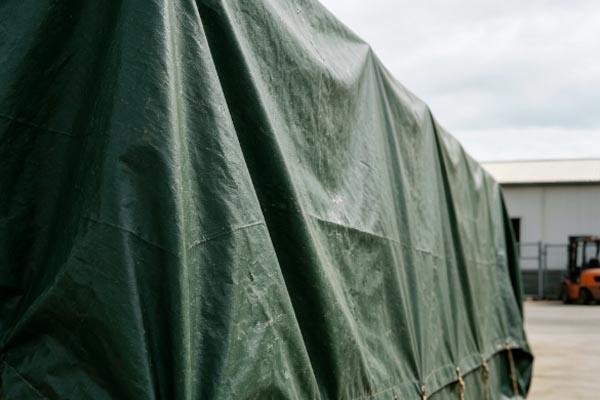
Outdoor feed storage is not simply a matter of covering the feed with a layer of plastic sheeting. It requires consideration of practical needs such as rain protection, moisture resistance, ventilation, sun protection, and daily loading and unloading. Selecting suitable PVC rainproof tarpaulins can provide stable external protection for temporary storage areas.
Feed is commonly packaged in woven bags, paper bags, or composite packaging. Prolonged exposure to rainwater can cause the packaging to soften or tear, and may even allow moisture to enter the contents. Rainproof tarpaulins must therefore provide effective rain protection for the covered area.
Form a continuous rainproof covering layer on top to reduce direct exposure to rainwater.
Add appropriate side protection according to the height of the stack.
Do not place feed stacks directly against the edges of the tarpaulin to prevent rainwater from entering along the edges.
Ensure that entrances and exits provide both rain protection and convenient loading and unloading.
For feed that is particularly susceptible to moisture, strengthen bottom moisture isolation at the same time.
Combining top rain protection with bottom moisture isolation helps reduce the risk of feed becoming damp.
During outdoor feed storage, even if there is no obvious leakage from the top, ground humidity, standing water, and moisture returning after rainfall may still affect the packaging. The tarpaulin solution should also address the separation between the goods and the ground. Pallets, support boards, or racks can be used to raise the feed stacks, and storage areas with higher ground levels and better drainage should be selected whenever possible. For long-term temporary storage areas, drainage ditches and water-accumulation prevention zones can also be planned to reduce moisture buildup after rainfall. Proper ground isolation helps improve the moisture resistance of the entire feed storage area.
Feed is rich in nutrients and inherently contains a certain level of moisture. If it is tightly wrapped directly with completely airtight PVC tarpaulins, temperature fluctuations between day and night or hot sunny weather will cause the moisture emitted by the feed to condense into water droplets on the inner wall of the tarpaulin. These droplets drip back onto the top of the feed stack, causing the top layer of feed to mold, clump, or even breed mycotoxins such as aflatoxin. Therefore, open-air feed covering must not only "isolate external rainwater" but also resolve the issue of "internal water vapor dissipation."
Feed packaging types, storage quantities, and turnover cycles vary, so tarpaulin specifications should not be selected simply on the basis that “thicker is better.” In practical applications, the storage period, storage yard area, local weather conditions, and loading and unloading methods should all be considered.
Different storage scenarios have different requirements for PVC tarpaulins. It is recommended to first clarify the actual usage method and then determine the covering structure and material performance.
Feed Storage Scenario | Main Issue | Key Tarpaulin Solution | Key Performance Requirements |
Short-term outdoor turnover | Sudden rainfall | Quick covering and easy installation and removal | Waterproofing and tear resistance |
Temporary farm storage | Rainwater and sunlight | Top covering + side protection | Waterproofing, weather resistance, and abrasion resistance |
Feed storage yard expansion | Insufficient storage space | Large-area tarpaulin covering | Strength, width, and weather resistance |
Logistics transfer storage | Frequent loading and unloading | Openable side curtains and wide passages | Abrasion resistance, tear resistance, and ease of operation |
Medium- to long-term outdoor storage | Rainwater, ultraviolet radiation, and aging | Stable covering structure | Waterproofing, weather resistance, and aging resistance |
Large-volume feed storage | Large covering area | Zonal or integrated tent solution | Strength, connection, and fastening performance |
Determining the solution according to the feed storage cycle and on-site operating methods is more practical than simply comparing tarpaulin prices.
Tarpaulins used for only a few days have significantly different performance requirements from products that need to be used continuously for several months or longer. Short-term use focuses on quick covering and rain protection, while long-term use requires greater attention to weather resistance and durability.
Short-term use: Focus on waterproofing, tear resistance, and ease of installation.
Seasonal use: Give greater consideration to weather resistance, abrasion resistance, and aging resistance.
Long-term outdoor use: Focus on stable waterproofing, UV resistance, aging resistance, and overall strength.
Large storage yards: Determine specifications according to the coverage area, wind conditions, and fastening method.
Frequent installation and removal: Consider the durability of the tarpaulin after repeated folding, rolling, and handling.
The longer the storage period and the larger the storage yard, the higher the requirements for the overall durability and structural strength of the PVC tarpaulin.
PVC rainproof tarpaulins themselves provide good waterproofing, but their final performance is also affected by drainage, overlapping, fastening, and ground conditions. For outdoor feed storage, on-site installation and routine inspection should not be overlooked.
When laying out large tarpaulins, it is necessary to form a reasonable roof slope to direct rainwater to designated drainage areas and prevent water accumulation on top. Crucially, an elevated air gap or ventilation/dehumidification windows must be reserved between the top of the feed stack and the tarpaulin. The PVC tarpaulin must not be tightly "sealed shut" directly against the feed packaging. A simple support framework can be built on top of the stack to suspend the tarpaulin, creating an airflow channel. This should be combined with roll-up side skirts to open and exhaust moisture in good weather, preventing high internal temperatures from deactivating heat-sensitive nutrients like vitamins or generating condensation.
If a large tarpaulin is installed too flat, standing water may form after continuous rainfall. Standing water increases localized stress on the tarpaulin and may also cause sagging, placing greater pressure on connection points. During installation, the top should be designed with a proper drainage direction, and obvious depressions should be avoided. For larger feed storage areas, the direction of rainwater flow should be determined in advance to prevent rainwater from flowing toward feed stacks or loading and unloading passages. Effective drainage design is an important foundation for the long-term stable use of outdoor rainproof tarpaulins.
Tarpaulin edges, eyelets, ropes, and connection areas usually bear considerable tension and may become loose in strong winds. These areas should be properly reinforced according to the tarpaulin size and on-site wind conditions.
Strengthen fastening at the four corners to prevent the corners from being lifted by the wind.
Add fastening points along the long edges to reduce large-area movement of the tarpaulin.
Avoid excessive concentrated tension around the eyelets.
When overlapping multiple tarpaulins, ensure that the overlap area provides sufficient coverage.
Use pallets to raise feed stacks and prevent the packaging from directly contacting the ground.
Maintain drainage channels around the stacks and avoid placing them in low-lying areas prone to water accumulation.
Combining secure tarpaulin fastening with bottom moisture isolation can reduce the risk of the tarpaulin being displaced or torn by wind, rainwater leakage, and moisture damage to feed packaging.
The cost of outdoor feed storage includes not only tarpaulin procurement, but also manual loading and unloading, repeated replacement, product loss, and routine maintenance. Selecting a solution that can be used reliably over the long term helps control overall storage costs.
An undersized tarpaulin may provide insufficient coverage, while an oversized tarpaulin may increase material costs, installation difficulty, and fastening pressure. Planning should be based on the actual dimensions of the feed stacks.
Determine the coverage length and width according to the maximum stack dimensions.
Reserve a reasonable allowance for edge fastening.
Avoid using overly complex covering structures in loading and unloading areas.
Large storage yards can use zonal covering for easier management.
For long-term fixed storage areas, consider combining storage tents with tarpaulins.
Reasonably controlling the coverage area can achieve a better balance between protection performance and material cost.
If feed storage has clear seasonal variations, tarpaulins may need to be installed, removed, and stored repeatedly. In addition to waterproofing, attention should also be paid to abrasion resistance, tear resistance, and stability after repeated folding. During use, avoid dragging the tarpaulin directly, and do not store it for long periods near damp areas or sharp objects. Before storage, clean surface dirt and keep the tarpaulin appropriately dry to reduce damage during subsequent use. Tarpaulins suitable for repeated use can reduce the long-term costs caused by frequent material replacement.
During actual procurement and use, customers are also concerned about tarpaulin specification matching, processing details, installation methods, and subsequent maintenance costs. Newstar Plastic Industry Co.,Ltd. specializes in the research, development, and production of PVC tarpaulins, PVC-coated fabrics, and outdoor protective materials. According to different application requirements, the company can provide customized PVC tarpaulin products with different specifications, weights, widths, and functional configurations, helping customers optimize covering performance, ease of use, and long-term durability while creating an outdoor storage protection solution better suited to on-site management.
