
Hot Keywords:
- All
- Product Name
- Product Keyword
- Product Model
- Product Summary
- Product Description
- Multi Field Search

Outdoor skate parks are usually located in open outdoor spaces, where the site needs to withstand long-term exposure to sunlight, rainfall, wind and dust, as well as seasonal changes. For a facility mainly used for skateboarding, rainwater can not only make the ground slippery, but may also affect skateboarding obstacles, metal connectors, and the normal use of site facilities. If you want to extend the usable time of a skate park, installing a suitable covering structure above the site is a relatively direct solution. PVC tarpaulin (PVC Tarpaulin / PVC Tarp) has good waterproof, weather-resistant, and tear-resistant properties and can be cut and processed according to the size, structural height, and covering requirements of the skate park.
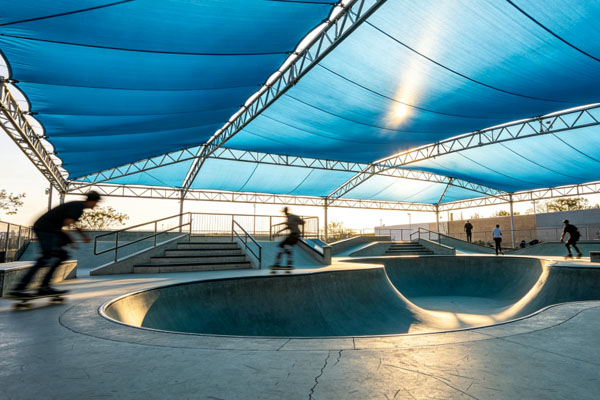
Unlike a simple small-area rain cover, an outdoor skate park covering usually needs to consider a relatively large span, drainage, fixing, ventilation, and daily maintenance. For small and medium-sized outdoor skate parks, partial covering can be used, such as covering the main skating areas, rest areas, or locations that are prone to water accumulation. For larger sites, continuous or sectional covering structures can be designed. By properly selecting the tarpaulin weight, color, size, and fixing method, the covering can meet rain protection requirements while minimizing its impact on the natural lighting, ventilation, and activity space of the skate park.
The covering of an outdoor skate park is different from an ordinary rain protection facility. Skateboarding requires a certain amount of open space, and the covering material cannot be too loose; otherwise, it may move excessively or even accumulate water in windy and rainy conditions. At the same time, the area above a skate park is usually relatively large, so the strength and long-term weather resistance of the tarpaulin are particularly important. PVC tarpaulin generally uses a fabric base as the structural layer and then uses a PVC coating to improve waterproofing and weather resistance. Compared with lightweight covering materials, PVC Tarp is more suitable for long-term outdoor use.
Rainwater is the most direct problem for a skate park. PVC Tarpaulin has good waterproof performance and, when properly installed, can reduce direct rainwater entering the skating area. After the tarpaulin is installed, rainwater will flow toward the edges along the preset slope. Therefore, when designing a PVC tarpaulin covering solution for a skate park, obvious low areas should be avoided in the middle of the tarpaulin. For larger covering structures, multiple drainage directions can also be provided so that rainwater can leave the site quickly.
Skate parks usually do not have complete exterior walls, so the tarpaulin will be exposed to sunlight for long periods. Ordinary covering materials may experience fading, hardening, and cracking after prolonged exposure to ultraviolet radiation. PVC tarpaulin can be selected with weather-resistant properties according to actual requirements, making it more suitable for long-term outdoor use. For skate parks that remain open throughout the year, it is recommended to confirm the weather resistance, tear resistance, and suitability for the intended environment when purchasing, rather than simply comparing the price per square meter.
The covering area of a skate park is often relatively large. The tarpaulin not only needs to withstand its own weight, but is also affected by wind, rainwater, and installation tension. Therefore, actual solutions usually use higher-strength PVC fabric and add reinforced structures, eyelets, or other fixing methods along the edges. Through reasonable load distribution, excessive localized stress on the tarpaulin can be reduced.
When determining the covering solution, the actual dimensions of the skate park need to be understood first, and the covering area should then be determined according to the activity areas and surrounding space. A larger covering area is not necessarily better; the proper covering location is equally important.
According to the requirements of the skate park, the covering area can be divided into full coverage and key-area coverage. Full coverage is suitable for skate parks that want to reduce rainwater entering the site and improve all-weather usability. Key-area coverage can provide tarpaulin over the main skating areas while keeping part of the site open. For example, for a rectangular skate park, the tarpaulin span can be arranged according to the skating direction, while the supporting structure can be placed around the perimeter to avoid placing columns in the main skating areas as much as possible.
PVC tarpaulin itself is a flexible material and needs to rely on a supporting structure to maintain a stable shape. A common method is to use a steel structure or another frame with suitable strength as the support, and then fix the tarpaulin through eyelets, ropes, tensioning components, and other methods. The spacing of the supporting structure cannot be determined only according to the tarpaulin size. It also needs to take local wind conditions, covering area, structural height, and tarpaulin weight into consideration. The larger the area and the higher the installation position, the greater the requirements for overall structural stability are generally.
The tarpaulin covering cannot remain completely horizontal; otherwise, rainwater can easily remain on the surface. By setting an appropriate slope, rainwater can flow toward designated locations and then be directed away from the skate park through drainage channels or drainage areas. This is particularly important for large covering structures.
Correct Process: Steel supporting structure → PVC tarpaulin tensioning → Forming a sloped surface → Rainwater collects toward the lower area → Drainage area water diversion
This method can reduce water accumulation on the tarpaulin and also help reduce the load caused by rainwater remaining on the surface for a long time.
Different skate parks have different areas, structures, and local weather conditions, so PVC tarpaulin should not be purchased directly according to one fixed specification. Before purchasing, the site's length and width, covering height, supporting structure spacing, local wind conditions, rainfall, sunlight intensity, and expected service life should be considered comprehensively. If the tarpaulin is too small, it may not completely cover the site; if it is too large, it can increase installation difficulty and wind load. Only by selecting a suitable weight, thickness, color, processing method, and fixing accessories according to actual requirements can the covering effect, safety in use, and convenience of later maintenance be ensured.
The tarpaulin size needs to take into account the actual covering area and the fixing edges that need to be reserved during installation. It should not simply be purchased according to the length × width of the site.
Item | Selection Considerations |
Tarpaulin length | Determine according to the site length and fixing locations |
Tarpaulin width | Determine according to the span and supporting structure |
Material weight | Select according to strength, installation method, and structural load capacity |
Edge structure | Reinforced edges can be added to improve strength around fixing areas |
Eyelets/Grommets | Determine according to fixing spacing and installation method |
Color | Select according to the visual effect of the site and natural lighting requirements |
If customization is required, it is recommended to provide the skate park layout dimensions, covering height, supporting structure drawings, and expected installation method so that the tarpaulin supplier can further confirm the processing dimensions.
If the skate park is located in an area with strong sunlight, frequent rainfall, or relatively high wind speeds, greater attention should be paid to weather resistance and mechanical strength when selecting the material. If the site is located in an ordinary urban environment, a suitable specification can be selected according to the actual budget. If it is a commercial outdoor skate park that is open throughout the year, it is more advisable to choose PVC tarpaulin suitable for long-term outdoor use and pay particular attention to weather resistance, waterproofing, and tear resistance.
PVC Tarp can be customized according to project requirements, such as heat-welded edges, reinforced edges, eyelets, rope loops, and other connection structures. The edge area is one of the locations where stress is more likely to become concentrated during installation. If holes are simply made directly along the edge of ordinary tarpaulin for fixing, long-term pulling caused by wind may enlarge the holes. Therefore, large skate park coverings generally require reinforced edge treatment.
Completing the installation of a PVC tarpaulin covering does not mean that all work is finished. Proper installation methods and regular inspections can help the tarpaulin maintain a stable condition. Since the skate park remains outdoors for long periods, the tarpaulin will be affected by sunlight, rainwater, wind, dust, and debris. Therefore, it is necessary to regularly check whether there is water accumulation, damage, or obvious looseness on the surface. At the same time, the eyelets, ropes, tensioning components, and supporting structure should also be checked to ensure that they remain secure. If local looseness, wear, or tearing is found, it should be dealt with promptly to prevent minor problems from gradually becoming larger and affecting the overall covering performance and safety.
Before installation, make sure that the steel structure has no obvious burrs or sharp edges to avoid wear caused by contact with the tarpaulin. The tarpaulin should be kept under appropriate tension during installation. Excessive looseness can easily cause water accumulation and large movements, while excessive tension can increase the stress around the edges and eyelets.
After installation, check:
Whether the tarpaulin is flat;
Whether the edges are securely fixed;
Whether stress is evenly distributed around the eyelets;
Whether the drainage direction is normal;
Whether the supporting structure is stable;
Whether the tarpaulin is in contact with sharp objects.
As an open outdoor environment, a skate park may accumulate dust, leaves, and other debris on the tarpaulin surface. It should be cleaned regularly, with particular attention paid to drainage areas. If a small damaged area is found on the tarpaulin, it should be repaired as early as possible to prevent the tear from becoming larger under the influence of wind. If fixing components become loose, they should also be adjusted promptly. For PVC Tarpaulin used over a long period, the tarpaulin color, surface condition, edges, and eyelets can also be inspected regularly according to the actual environment. If obvious aging or structural damage occurs, the relevant section should be replaced promptly.
PVC tarpaulin coverings can be designed differently according to the size of the skate park. Small community skate parks can use partial rain protection structures to mainly protect the core skating areas. Commercial skate parks can consider larger overall covering structures to provide users with a more stable skating space. Large outdoor skate parks can use sectional covering so that different areas can maintain different levels of openness. This approach also has another advantage: if the site's requirements change later, the covering area can be adjusted according to the existing structure without necessarily requiring large-scale reconstruction of the entire site.
Yes, but it needs to be selected according to the local climate, usage time, tarpaulin specification, and installation structure. For long-term outdoor use, particular attention should be paid to weather resistance, waterproofing, tear resistance, and reinforced edges.
It may have some impact, but this can be adjusted through the color, coverage ratio, and structural design. If the site needs to maintain good natural lighting, partial covering can be used or a suitable tarpaulin color can be selected according to the requirements.
For large skate parks, customization is generally recommended. Since site dimensions, supporting structures, fixing points, and drainage directions are different, customized tarpaulin can better match the actual installation conditions.
Not necessarily. If there is only a small area of localized damage, professional repair can be carried out according to the extent of the damage. If there is extensive aging, tearing, or serious damage to the edge structure, it is necessary to evaluate whether replacement is required.
Installing PVC tarpaulin over an outdoor skate park is not simply about providing rain protection. A suitable solution needs to consider the tarpaulin material, coverage area, supporting structure, drainage method, and fixing method as a whole. Even if the tarpaulin itself is of good quality, long-term use may still be affected if water accumulates easily after installation, the edge stress is uneven, or the fixing points are not secure. Therefore, when designing a covering solution for a skate park, it is best to first determine the site dimensions and usage requirements, and then select the appropriate PVC Tarpaulin specification. For skate parks with a high frequency of daily use, PVC tarpaulin can help reduce the impact of rainwater on skating areas and also reduce the effects of prolonged sun exposure on certain site facilities. After installation, regularly removing leaves and dust, checking the eyelets, edges, and fixing components, and addressing minor problems promptly can help keep the tarpaulin in good condition.
If your skate park is under construction, or if you already have a steel structure but lack suitable covering material, you can choose a customized solution based on the site length, width, covering height, and installation method. If you are unsure which specification to choose, there is no need to focus only on the price. You can provide the specific dimensions and installation requirements to a professional PVC tarpaulin manufacturer for evaluation. This will help ensure that the selected material better suits the actual application and reduce the need for repeated modifications and replacements later.
Email: tarp@newstarventilation.com
Phone: 0086-13921439224
