
Hot Keywords:
- All
- Product Name
- Product Keyword
- Product Model
- Product Summary
- Product Description
- Multi Field Search

Outdoor sports activities are becoming increasingly common in schools, communities, and enterprises. However, in practical implementation, weather remains the most uncontrollable factor. Whether it is strong sunlight or sudden rainfall, both can disrupt the progress of activities. Therefore, configuring a stable, durable, and highly adaptable PVC tent system has become an important condition to ensure the smooth execution of outdoor sports activities. Through reasonable structural design and material selection, the safety and comfort of the activity space can be effectively improved, thereby optimizing the overall user experience.
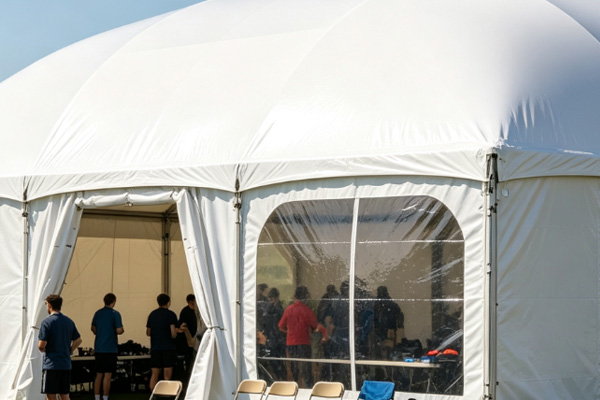
Outdoor sports activities are highly dependent on environmental conditions, and PVC tents can provide stable shelter and protection under various weather conditions, making them a very important infrastructure in event organization.
The most common challenge in outdoor activities is frequent weather changes, and PVC tents can provide effective buffering at critical moments.
Rainproof structures reduce interference from rainfall.
Sunshade design lowers discomfort caused by high temperatures.
Wind-resistant structures enhance overall stability.
By improving basic protection capabilities, the activity process becomes smoother.
The stability of the activity environment directly affects participants’ experience, and tent spaces can provide more controllable conditions.
Reduce heat stress caused by direct sunlight.
Lower safety risks caused by slippery ground conditions.
Create relatively independent and stable activity zones.
Environmental improvement helps enhance overall activity quality.
Different sports projects have significantly different spatial requirements. PVC tents offer strong adaptability and can be used for ball training and temporary competition venues, support expanded space for school physical education courses, and also accommodate community fitness and group activities. This flexibility makes their application scenarios more diverse.
Reasonable structural design is the key to maximizing tent functionality. Different usage scenarios require matching solutions.
Activity scale directly affects tent size and structural form. Scientific planning can improve space utilization efficiency.
Small-scale activities are suitable for single-unit structures with easy setup.
Medium-scale activities can use combined structures for greater flexibility.
Large-scale events are recommended to use modular expansion solutions.
When the structure is properly matched, overall efficiency is higher.
Different regional climates vary significantly, requiring targeted optimization of tent performance.
In rainy regions, strengthen waterproofing and drainage capacity.
In high-temperature environments, enhance sunshade and ventilation design.
In windy areas, improve wind-resistant structures and anchoring systems.
The more precise the environmental adaptation, the higher the operational stability.
Different sports activities have different priorities in spatial division. Training activities emphasize open and continuous space, competition activities require clear zoning and movement flow, and recreational activities focus more on comfort and shading experience. Reasonable layout can improve overall effectiveness.
Different types of PVC tents vary in performance and application scenarios. Proper selection helps balance investment and effectiveness.
Usage Scenario | Main Requirements | Recommended Type | Features |
School daily sports activities | Safety, basic protection | Standard PVC tent | Cost-effective, easy to install |
Community outdoor fitness activities | Comfort, sunshade | Thickened sunshade tent | Better UV protection |
Temporary sports event venues | Stability, large space | Modular large tent | Strong expandability |
High-temperature and rainy regions | Waterproof, sunproof, wind-resistant | High-strength PVC tent | Excellent weather resistance |
Long-term fixed outdoor sites | Durability, low maintenance | Industrial-grade PVC tent | Longer service life |
Scientific selection helps achieve a balance between cost and performance.
The actual performance of a tent depends not only on the material itself but also on installation methods and subsequent maintenance.
Outdoor environments are complex, and a stable structure is essential for safe use.
Use ground anchors or counterweights to enhance wind resistance.
Reinforce key stress points at corners and edges.
Regularly check whether connection structures are secure.
Stability determines the overall safety level.
Good air circulation and drainage capacity can significantly improve comfort during use.
Properly set ventilation openings to reduce stuffiness.
Optimize roof structure to prevent water accumulation.
Improve rainwater drainage efficiency to reduce load.
Functional optimization directly affects user experience.
Standardized maintenance management can effectively reduce wear and extend service life.
Regularly clean surface stains and dust.
Avoid damage caused by sharp objects.
Inspect overall condition promptly after activities.
The more standardized the maintenance, the longer the service life.
In practical applications, the combination of high-quality PVC materials and professional structural design is particularly important. Newstar Plastic Industry Co., Ltd. specializes in the R&D and production of PVC tarpaulins and industrial-grade tent materials. It can provide customized solutions for outdoor sports activities, school sports fields, and large-scale events, helping customers build safer, more durable, and more efficient outdoor activity space support systems.
