
Hot Keywords:
- All
- Product Name
- Product Keyword
- Product Model
- Product Summary
- Product Description
- Multi Field Search

Port cargo stored outdoors is exposed to the outdoor environment for extended periods. From loading and unloading to storage and waiting for transportation, cargo often needs to remain outdoors for a relatively long time. When exposed to rainfall, strong winds, intense sunlight, and day-night temperature differences, cargo surfaces can easily become damp without reliable covering protection, while packaging may also suffer from damage and aging. This is especially true for metal materials, machinery and equipment, wooden packaging, and water-sensitive cargo. Once rainwater enters the interior, it may not only affect the appearance but also increase subsequent handling and maintenance costs. For the protection needs of cargo stored outdoors at ports, PVC tarpaulin is a practical covering material. It uses fabric as the base material and is then treated with a PVC coating, providing a combination of waterproofing, abrasion resistance, and weather resistance. According to cargo dimensions, stacking methods, and on-site fixing conditions, different widths, lengths, thicknesses, colors, and eyelet spacing can also be customized, allowing the tarpaulin to better meet the actual covering requirements of outdoor port cargo.
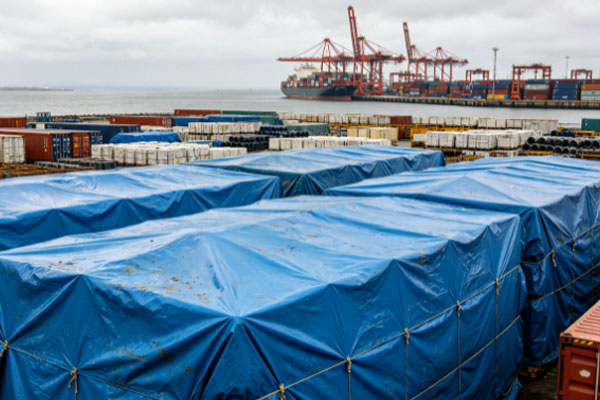
Cargo stored in port yards cannot usually all be placed inside warehouses. Some cargo needs to be temporarily stored outdoors according to vessel schedules, transportation arrangements, and loading and unloading plans. During rainfall, rainwater may enter through gaps in cargo packaging. After prolonged exposure to sunlight, some outer packaging may also become aged. Therefore, covering materials need to not only block rain but also withstand wind, sunlight, and other outdoor conditions. PVC tarpaulin has good waterproof performance on its surface. Once applied, it can reduce direct contact between rainwater and the cargo, adding a simple and reliable protective layer for outdoor storage.
Cargo covering at ports may look simple, but actual use also requires consideration of the durability of the tarpaulin itself. If the tarpaulin is too thin, frequent installation, dragging, or exposure to wind may easily cause wear. If the eyelet positions are not properly designed, stress may become concentrated during fixing. Therefore, when using PVC Tarp for outdoor port cargo, an appropriate fabric specification should be selected according to cargo weight, stacking height, covering area, and local weather conditions.
Consideration | Features Required for PVC Tarpaulin |
Rain protection | Good surface waterproofing capability |
Sun exposure | Certain weather resistance and UV resistance |
Frequent use | Good abrasion resistance of the fabric |
Large-area coverage | Dimensions can be customized according to the cargo |
Fixing | Can be equipped with eyelets, ropes, and other structures |
Long-term storage | Easy to clean, fold, and reuse |
A PVC tarpaulin is not necessarily better simply because it is larger. If the size is too small, it cannot completely cover the cargo. If it is too large, it may increase the weight and make installation and fixing more difficult. During customization, the required covering dimensions can be calculated according to the cargo length, width, and height, while allowing a certain amount of overhang. For cargo with different stacking heights, the covering distance after the tarpaulin extends from the top toward both sides also needs to be considered. For example, if a batch of cargo has overall dimensions of 8 meters long, 4 meters wide, and 2.5 meters high, and the tarpaulin needs to cover the top and extend down both sides of the cargo, the required size cannot simply be made at 8 × 4 meters. The height of both sides and the allowance required for fixing must also be included in the calculation.
Outdoor port environments place relatively high durability requirements on tarpaulins. For temporary covering over a short period, a relatively lightweight PVC tarpaulin can be considered. If long-term outdoor coverage is required, or if the tarpaulin needs to be frequently installed and removed, a thicker Heavy Duty PVC Tarp with better abrasion resistance is more suitable. Fabric weight, thickness, fabric strength, and surface treatment can all affect the final performance. When purchasing, it is not recommended to compare only the price per square meter. The service period, covering area, and number of reuses should also be considered.
When covering large cargo areas, the tarpaulin will experience a certain amount of tension after being exposed to wind. If there are too few fixing points, the tarpaulin can easily be blown upward. If the eyelet spacing is too large, the edges may become loose. Therefore, PVC Tarpaulin can be equipped with metal eyelets according to actual requirements, with eyelet spacing arranged appropriately. For large-area tarpaulins, the edge structure can also be reinforced to distribute stress more evenly during fixing.
Although PVC tarpaulin has good abrasion resistance, sharp metal edges, protruding bolts, and burrs on cargo can still scratch the fabric. Therefore, the top and edge areas of the cargo should be inspected before covering. If the cargo has obvious sharp corners, they can be treated in advance, or an additional protective layer can be added at contact points. This can reduce localized wear when the tarpaulin is tightened.
After the tarpaulin has been installed, checking only whether the top is covered is not enough. The surrounding edges should also be inspected. Rainwater may enter from the edges, while strong winds can easily lift the tarpaulin from loose areas. After fixing is completed, the eyelets, ropes, and fixing points around the tarpaulin can be checked to ensure they are secure. For cargo stored for long periods, it is also recommended to regularly check whether the tarpaulin surface has damage, accumulated water, or obvious looseness.
Port environments may contain dust, sand, mud, and other contaminants. If the tarpaulin remains dirty for a long time, it may affect subsequent use. After use, it can be cleaned according to the type of stains and folded for storage after it has completely dried. Do not seal and store a tarpaulin that still contains a large amount of moisture. Keeping the fabric dry can help reduce problems such as mildew during long-term storage.
When metal materials are stored outdoors, the focus should be on reducing the effects of rainwater and humid air. During covering, the tarpaulin should form as complete a protective surface as possible while avoiding long-term accumulation of rainwater on the top. For heavy metal cargo, Heavy Duty PVC Tarpaulin with higher strength can be selected, along with a reasonable number of fixing points.
For cargo that has already been packaged, PVC Tarp can serve as an external protective layer to reduce direct contact between rainwater and the packaging. When selecting a tarp, attention should be paid to its dimensions so that it can cover the entire cargo area while leaving sufficient space for fixing.
Large equipment is often irregularly shaped, so dimensional measurements are required. For cargo with greater height or complex contours, customized PVC tarpaulins can be used, with the covering dimensions designed according to the equipment profile. This approach can more easily achieve complete coverage than directly purchasing ordinary tarpaulins in fixed sizes.
Cargo Situation | Key Considerations |
Metal materials | Rain protection, abrasion resistance, secure fixing |
Packaged cargo | Complete coverage, reduced rainwater entry |
Large equipment | Customized dimensions, reinforced edges |
Long-term stored cargo | Weather resistance, fabric strength, reusability |
Large cargo piles | Appropriate eyelet spacing, reinforced fixing |
Yes, but the actual service life depends on the fabric specification, weather conditions, usage method, and maintenance. For long-term outdoor coverage, it is recommended to choose PVC tarpaulins with good weather resistance and regularly inspect the fabric surface and fixing positions.
Not necessarily. Greater thickness generally means greater weight, which can make installation, removal, and storage more difficult. The appropriate specification should be selected according to cargo size, service period, and on-site operating conditions.
Yes. PVC Tarpaulin can be customized according to requirements such as length, width, thickness, color, and eyelet spacing. For large cargo, customized products can usually meet actual covering requirements more effectively.
This depends on the location and size of the damage. If the damage is only minor and localized, it can be repaired promptly. If the damage is located at a major stress-bearing position or continues to expand, replacement or remanufacturing should be considered.
Prices are usually related to fabric weight, thickness, fabric strength, surface treatment, dimensions, number of eyelets, and customization requirements. Therefore, when purchasing, it is not advisable to look only at the unit price. Actual service life and maintenance costs should also be considered.
The purpose of covering and protecting outdoor port cargo is to ensure that the tarpaulin is truly suitable for the cargo and the on-site environment. With the right size, the coverage can be complete; with the appropriate fabric strength, the tarp can withstand repeated use; and with properly designed eyelets and fixing positions, it can remain more stable in strong winds. PVC tarpaulin is suitable for protecting outdoor port cargo mainly because it can combine practical requirements such as waterproofing, abrasion resistance, and weather resistance while also allowing customization according to cargo size. For cargo that needs to be stored outdoors for long periods, a durable PVC Tarpaulin can be selected. For temporary covering, a specification that is easier to handle can be selected according to the frequency of handling. When purchasing, there is no need to pursue the thickest or most expensive product. Instead, cargo dimensions, storage time, local weather, fixing methods, and frequency of use should all be considered together. Only with an appropriate specification can the tarpaulin perform its intended function and reduce the inconvenience of later replacement and maintenance. For port cargo with specific dimensions and usage requirements, communicating with a PVC tarpaulin manufacturer in advance generally makes it easier to determine the appropriate material and customization solution.
Email:tarp@newstarventilation.com
Phone:0086-13921439224
