
Hot Keywords:
- All
- Product Name
- Product Keyword
- Product Model
- Product Summary
- Product Description
- Multi Field Search

During port truck transportation, cargo usually goes through multiple stages, including loading and unloading, short-distance transfer, yard waiting, and long-distance road transportation. As vehicles continue traveling on port roads, urban roads, and highways, the covering material above the cargo must withstand not only rainwater but also strong winds, dust, sunlight, and friction caused by frequent loading and unloading. If the tarpaulin is not properly sealed, rainwater may enter through the edges, seams, or fastening points, while the cargo surface can also be affected by the external environment. PVC tarpaulin offers good waterproofing, abrasion resistance, and weather resistance. It can also be cut, welded, and fitted with eyelets according to vehicle dimensions, cargo height, and fastening methods, making it suitable for sealed covering in port truck transportation. For vehicles that require long-term transportation and repeated use, selecting the right PVC material and covering structure can help maintain stable protection during actual transportation.
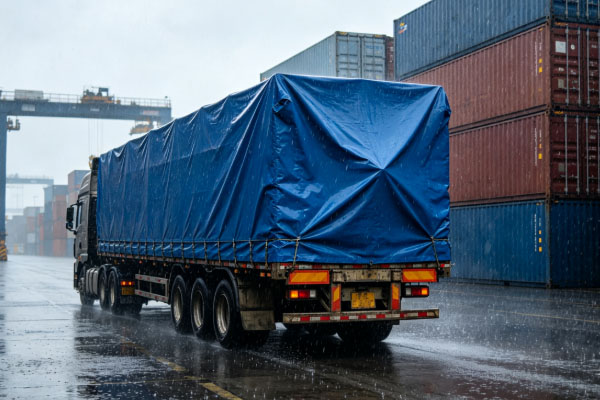
The transportation routes used by port vehicles differ from those used for ordinary short-distance transportation. Vehicles may travel frequently between terminals, yards, and warehouses, or may enter highway transportation directly from the port area. After loading, cargo usually needs to remain covered until it reaches its destination. During transportation, the tarpaulin is continuously exposed to wind pressure. As vehicle speed increases, the air resistance acting on the tarpaulin surface also increases. If the covering size is insufficient or the number of fastening points is inappropriate, the tarpaulin edges may loosen, bulge, or even be lifted by the wind. Rainwater may enter not only through the tarpaulin surface but also through overlapping edges, areas around eyelets, and fastening points. Therefore, covering materials used on port trucks need stable waterproof performance while maintaining good overall sealing.
PVC Tarpaulin is typically produced by applying a PVC coating to a fabric base, allowing the material to combine the tensile strength of the fabric with the protective properties of the PVC layer. Compared with ordinary lightweight tarpaulins, heavy-duty PVC tarpaulins can use higher fabric weights and thicker material structures, making them suitable for frequent loading and unloading and repeated use.
Item | Actual Requirements for Port Truck Transportation | Corresponding Features of PVC Tarpaulin |
Waterproofing | Reduce rainwater entering the cargo area | PVC coating provides good waterproof performance |
Wind Resistance | Maintain stable coverage during high-speed transportation | High-strength base fabric combined with proper fastening |
Abrasion Resistance | Friction may occur during loading, unloading, and folding | Good surface abrasion resistance |
Weather Resistance | Long-term exposure to outdoor environments | UV-resistant formulations can be selected |
Sealing | Reduce water and dust entering through the edges | Can be customized according to vehicle dimensions |
Service Life | Requires repeated rolling, unfolding, and fastening | Heavy-duty structures are suitable for repeated use |
The size of the PVC tarpaulin needs to be calculated according to the cargo bed length, width, cargo height, and required overlap after covering. If the tarpaulin is too small, the edges may not hang down sufficiently after covering, making gaps more likely to appear while the vehicle is moving. If the tarpaulin is too large, it can provide a wider covering area, but the excess material may create stronger movement during transportation and increase the difficulty of rolling and fastening. Therefore, when customizing a Truck Tarp, the actual vehicle dimensions should be confirmed in advance, and the loaded cargo height should also be included in the design.
The edges of a tarpaulin are usually areas subject to significant stress. During transportation, ropes, fasteners, or other fastening devices continuously apply tension to the edges. Adding reinforcement structures in these areas can reduce the possibility of tearing and deformation during long-term use. Depending on the vehicle structure, multiple eyelets or fastening points can also be installed to distribute the load more evenly across the tarpaulin.
Large PVC tarpaulins often require joining multiple sections to achieve a larger covering size. Conventional sewing methods may have a risk of water penetration under long-term exposure to rain. Therefore, PVC materials can generally use high-frequency welding or hot-air welding to treat connection areas. Proper seam treatment can reduce the possibility of water entering through the joints.
Different cargo loading heights result in different stress conditions after the tarpaulin is installed. When the cargo is relatively high, the tarpaulin may form obvious raised areas, where wind pressure can become concentrated during transportation. If the covering structure does not provide sufficient space, the tarpaulin may experience greater tension. Therefore, when producing a Heavy Duty Tarp, it is necessary to consider not only the cargo bed dimensions but also the typical loading height and shape of the cargo. By providing appropriate allowance, adjusting fastening points, and reinforcing stressed areas, the covered tarpaulin can remain flatter.
After the tarpaulin is installed, inspection should not be limited to whether the top is covered. The surrounding edges also need to be checked. The length of the edge overlap, whether all fastening points are connected, and whether there is obvious tension around the eyelets can all affect stability during transportation. Especially in rainy conditions and at high speeds, even a small gap along the edge may become an entry point for rainwater.
Tarpaulin fastening does not mean that the tighter it is, the better. If excessive tension is applied to individual areas while other areas remain loose, the load during transportation will become concentrated on a small number of fastening points. After long-term use, these areas may experience eyelet deformation or edge damage. A reasonable fastening method should maintain appropriate overall tension while reducing large areas of looseness and obvious bulging.
Port trucks may perform multiple transportation operations each day, requiring the tarpaulin to be unfolded, covered, removed, and rolled up frequently. If a large amount of mud, sand, or debris remains on the tarpaulin surface after use, folding it directly may increase surface friction. Over time, this can affect the appearance and condition of the tarpaulin. Therefore, the surface can be cleaned after transportation, with particular attention given to eyelets, edges, welded areas, and areas subject to frequent friction. Timely treatment of local damage can prevent minor problems from becoming more serious.
Inspection Area | Key Points to Check | Recommended Action |
Tarpaulin Surface | Whether there are obvious tears or scratches | Repair promptly |
Surrounding Edges | Whether there is wear or cracking | Check reinforcement structures |
Eyelet Areas | Whether they are loose or deformed | Replace or reinforce |
Welded Areas | Whether openings are present | Repair promptly |
Fastening Ropes and Fasteners | Whether they are aged or broken | Replace as needed |
Folding Areas | Whether long-term creases are present | Avoid excessive folding |
PVC tarpaulin is available in different specifications. Material thickness, fabric weight, base fabric strength, surface treatment, and weather resistance can all be selected according to actual transportation conditions. If vehicles are used for long-term outdoor transportation, UV resistance and weather resistance can be given greater consideration. If the tarpaulin needs to be frequently removed and installed, tensile strength and abrasion resistance should receive more attention. For port truck transportation, Heavy Duty Waterproof PVC Tarpaulin is generally more suitable for applications requiring repeated use, long-term covering, and strong protection.
When customizing a PVC Tarp, basic information such as cargo bed dimensions, covering method, cargo height, and fastening positions can be provided. Confirming these details before production helps determine the tarpaulin length, width, edge reinforcement method, and eyelet spacing. For tarpaulins purchased in batches for a fleet, standard specifications can also be produced according to the same vehicle model, making subsequent management and replacement more convenient.
The actual performance of a PVC tarpaulin depends not only on the PVC material itself but also on the processing method. Whether the edges are reinforced, whether the eyelets are securely installed, whether welded areas are smooth, and whether the dimensions are accurate can all affect the final installation performance. For port transportation vehicles, the tarpaulin also needs to withstand frequent unfolding and rolling, so consistent processing quality is important.
For long-term outdoor transportation, frequent use, and high waterproofing requirements, Heavy Duty PVC Tarpaulin can be selected. The specific thickness and specifications should be determined according to vehicle dimensions, cargo weight, and transportation conditions.
PVC tarpaulin provides good waterproofing, abrasion resistance, and weather resistance. It can also be cut, welded, edge-reinforced, and fitted with eyelets, allowing different sizes to be produced according to vehicle structures.
Yes. PVC Tarp can be customized according to cargo bed length, width, cargo height, and fastening positions. Eyelets, edge reinforcement, and seam structures can also be adjusted.
During truck transportation, the edges and fastening points are continuously exposed to tension. If these areas do not have sufficient strength, tearing or deformation may occur during long-term use. Adding edge reinforcement can help improve overall durability.
The tarpaulin size, covering method, edge overlap, seams, and fastening structure need to be properly designed together. Simply improving the waterproof performance of the material cannot completely solve water penetration through edges and connection areas.
It is recommended to regularly inspect the surface, edges, eyelets, welded areas, and fastening accessories. Keeping the tarpaulin clean after use and rolling it up properly can also help reduce long-term wear.
The selection of port truck PVC tarpaulin should be based on actual transportation conditions, with comprehensive consideration of vehicle dimensions, cargo height, transportation distance, frequency of use, fastening method, and local climate conditions. For vehicles used for long-term outdoor transportation and frequent repeated use, it is recommended to prioritize a Heavy Duty Tarp with suitable dimensions, stable base fabric strength, reinforced edges, and reliable fastening structures to meet requirements for rain protection, dust protection, wind resistance, and abrasion resistance. After the tarpaulin is put into use, the surface, edges, welded areas, eyelets, and fastening accessories should be inspected regularly. Loose, worn, or locally damaged areas should be handled promptly to prevent minor damage from affecting the overall covering performance. Proper material selection, accurate dimensional design, and continuous maintenance are important conditions for ensuring stable long-term use of PVC tarpaulin.
Email:tarp@newstarventilation.com
Phone:0086-13921439224
