
Hot Keywords:
- All
- Product Name
- Product Keyword
- Product Model
- Product Summary
- Product Description
- Multi Field Search

PVC tarpaulin ventilation ducts are flexible ventilation ducts characterized by light weight, flexible installation, convenient transportation, and relatively fast assembly and disassembly. They are commonly used in factories, warehouses, construction areas, tunnels, mines, and temporary ventilation locations. Compared with metal air ducts, PVC tarpaulin ducts can be bent and adjusted according to the site layout. However, the installation quality of flexible materials directly affects the ventilation performance of the duct. If the duct sags, the connections leak air, the support is insufficient, or the duct is excessively bent during installation, even PVC tarpaulin with good strength may experience reduced airflow or localized damage.
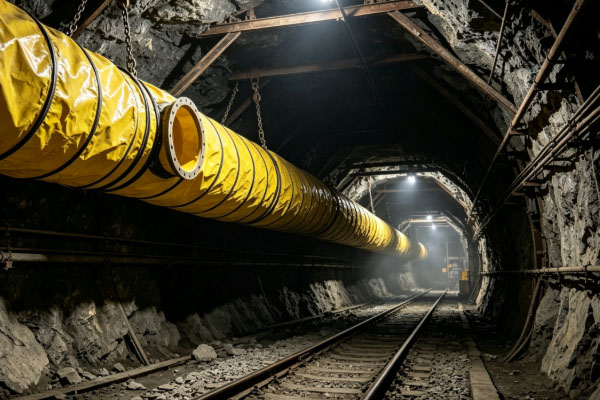
When installing PVC tarpaulin ventilation ducts, the fan parameters, duct dimensions, connection method, and installation location need to be confirmed in advance. The tarpaulin surface should also be checked for damage, scratches, or coating peeling. After the duct is unfolded, it should not be dragged carelessly or allowed to rub against sharp metal edges for extended periods. For longer air ducts, suspension straps, support rings, or other fixing structures should be arranged appropriately to keep the duct in a stable shape. Negative-pressure exhaust ducts require particular attention to whether the duct body is likely to contract.
Before installing PVC tarpaulin ventilation ducts, the duct diameter, length, connection type, and fan position need to be confirmed according to the actual operating conditions. A duct diameter that is too small may increase airflow resistance, while a diameter that is too large may affect installation stability. The duct length should also be checked in advance to avoid problems such as excessive length, insufficient length, or unreasonable connection positions at the installation site. If the ventilation route contains many curved sections, the duct layout should be planned in advance. Although flexible air ducts can be bent, this does not mean they can be folded arbitrarily. An excessively small bending radius can create local wrinkles and reduce the effective ventilation cross-section.
Before installation, the air duct should be completely unfolded and the material surface inspected. The following four points should be checked carefully:
Check whether the PVC coating has obvious scratches, cracks, or delamination.
Check whether the heat-sealed seams, sewn sections, and duct ends are intact.
Confirm that accessories such as clamps, flanges, suspension straps, and support rings are not deformed or damaged.
Check whether there are foreign objects inside the air duct to prevent them from being drawn into the equipment after the fan starts.
If obvious damage is found, the duct should be repaired or replaced before installation. If a damaged duct is put into operation directly, airflow pressure may cause the damaged area to expand further.
Flexible PVC air ducts generally need to be secured using suspension straps, hooks, or support structures. The distance between fixing points should not be excessive, otherwise the duct may develop significant sagging. Sagging areas can change the duct cross-section and may also cause dust accumulation or localized resistance. During installation, the duct should remain naturally expanded without excessive tension. Excessive stretching may increase stress at the connections and can lead to seam damage during long-term operation.
PVC tarpaulin has a certain level of abrasion resistance, but prolonged friction against sharp edges can still cause damage. During installation, steel cut edges, bolt tips, equipment corners, and other locations that may scratch the material should be avoided whenever possible. If obstacles cannot be avoided at the site, a protective layer can be added to the contact area or the duct route can be adjusted. For flexible air ducts that need to be moved frequently, ground dragging should also be minimized to prevent continuous surface friction.
During positive-pressure air supply, air inside the duct helps expand the PVC tarpaulin. During negative-pressure exhaust, external pressure may push the flexible duct wall inward. Therefore, negative-pressure ducts generally have stricter installation requirements. If the duct is prone to contraction, structures such as spiral steel wire or support rings can be used to improve resistance to collapse. The support components need to match the duct diameter and remain continuously and securely installed to prevent localized deformation caused by insufficient support in a particular section.
Connection points are areas where PVC tarpaulin ventilation ducts are relatively prone to air leakage. When connecting the duct to a fan, rigid air duct, or another flexible duct, confirm that the connection dimensions match and use suitable clamps, flanges, or connection straps for fastening. The connection should not be obviously loose, nor should the PVC tarpaulin be damaged by excessive fastening pressure. For ventilation systems that need to operate for long periods, the connections can be checked for air leakage after installation and readjusted according to the actual condition.
PVC flexible air ducts can be bent, but the airflow passage needs to remain relatively smooth. If a pronounced crease forms at a bend, the duct cross-sectional area will decrease and airflow resistance will increase. During installation, a larger bending radius can be used whenever possible to allow the duct to transition naturally. For ducts that must pass through narrow areas, the dimensions and route should be determined in advance rather than relying on forced folding to solve space limitations.
After the duct is installed, it should not be placed into long-term operation simply after checking its appearance. After starting the fan, observe whether the PVC tarpaulin expands normally, whether the connections remain stable, and whether the duct develops abnormal vibration, air leakage, collapse, or excessive expansion. If a section shows obvious deformation, the equipment should be shut down before checking the support and fixing points. For ventilation systems operating at relatively high pressure, inspections should also be carried out according to the specified working pressure of the equipment. The fan pressure should not be increased blindly to test the pressure-bearing capacity of the duct.
They can be temporarily laid on the ground, but the flatness of the ground and the presence of sharp objects need to be considered. During long-term use, direct ground placement can expose the duct to foot traffic, vehicle loads, and friction, and may also cause deformation. When conditions permit, suspension or support installation is recommended.
No. The duct needs to remain stable, but excessive tension increases stress on the duct body and connections. A properly installed duct should be naturally expanded and securely fixed while retaining an appropriate degree of flexibility.
Yes. Significant sagging can reduce the effective cross-sectional area, obstruct airflow, and increase localized pressure loss. If the duct is long, additional suspension points or support structures should be arranged appropriately to reduce excessive sagging.
First, determine the location of the air leakage. If the problem occurs at a connection, check whether the clamps, flanges, or connection straps are properly secured. If the PVC tarpaulin itself is damaged, professional repair or replacement should be carried out according to the extent of the damage. Serious air leakage should not be compensated for simply by increasing fan pressure.
When installing PVC tarpaulin ventilation ducts, material inspection, route planning, fixing methods, connection procedures, and operational checks all need to be arranged in advance. Although flexible air ducts are more adaptable than some rigid air ducts, this flexibility also means that installation conditions can have a significant effect on actual performance. Too few fixing points can cause sagging; sharp bends can reduce the ventilation cross-section; improperly secured connections can cause air leakage; and insufficient support in negative-pressure environments can cause the duct body to contract. Before installation, a suitable route can be determined according to the fan position and available site space, while unnecessary sharp bends and long unsupported sections should be minimized. During installation, the PVC tarpaulin should remain naturally expanded, excessive stretching should be avoided during fixing, and sufficient clearance should be maintained between the duct and walls, equipment, and metal edges. For negative-pressure exhaust, support structures should be configured according to the actual pressure conditions.
After installation is complete, a full inspection should also be performed. After starting the fan, observe the duct shape, connection condition, and airflow to confirm that there is no obvious air leakage, abnormal vibration, or duct collapse before entering normal operation. The installation quality of PVC tarpaulin ventilation ducts directly affects airflow volume, airflow stability, and material service life. Selecting the appropriate duct diameter and PVC-coated fabric is only the foundation; proper fixing, connection, and support are equally important. For continuous operation environments such as industrial facilities, tunnels, and mines, the installation plan should also be determined according to equipment parameters and site requirements. When necessary, pressure, airtightness, and operating conditions should be inspected by qualified professionals. This can reduce unnecessary material loss and help flexible ventilation ducts maintain stable performance under their specified operating conditions.
