
Hot Keywords:
- All
- Product Name
- Product Keyword
- Product Model
- Product Summary
- Product Description
- Multi Field Search
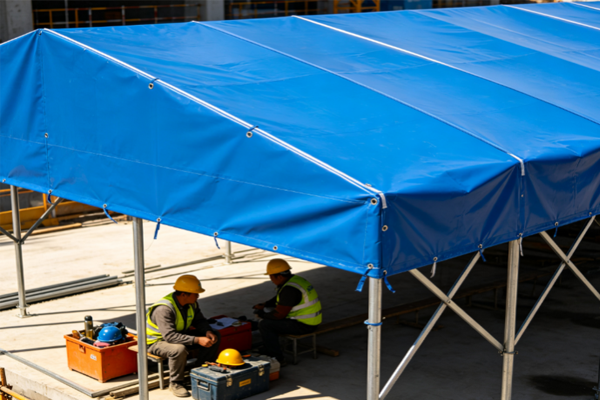
When summer arrives, one of the most uncomfortable places on a construction site is often not the office but the outdoor working area. Steel plates, concrete, machinery, and other materials can become extremely hot after long exposure to direct sunlight. Workers also need a place that can provide real protection from the sun when they take breaks, eat meals, or perform tasks that require temporary shade. A temporary shade shelter may seem simple—just a few steel pipes covered with a sheet of fabric—but there are several practical factors to consider. Fabric that is too thin can be easily damaged, incorrect dimensions can make installation difficult, and an improperly designed roof may collect rainwater. PVC fabric offers good weather resistance, waterproofing, and overall strength. It can be used for worker rest shelters, equipment shelters, material storage shelters, and temporary work areas, providing a practical shaded space on construction sites.
Shade requirements on construction sites are highly practical. It is not enough to simply build a shelter and consider the job finished. Workers need places to rest, equipment needs protection while parked, and some materials should not remain exposed to strong sunlight for long periods. Different areas have different requirements for fabric size, fixing methods, and service life. Before purchasing PVC fabric, it is more practical to determine exactly where it will be used rather than simply asking, “Which fabric is cheaper?” This can also help prevent problems caused by unsuitable dimensions or applications after the fabric arrives.
During summer construction, workers need a temporary rest area where they can avoid direct sunlight. This area is usually used every day, so the shelter fabric should provide more than shade. It should also be easy to secure, clean, remove, and reinstall. PVC fabric can be installed on steel pipes or other temporary frames to create a relatively stable overhead covering.
Suitable for construction worker rest areas;
Ideal for temporary lunch and break shelters;
Can be installed on steel pipe frames;
Can be removed and stored when not in use.
A rest shelter does not need to be overly complicated. As long as the roof provides stable shade, the sides allow sufficient airflow, and people can enter and exit easily, it can meet the basic requirements of daily use.
Excavators, forklifts, construction vehicles, and other equipment are often parked in outdoor areas. After prolonged exposure to sunlight, the surfaces of the equipment can become extremely hot, making them uncomfortable for operators to touch. For machinery that remains parked for extended periods, a PVC shade shelter can provide simple overhead protection.
Suitable for temporary construction equipment parking areas;
Can provide shade for forklifts and small equipment;
Can cover some construction vehicles;
Suitable for long-term construction projects.
The key purpose of an equipment shelter is not to completely enclose the machinery. Instead, it should provide sufficient overhead coverage while leaving enough space for workers to enter and for equipment to move.
Material Storage Areas Can Reduce Direct Sun Exposure
Pipes, timber, tools, and other construction supplies often need to be stored temporarily on construction sites. If these items remain exposed to strong sunlight for long periods, their surfaces can accumulate a significant amount of heat, making them less convenient for workers to handle. PVC fabric can be installed over a simple frame to provide a shaded storage area for construction materials.
One of the most common problems with shade shelters is that the site measurements do not match the actual installation requirements. Some buyers purchase fabric based only on the roof dimensions and later discover that there is not enough material along the edges for proper fixing. Others purchase fabric that is much larger than necessary as a precaution, only to find that it drags on the ground, obstructs movement, and wears out more quickly. PVC fabric specifications should be selected together with the frame dimensions, coverage area, and expected service period. Organizing these details before purchasing can save considerable time and effort later.
During installation, the fabric needs to cover the top of the frame while also leaving enough material along the edges for secure fixing. If the roof has a certain height or the sides also need to be covered, these requirements should be confirmed in advance.
Measure the actual length and width of the frame;
Confirm whether the sides also need to be covered;
Leave sufficient allowance for edge fixing;
Plan fixing points in advance for large shelter fabrics;
Provide detailed dimensions for irregular frames.
With properly planned dimensions, the PVC fabric can remain flat and properly tensioned after installation instead of being too tight on one side and too short on the other.
A temporary construction shelter may only be used for several weeks, while a shade shelter for a large building project may remain in service for several months. Different service periods naturally create different requirements for PVC fabric durability.
Short-term projects may place greater emphasis on installation and removal efficiency. Long-term projects should focus more on the effects of outdoor sunlight, wind, rain, and frequent use on the fabric. Providing the supplier with the expected service period in advance can make product selection more accurate.
Some purchasing personnel assume that thicker PVC fabric is automatically stronger and choose the highest specification available. However, excessively thick fabric can increase the overall weight, making installation, transportation, and removal more difficult.
For a small temporary shade shelter, there is usually no need to pursue an unnecessarily high specification. For a large fixed shelter, the fabric should be selected according to the fabric area, the load-bearing capacity of the frame, and the actual operating environment.
When construction companies purchase tarpaulins, PVC and Canvas are often compared together. In reality, the two materials can serve different construction needs. PVC is a preferred option for areas that require long-term fixed use and some degree of rain protection, while Canvas can be valuable for temporary coverings or areas where the shelter needs to be moved frequently. Companies do not need to use the same fabric throughout every area of a construction site.
PVC tarpaulins are well suited to shade shelters that remain on construction sites for extended periods. For projects with long construction schedules and shelters that do not need to be moved frequently, PVC fabric can be securely fixed to a stable frame.
Suitable for worker rest shelters;
Can be used for equipment parking shelters;
Suitable for temporary material storage shelters;
Can also provide basic rain protection.
If a construction site wants a shade shelter that can block sunlight and remain in place during ordinary showers, PVC fabric is a practical choice.
Canvas tarpaulins can be used for temporary work areas, short-term construction shelters, and locations that require frequent repositioning. Construction sites can change every day. An area may be used for material processing today and need to be cleared for the next construction stage a few days later.
In these situations, the tarpaulin should be easy to move and reinstall, making Canvas a flexible option.
Large construction projects do not need to use the same tarpaulin material in every area. Long-term and short-term application areas can be equipped separately.
Application Area | Main Requirements | Recommended Material | Key Considerations |
Worker rest shelter | Shade and rain protection | PVC | Coverage area and ventilation |
Construction equipment shelter | Shade and protection | PVC | Frame stability |
Material storage shelter | Shade and temporary rain protection | PVC | Drainage and fixing |
Temporary processing area | Shade and rain protection | PVC / Canvas | Installation convenience |
Short-term construction shelter | Flexible covering | Canvas | Mobility and removal |
Temporary tool area | Basic shade | Canvas | Lightweight handling |
This approach makes purchasing quantities, application areas, and future management clearer. It also prevents high-specification products from being used unnecessarily in temporary areas.
The performance of a shade shelter depends on more than the PVC fabric itself. Construction sites are often open and exposed to wind. When wind enters from underneath the shelter, the fabric can experience considerable pulling force. If the edges are not properly secured or the frame itself is unstable, the shelter may need to be adjusted whenever the weather changes. During installation, the fabric, fixing points, and frame should form a properly designed structure rather than simply placing the fabric over the frame.
Large PVC fabrics can be significantly affected by wind. Securing only the four corners does not necessarily make the entire shelter stable. Sufficient fixing points should be arranged along the edges according to the actual dimensions.
Secure the four corners carefully;
Add intermediate fixing points along the longer edges;
Avoid placing eyelets in areas exposed to excessive stress;
Check whether the fabric remains flat after fixing.
When the fixing points are properly arranged, the load on the PVC fabric is distributed more evenly, reducing the risk of repeated pulling at a single location during daily use.
If the frame moves noticeably, even strong fabric will not perform effectively. Small shade shelters can use simple structures, while larger shelters require sufficient roof support and reliable connections between the posts and the frame.
For large construction-site shade shelters, it is not enough to consider whether the frame can support the fabric. The overall structure must also remain stable. Excessive movement can reduce the effectiveness of the shade and create additional safety risks during use.
PVC fabric can provide rain protection, but if the roof is completely flat, rainwater can collect in the center. As the water accumulates, it can cause the fabric to sag and increase the load on the frame. During installation, the roof should therefore have an appropriate slope so that rainwater can drain away naturally. This allows the shelter to provide shade during sunny weather and remain usable during rain, improving its overall practicality.
Construction sites often purchase PVC fabric in batches, and site conditions can vary significantly from one project to another. In addition to specifications and price, transportation, fabrication, installation, and later storage should also be considered in advance. For construction companies that need to reuse their shelters over the long term, arranging temporary purchases and fabrication for every project can gradually increase labor and time costs. A clear purchasing process can make future use much easier.
Organize the dimensions of commonly used shade shelters and identify which are fixed shelters and which are temporary shelters. For large projects, it is also useful to estimate the amount of fabric required for different areas in advance.
PVC fabric may require edge reinforcement, eyelets, additional strengthening, or production according to special dimensions. Communicating the installation method during the purchasing stage allows the fabric to be installed more directly after delivery.
After a project is completed, PVC fabric without significant damage can be cleaned, dried, and stored properly for use on another project. During removal, avoid dragging the fabric across sharp surfaces. During storage, do not mix it with metal scraps, tools, or other objects that could cause damage.
For companies that undertake construction projects over the long term, a batch of reusable shade tarpaulins often provides greater practical value than low-cost products designed for one-time use.
A construction-site shade shelter may seem like a simple solution to excessive sunlight, but practical use also requires consideration of fabric specifications, fixing methods, drainage, ventilation, and future reuse. PVC tarpaulins are suitable for worker rest shelters, equipment shelters, and material storage shelters in construction projects, while also providing a certain level of rain protection. Canvas tarpaulins are more suitable for temporary areas that need to be moved frequently. NEWSTAR PLASTIC INDUSTRY CO., LTD. supplies PVC and Canvas tarpaulins for construction, agriculture, aquaculture, ventilation engineering, and other outdoor covering applications.
