
Hot Keywords:
- All
- Product Name
- Product Keyword
- Product Model
- Product Summary
- Product Description
- Multi Field Search

Outdoor storage tents are exposed to rain, sunlight, windblown sand and dust, and temperature changes for long periods. PVC materials provide rain protection, sun protection and enclosure, while also affecting the service life and maintenance costs of the tent. Different storage applications have different requirements for material weight, tear resistance, weather resistance, flame retardancy and processing performance. Focusing only on thickness or low price can easily lead to improper material selection. Properly matching PVC tent materials with the structure, environment and service life can improve the stability and practicality of outdoor storage spaces.
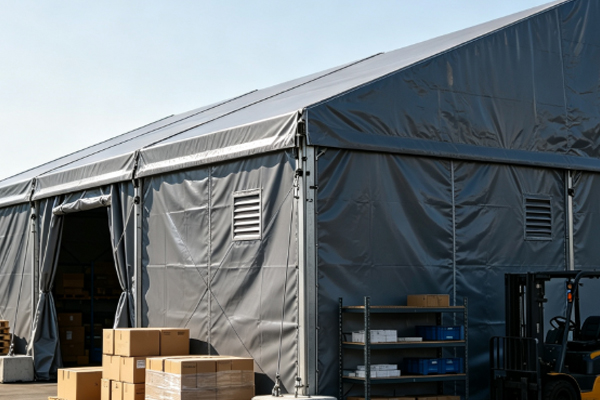
Storage tents are exposed to outdoor conditions for long periods, so material performance directly affects their protective performance. PVC tarpaulins are generally made of polyester base fabric and PVC coating, with different performance options available according to application requirements.
Outdoor storage mainly requires rain protection, sun protection and resistance to aging.
Waterproofing: The PVC coating can form a waterproof layer suitable for tent roofs and sidewalls.
UV resistance: Long-term exposure to sunlight accelerates aging, so UV-resistant materials can be selected for areas with strong sunlight.
Weather resistance: The material should be able to withstand high temperatures, low temperatures and rainfall.
Mildew resistance: In humid environments, mildew-resistant materials can be selected to reduce mold growth.
PVC tarpaulin selection should not focus only on waterproofing performance. Long-term outdoor use requirements should also be considered.
Purchasers should not judge PVC materials solely by the idea that “the thicker, the more durable,” because tent performance is also related to span, wind load, fixing methods and processing techniques. Material selection should consider base fabric strength, PVC coating thickness, overall weight, tear resistance, abrasion resistance, seam strength and weather resistance. The appropriate specification should be determined according to the tent structure and actual operating environment rather than a single weight indicator.
Different storage applications expose tents to different environmental pressures. Temporary transfer warehouses, long-term storage tents and large logistics warehouses should not necessarily use exactly the same material configuration.
Before selecting materials, applications can be classified according to service life, storage scale and site conditions, after which the key performance requirements can be determined.
Outdoor Storage Scenario | Main Environmental Pressure | Key PVC Material Requirements | Supporting Design |
Short-term temporary storage | Rainfall, handling abrasion | Waterproofing, tear resistance, easy processing | Quick installation and easy dismantling |
Medium- to long-term storage tent | Sunlight, rainwater, wind load | Waterproofing, weather resistance, UV resistance, abrasion resistance | Stable fixing and regular inspection |
Large-span storage tent | Wind load, structural tension | High strength, tear resistance, seam strength | Reinforcement of edges and load-bearing areas |
Logistics transfer warehouse | Frequent access, friction | Abrasion resistance, tear resistance, flexibility | Reinforcement of curtains and openings |
Equipment storage tent | Rainwater, dust, sunlight | Waterproofing, weather resistance, aging resistance | Continuous enclosure of sidewalls and roof |
Storage area with fire safety requirements | Fire risk | Flame-retardant PVC material meeting project requirements | Relevant test reports and compliance documents |
PVC materials can be enhanced with UV resistance, flame retardancy, antistatic properties and other functions according to the application. However, the specific grade should be determined according to project standards, and one performance configuration should not be applied directly to all storage tents.
Large storage tents cover extensive areas. During procurement, attention should be paid to the width, weight, thickness, tear resistance, weather resistance, UV resistance and abrasion resistance of the PVC tarpaulin. The appropriate specification should be determined according to the tent span, structural design, wind load and service life. Reducing the number of on-site seams as much as possible can improve production and installation efficiency.
PVC materials provide waterproofing and certain mechanical properties. However, water leakage, bulging or edge tearing does not necessarily indicate insufficient material quality. The installation structure also affects the overall performance.
Large tents usually require PVC materials to be cut, joined and heat-welded. Seam quality affects the overall waterproofing performance. During processing, attention should be paid to the following:
Use stable heat-welding processes;
Reduce unnecessary seams on the roof;
Reinforce doors, windows, corners and openings;
Strengthen edge structures;
Check the continuity and sealing performance of welded seams.
The combination of PVC coating and high-strength polyester base fabric provides a certain level of strength while also facilitating the production of large tarpaulin structures.
When outdoor tents are exposed to strong winds, simply increasing material thickness is not enough. Edges, corners, eyelets and fixing points must also be reinforced. During installation, particular attention should be paid to the following:
Reinforce edges and corners;
Arrange fixing points reasonably according to the tent area;
Locally reinforce eyelet areas;
Reduce direct friction between sharp components and the PVC surface;
Regularly inspect ropes, fasteners, welded seams and fixing structures;
After strong winds, check whether the material has stretched, torn or deformed.
Material strength, edge treatment and fixing structures should be designed as an integrated system to reduce the risk of damage during long-term outdoor use.
The purchase cost of an outdoor storage tent is only the initial investment. Installation, maintenance, cleaning, replacement and repair costs will also arise during use. PVC material selection should therefore be evaluated based on the entire service life.
For tents intended for long-term use, attention should be paid to the PVC material’s resistance to sunlight, rain, folding and abrasion. During procurement, the following items can be confirmed:
Weight and thickness;
Base fabric strength;
Waterproofing, tear resistance and abrasion resistance;
UV resistance and weather resistance;
Mildew resistance and aging resistance;
Flame-retardant or antistatic requirements;
Welded seam strength;
Applicable temperature range.
PVC tarpaulins are generally available in different weights, widths and thicknesses, with optional functions such as UV resistance, flame retardancy and antistatic treatment. The specific configuration should be determined according to project requirements.
To avoid a mismatch between material specifications and tent requirements, the following information should be confirmed before procurement:
Tent dimensions, span and installation method;
Operating environment and expected service life;
Local sunlight, rainfall and wind conditions;
PVC material weight, thickness, width and base fabric specifications;
Waterproofing, weather resistance, UV resistance, abrasion resistance and tear resistance requirements;
Whether flame-retardant or antistatic treatment is required;
Requirements for edge reinforcement, eyelets and heat welding;
Whether sample testing is required in advance.
Confirming these parameters in advance can reduce the need for later modifications and material replacement.
In actual procurement, PVC tarpaulin specifications should be determined according to the tent dimensions, service life, site conditions and functional requirements. Newstar Plastic Industry Co.,Ltd. can provide PVC tarpaulins and PVC-coated fabrics with different weights, widths and performance configurations, while also supporting customized material specifications and processing solutions to help customers plan the complete process from material selection to finished-product application.
