
Hot Keywords:
- All
- Product Name
- Product Keyword
- Product Model
- Product Summary
- Product Description
- Multi Field Search
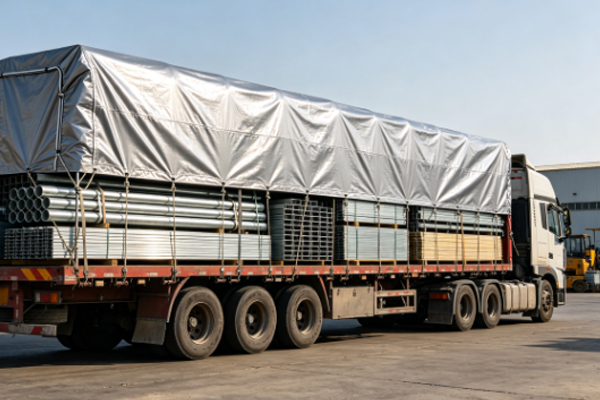
Building materials often need to be transported between factories, warehouses, construction sites, distribution centers, and commercial projects. During road transportation, many materials are exposed to rain, dust, mud splashes, sunlight, and mechanical friction. Cement bags, steel products, pipes, timber, insulation materials, panels, tiles, packaged hardware, and other construction products may experience moisture, contamination, surface damage, or packaging deterioration if they are not properly covered. PVC tarpaulin provides a flexible external protection system for open freight vehicles, flatbed trucks, trailers, and construction logistics vehicles. Its woven fabric substrate combined with a PVC coating provides useful tensile strength, waterproofing, weather resistance, and abrasion resistance for demanding outdoor transportation conditions. The tarpaulin can also be customized according to cargo dimensions, vehicle structures, fixing points, and transportation requirements. With reinforced edges, eyelets, heat-welded seams, ropes, tensioners, and other fastening components, PVC tarpaulin can create a stable protective layer around building materials. This makes it suitable for construction material logistics where reliable covering, repeated use, convenient handling, and adaptable dimensions are required.
Building material transportation often involves heavy, oversized, irregularly shaped, or packaged cargo. PVC tarpaulin should therefore be selected according to the cargo characteristics rather than using a single standard specification for every shipment. The fabric substrate provides the basic tensile structure, while the PVC coating helps protect the surface against rainwater, dust, and outdoor exposure. For heavy building materials, reinforced PVC tarpaulin can be equipped with stronger edge webbing and durable eyelets to withstand repeated fastening. Heat-welded seams can create larger continuous sheets for covering wide cargo platforms. For materials with sharp edges, protective pads can be positioned between the cargo and tarp to reduce abrasion during vehicle movement. The tarp dimensions should also provide enough allowance for securing the material without creating excessive loose sections. A carefully designed combination of material specification, dimensions, reinforcement, and fastening structure can improve cargo protection during long-distance building material transportation.
Rain and dust are common challenges during construction material logistics. Cement products and certain packaged materials can be particularly sensitive to moisture, while boards, panels, metal products, and finished construction components may require protection from road dust and mud. PVC tarpaulin creates an external covering layer that helps separate the cargo from direct exposure to rain and airborne contaminants. When properly installed, water can flow across the tarp surface toward the edges instead of remaining on top of the cargo. A suitable covering configuration can also reduce the amount of dust settling directly onto exposed materials during transportation. For building materials moving between warehouses and construction sites, this protection can help maintain cleaner cargo surfaces and reduce the possibility of packaging contamination.
Different construction products place different demands on transportation tarpaulins. Cement bags may require strong rain protection, steel products can create abrasion around sharp edges, and pipes may require larger covering dimensions because of their length. Timber and boards may need protection against rain and dust, while packaged hardware can benefit from complete external coverage. The selected PVC tarpaulin should consider cargo weight, shape, dimensions, transportation distance, loading frequency, and expected environmental conditions. Heavy-duty material can be used for demanding applications, while lighter specifications may be preferred when manual handling and frequent removal are priorities.
Building Material | Recommended PVC Tarpaulin Use | Main Protection Requirement | Design Consideration |
Cement and Bagged Materials | Full Top and Side Cover | Moisture Protection | Waterproof Coverage |
Steel Products | Reinforced Cargo Cover | Rain and Abrasion Protection | Edge Reinforcement |
Pipes | Large-Size Cover | Rain and Dust Protection | Extended Dimensions |
Timber | Full Surface Cover | Moisture and Dust Protection | Complete Coverage |
Boards and Panels | Flat Top Cover | Rain and Surface Protection | Smooth Contact |
Insulation Materials | Protective Cover | Moisture and Contamination Protection | Gentle Handling |
Tiles | Cargo Cover | Dust and Rain Protection | Secure Fastening |
Hardware Packages | Enclosed Top Cover | Water and Dust Protection | Compact Fixing |
Large construction cargo may require PVC tarpaulins much larger than standard sheet sizes. Heat-welding technology allows separate material sections to be joined into larger continuous covers, helping reduce unnecessary gaps between panels. Reinforced edges can distribute tension around the perimeter, while eyelets provide convenient connection points for ropes and tensioners. Areas that experience frequent fastening can also use additional webbing or reinforcement patches. For building material transportation, these structural details are particularly useful because cargo can be heavy and the tarp may need to be installed and removed repeatedly. A correctly reinforced tarp can provide better stability and reduce damage caused by concentrated tension around individual eyelets.
PVC tarpaulin can be used during different stages of building material logistics, including factory dispatch, warehouse transfer, regional delivery, long-distance transportation, construction site delivery, and temporary outdoor storage. The installation method should be selected according to the cargo shape and the vehicle structure. Before covering the materials, workers should check whether sharp corners, protruding steel components, nails, straps, or other objects could damage the tarp. Protective pads can be added to high-friction locations. After the tarp is spread over the cargo, the edges should be connected to appropriate vehicle fixing points. The tension should be adjusted gradually to create stable coverage without placing excessive stress on the material. For cargo that requires ventilation, the covering system should allow suitable airflow while still providing the required rain and dust protection.
A practical installation procedure helps improve the stability of the cargo cover and reduces damage caused by improper fastening. The following steps can be incorporated into regular loading operations:
Inspect the cargo: Check building materials for sharp corners, protruding metal, broken packaging, and other conditions that may damage the tarp.
Prepare contact protection: Place suitable protective pads between sharp cargo edges and the PVC tarpaulin.
Check the tarp dimensions: Confirm that the tarp provides sufficient coverage for the cargo length, width, and height.
Spread the tarp: Position the material evenly over the cargo and make sure important areas are fully covered.
Align the fixing points: Match eyelets and reinforced sections with the vehicle’s ropes, hooks, tensioners, or other fastening locations.
Secure the tarp gradually: Fasten both sides progressively instead of applying excessive tension to only a few points.
Adjust the top shape: Avoid deep depressions that could collect rainwater during transportation.
Inspect before departure: Check edges, eyelets, ropes, tensioners, and clearance around wheels and other vehicle components.
A final inspection before the vehicle leaves the loading area can help ensure that the PVC tarpaulin remains properly positioned and that the building materials are adequately covered.
PVC tarpaulin is suitable for many construction logistics environments. Flatbed trucks can use large sheets to cover steel beams, pipes, boards, timber, and other open cargo. Sideboard trucks can use the existing side structure to support the edges of the tarp. Construction site delivery vehicles can use customized covers to protect materials during transportation between distribution centers and project locations. Warehouses may also use PVC tarpaulin temporarily when building materials need to remain outdoors during loading, unloading, or short-term staging. Industrial suppliers can prepare different tarp sizes for different material categories, improving operational efficiency when multiple types of construction products are transported on a regular basis. For oversized cargo, customized tarpaulins can be fabricated according to the actual dimensions and fixing requirements.
Building material protection does not end when the truck begins moving. During loading and unloading, tarpaulins can be exposed to dragging, contact with forklifts, metal edges, and repeated folding. Proper handling can reduce unnecessary wear. After unloading, a PVC tarp can also be used for temporary outdoor protection when construction materials cannot immediately be moved indoors. The tarp should be arranged so that rainwater does not collect directly on top of the materials. Adequate ventilation should be considered for materials that should not remain in a sealed environment for extended periods. Once temporary protection is no longer required, the tarp should be cleaned, dried, folded, and stored in a suitable location.
PVC tarpaulin offers a reusable and customizable approach to construction material logistics protection. Its waterproof coating, textile reinforcement, flexible dimensions, and available reinforced structures make it suitable for many outdoor freight applications. Unlike disposable plastic covers, PVC tarpaulin can be fabricated for repeated use and equipped with fastening structures that correspond to specific vehicles. Logistics companies can select different specifications according to cargo weight, dimensions, transportation frequency, weather conditions, and handling requirements. The material can also be produced in different colors and customized sizes, allowing companies to create dedicated covers for specific fleets or material categories. When combined with proper fastening and maintenance, PVC tarpaulin can provide consistent external protection for construction materials throughout repeated transportation cycles.
Construction materials can travel through changing weather conditions during regional or long-distance delivery. Rainwater may damage packaging, contaminate surfaces, or affect materials that should remain dry. Road dust and mud can also accumulate on exposed cargo. PVC tarpaulin forms a protective barrier above the materials and helps reduce direct contact with these external contaminants. Complete coverage, suitable tarp dimensions, and correct fastening are important for achieving effective protection. For materials with strict moisture requirements, additional packaging or specialized transport systems may still be necessary depending on the cargo specifications.
Construction materials often include steel, pipes, timber, panels, and other products with hard or angular surfaces. During vehicle movement, repeated vibration may cause the tarp to rub against these surfaces. PVC tarpaulin with suitable fabric strength and reinforced edges can withstand regular handling and transportation conditions. Protective pads should still be used around sharp corners and high-friction locations. Reinforced eyelets and webbing can distribute fastening loads and reduce localized stress. This combination is useful for logistics fleets that frequently transport heavy construction materials over long distances.
Construction cargo rarely has identical dimensions across every shipment. PVC tarpaulin can be manufactured according to cargo length, width, height, vehicle structure, and fixing-point layout. Eyelets can be placed at specified intervals, while reinforced webbing can be added to sections exposed to greater tension. Heat-welded seams can also be used to manufacture large covers for oversized cargo. Customized dimensions reduce unnecessary exposed areas and help improve the compatibility between the tarp and the vehicle. For companies transporting several categories of building materials, different tarp specifications can be prepared for individual cargo types.
Building material transportation is often a continuous process involving repeated dispatches between suppliers, warehouses, distributors, and construction sites. A reusable PVC tarpaulin can be removed, folded, transported back, and installed again for another shipment. Proper cleaning and drying after use can help maintain its surface condition. Regular inspection of seams, edges, eyelets, and fixing accessories can identify damage before it affects a subsequent delivery. For logistics operators with frequent transportation requirements, reusable tarpaulins can provide a practical long-term covering solution.
PVC tarpaulin can be used for urban construction logistics, regional distribution, long-distance freight, industrial material transportation, warehouse transfers, and construction site delivery. Each environment may require a different tarp specification. Dust-heavy construction routes may require stronger external coverage, while rainy regions may prioritize waterproofing and drainage. Heavy steel products may require reinforced edges and protective padding, while lightweight packaged goods may prioritize easy handling. The flexibility of PVC tarpaulin allows the material specification, dimensions, reinforcement, and fastening system to be selected according to actual operating conditions.
For logistics companies and construction material suppliers looking for PVC building material tarpaulin, PVC truck tarpaulin, construction cargo covers, waterproof PVC tarps, heavy-duty transportation tarpaulins, building material protection covers, or custom PVC cargo tarps, products can be customized according to vehicle dimensions, cargo size, material type, transportation distance, weather conditions, and fastening requirements.
WeChat: 0086-13921439224
Email: tarp@newstarventilation.com
If you need PVC tarpaulin for building material transportation, please provide the vehicle dimensions, cargo type, cargo size, expected coverage area, transportation distance, and preferred fastening method. We can recommend suitable PVC tarpaulin specifications, dimensions, reinforced structures, eyelet layouts, and installation methods to help establish a durable, reusable, and practical protection system for construction material logistics
