
Hot Keywords:
- All
- Product Name
- Product Keyword
- Product Model
- Product Summary
- Product Description
- Multi Field Search

Goods in logistics and warehousing often face temporary storage, outdoor transfer, and warehouse expansion. Especially during the rainy season or long-term outdoor storage, rainwater, dust, ultraviolet rays, and strong winds may affect the packaging and storage condition of goods. PVC tarpaulin covering is a flexible protection method, but its actual performance depends not only on the tarpaulin itself, but also on the type of goods, covering dimensions, drainage design, fixing methods, and daily maintenance. Only by developing a reasonable PVC tarpaulin covering solution for different warehousing scenarios can companies balance cargo protection, loading and unloading efficiency, and operating costs.
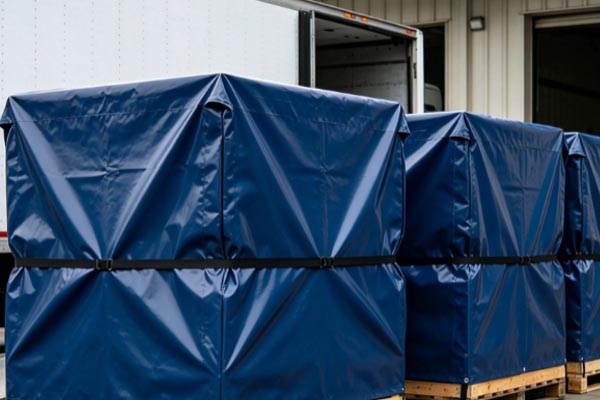
The storage environment of logistics and warehouse goods varies considerably. From short-term transit to long-term outdoor storage, the requirements for covering materials also differ. Selecting suitable PVC tarpaulin can provide goods with an additional layer of reliable outdoor protection.
Goods stored outdoors are easily affected by rainfall, dust, sand, and falling leaves.
Covering the tops of goods with waterproof PVC tarpaulin can reduce direct exposure to rainwater.
For large cargo piles, overall covering can be used to reduce partially exposed areas.
Additional side protection can be added according to the site environment to reduce the attachment of dust and debris.
During covering, the tarpaulin should form a suitable slope so that rainwater can drain toward both sides.
Rain and dust protection in logistics and warehousing should focus not only on the covering condition, but also on the coverage area and drainage performance.
Logistics operations are subject to significant fluctuations. During peak-season stocking, warehouse renovation, or temporary transfer, indoor space may not be sufficient for all storage needs. PVC tarpaulin covering solutions can be used for:
Temporary outdoor storage yards;
Warehouse expansion areas;
Goods in logistics transit;
Temporary storage of engineering materials.
Flexible outdoor covering methods can help companies cope with temporary storage space pressure while reducing the investment required to construct permanent storage facilities.
Tarpaulin is not necessarily better simply because it is thicker, and a lower price does not always mean better value. The appropriate material specifications should be selected based on the type of goods, storage period, coverage area, and local environmental conditions.
Different goods have different requirements for PVC tarpaulin. Before purchasing, companies should first identify the main issues that need to be addressed.
Warehouse Goods and Scenarios | Main Environmental Risks | Key PVC Tarpaulin Performance | Recommended Covering Method |
Cartons and packaged goods | Rainwater, moisture, dust | Waterproof, weather-resistant | Overall covering |
General finished goods | Rainwater, dust | Waterproof, dustproof | Top + sides |
Machinery and equipment | Rainwater, dust, friction | Waterproof, tear-resistant, wear-resistant | Customized covering |
Engineering materials | Wind, rain, wear | High strength, weather-resistant | Heavy-duty tarpaulin covering |
Palletized goods | Rainwater, ground moisture | Waterproof, wear-resistant | Top covering + bottom isolation |
Long-term outdoor goods | UV rays, wind, rain, aging | UV-resistant, weather-resistant, tear-resistant | Reinforced overall covering |
Determining material performance according to the characteristics of the goods can reduce cost waste caused by insufficient protection or excessive specifications.
Short-term turnover and long-term outdoor storage have different requirements for PVC tarpaulin. In addition to measuring the length, width, and height of the cargo pile, the following factors should also be considered:
The extra allowance required for fixing the tarpaulin edges;
The slope needed to create drainage at the top;
Whether the goods have protruding parts;
Whether frequent removal and installation will be required later.
Making dimensional plans in advance helps improve covering efficiency and long-term performance.
A practical PVC tarpaulin covering solution should consider rain protection, drainage, fixing, and daily loading and unloading at the same time. The tarpaulin should not simply be laid over the goods.
The covering methods for regular goods and irregular equipment are different. Palletized goods can be covered according to the overall dimensions of multiple pallets.
Small goods can be covered individually for convenient classification and management.
Multiple pallets are suitable for overall covering, reducing the number of tarpaulins required.
Large equipment can be customized according to its height and protruding parts.
Large storage yards can be covered by zones to facilitate subsequent loading and unloading.
Matching the tarpaulin dimensions with the cargo stacking method can improve covering completeness.
Rain protection should minimize the time rainwater remains on the tarpaulin surface. During installation, top depressions should be avoided. A slope can be created through the shape of the cargo pile or by using supports, allowing rainwater to drain naturally. In response to outdoor wind, the edges and fixing points should be reinforced. Binding, weighting, or anchoring can be used, and additional fixing points should be added where appropriate to prevent concentrated stress. When large tarpaulins are joined together, the seams should be properly sealed and the processing quality should be reliable.
After tarpaulin selection and installation are completed, subsequent maintenance will also affect actual performance. Proper management can reduce unexpected damage and help control long-term warehouse protection costs.
PVC tarpaulin used outdoors for extended periods should be inspected according to the actual frequency of use, especially after strong winds, heavy rain, and other severe weather. The following areas should be checked carefully:
Fixing points at the four corners and along the edges;
Whether the tarpaulin surface has been damaged;
Whether there are abnormalities in the seams;
Whether water has accumulated on the top;
Whether the tarpaulin has shifted significantly.
Top tarpaulin covering provides rain protection but cannot completely prevent moisture from affecting the goods. When goods are placed directly on the ground, standing water and moisture may affect the packaging from below.
When selecting PVC tarpaulin, logistics companies should not compare only the price per square meter. The material’s service life, number of reuses, maintenance requirements, and labor costs for installation and removal are also part of the actual cost. For long-term outdoor storage, attention should be paid to:
The weather resistance of the PVC tarpaulin;
UV and aging resistance;
Tear resistance and wear resistance;
Suitability for repeated installation and removal;
Convenience of subsequent maintenance.
Evaluating material value over the entire service life and establishing standardized use and storage management practices are more conducive to controlling the overall protection costs of logistics and warehouse goods.
In logistics and warehousing scenarios, cargo covering needs to balance protection performance, operational convenience, and subsequent maintenance costs. Properly configuring the specifications, weight, width, and fixing methods of PVC tarpaulin can enhance overall rain and dust protection while reducing additional expenses caused by frequent replacement. Newstar Plastic Industry Co.,Ltd. specializes in the research, development, and production of PVC tarpaulin, PVC-coated fabrics, and outdoor protection materials. Based on the needs of various application scenarios, the company can provide customized materials and supporting solutions to help customers improve the stability and efficiency of cargo covering.
