
Hot Keywords:
- All
- Product Name
- Product Keyword
- Product Model
- Product Summary
- Product Description
- Multi Field Search
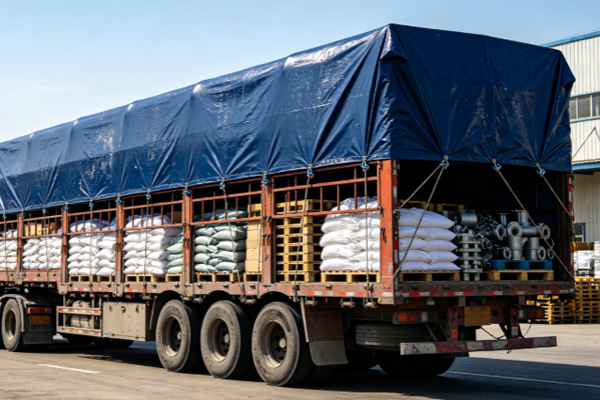
Heavy-duty trucks are widely used for long-distance freight, industrial transportation, machinery delivery, steel logistics, construction equipment transportation, and bulk cargo distribution. Compared with ordinary freight vehicles, heavy-duty trucks often carry larger and heavier loads and travel for longer periods under complex road and weather conditions. During transportation, cargo may be exposed to rain, dust, strong sunlight, wind, mud splashes, and continuous vibration. An unsuitable cover can easily become loose, damaged, or displaced, leaving cargo partially exposed and increasing the risk of contamination or moisture penetration. PVC tarpaulin provides a practical covering solution for heavy-duty truck transportation because it combines a woven textile substrate with a PVC coating, offering useful tensile strength, waterproof performance, weather resistance, and abrasion resistance. The material can be manufactured in large dimensions and customized with reinforced edges, eyelets, webbing, heat-welded seams, ropes, buckles, and tensioning systems. This allows the tarp to be matched to different heavy-duty truck structures and cargo configurations. With appropriate material selection, installation, and maintenance, PVC tarpaulin can provide a stable reusable cover for demanding freight operations.
Heavy-duty truck tarpaulins need to withstand repeated installation, strong airflow, vehicle vibration, friction, and changing outdoor conditions. PVC tarpaulin normally uses a woven fabric base to provide structural strength and a PVC coating to improve waterproofing and surface protection. The material specification can be selected according to cargo weight, vehicle dimensions, transportation frequency, climate, and expected service conditions. For heavy-duty applications, reinforced PVC tarpaulin can be equipped with additional webbing around the perimeter and at high-stress areas. Eyelets can be installed at suitable intervals to distribute fastening loads more evenly. Large tarpaulins may use heat-welded seams to create wide continuous covering surfaces. For cargo with sharp corners or rough surfaces, protective pads should be placed between the cargo and tarp to reduce direct friction. A suitable combination of material strength, dimensions, reinforcement, and fastening components can improve the stability of the cover during long-distance transportation.
Heavy-duty freight vehicles frequently operate in outdoor environments where the tarp may experience rain, sunlight, wind, dust, and temperature changes. PVC tarpaulin provides an external protective layer that helps reduce direct exposure to these conditions. The woven substrate supports tensile performance, while the PVC coating contributes to waterproofing and surface durability. For long-distance routes, selecting a specification suitable for repeated outdoor use is important. Reinforced edges can help withstand frequent tensioning, while reinforced eyelet areas can improve fastening durability. The actual service life of a tarp depends on material quality, loading conditions, frequency of use, storage practices, and exposure to harsh environments.
Heavy-duty trucks commonly carry large equipment, machinery, steel products, industrial components, pipes, timber, construction equipment, and other oversized cargo. Standard-size covers may not provide adequate coverage for such loads. Large PVC tarpaulins can be manufactured according to the actual cargo dimensions and vehicle structure. Additional material allowance can be provided around the edges to facilitate fastening. For tall or irregular loads, customized shapes can improve coverage and reduce exposed sections. Heat-welded seams can be used when a large continuous tarp is required. Customization also allows eyelet positions and reinforced sections to be arranged according to the truck’s fixing system.
Heavy-Duty Truck Application | Typical Cargo | Main Protection Requirement | PVC Tarpaulin Design |
Industrial Freight | Machinery and Components | Rain and Dust Protection | Reinforced Large Cover |
Steel Transportation | Steel Products and Pipes | Moisture and Abrasion Protection | Heavy-Duty Material |
Equipment Delivery | Large Machinery | Weather and Surface Protection | Customized Dimensions |
Construction Logistics | Equipment and Materials | Rain, Dust, and Mud Protection | Reinforced Edges |
Timber Transportation | Timber and Boards | Moisture Protection | Large Coverage Area |
Long-Distance Freight | Mixed Cargo | Comprehensive Outdoor Protection | Heavy-Duty PVC Tarp |
The edge structure is an important part of a heavy-duty truck tarpaulin because fastening forces are concentrated around the perimeter. Reinforced webbing can strengthen the edge, while eyelets provide connection points for ropes, hooks, buckles, and tensioners. Heat-welded seams can provide strong connections between PVC-coated fabric sections when manufacturing large covers. Additional reinforcement patches may be added to frequently used fastening areas. These structural details can make the tarp more suitable for repeated loading and unloading operations. When the tarp is installed, fastening tension should be distributed across multiple fixing points rather than concentrated on only a few eyelets.
Correct installation is essential for maintaining stable cargo coverage during heavy-duty truck transportation. After loading, the cargo should be checked for sharp edges, protruding components, unstable packaging, and surfaces that could damage the tarp. Protective pads can be placed at high-friction points before covering. The tarp should then be spread evenly over the cargo, ensuring that the main exposed areas are covered. The edges should be connected to suitable fixing points using ropes, hooks, buckles, tensioners, or other compatible hardware. The tarp should be tightened progressively from multiple points to create balanced tension. Excessively loose material may flap under high-speed airflow, while excessive tension can place unnecessary stress on eyelets and reinforced sections. The final installation should also maintain safe clearance from wheels, exhaust components, braking systems, lights, and other vehicle equipment.
A consistent installation process can improve the reliability of the cargo cover and reduce unnecessary material damage. The following steps can be incorporated into regular heavy-duty freight operations:
Inspect the load: Check cargo stability, sharp corners, protruding components, and exposed surfaces before covering.
Protect vulnerable areas: Use protective pads around steel edges, machinery corners, and other high-friction contact points.
Select the correct tarp: Confirm that the PVC tarpaulin is large enough to cover the cargo and provide sufficient fastening allowance.
Spread the material: Position the tarp evenly across the load without creating unnecessary folds or concentrated stress.
Connect the fixing points: Attach eyelets, ropes, hooks, buckles, and tensioners according to the truck’s fastening configuration.
Balance the tension: Tighten the tarp progressively across both sides to avoid excessive load on individual fixing points.
Check the top surface: Prevent large depressions that may collect rainwater during transportation.
Perform a safety inspection: Make sure no tarp section, rope, or fastening accessory can contact moving vehicle components.
A final check before departure helps ensure that the tarp remains secure and provides continuous coverage throughout the journey.
PVC tarpaulin can be used for a broad range of heavy-duty freight applications. Industrial trucks can cover large machinery and equipment during transportation between manufacturing facilities and project locations. Steel logistics vehicles can use reinforced tarpaulins to protect steel products, pipes, profiles, and other metal cargo from rain and road contamination. Construction equipment transporters can use customized covers for machinery and oversized components. Timber and board transportation can also benefit from large waterproof covers when cargo is temporarily exposed to outdoor conditions. Long-distance freight fleets carrying mixed industrial goods can prepare different tarp sizes according to vehicle type and cargo configuration. For specialized loads, customized tarpaulins can include specific fastening points and reinforcement zones to match the actual vehicle structure.
Heavy-duty tarpaulins are often exposed to demanding handling conditions during loading and unloading. Workers may pull the material across cargo surfaces, fold it repeatedly, or reposition it around large equipment. Dragging the tarp directly across sharp steel surfaces can cause abrasion and should be avoided whenever practical. During unloading, the tarp should be removed in a controlled manner instead of allowing it to fall onto rough ground. Forklifts, cranes, hooks, and other loading equipment should be kept away from the fabric whenever possible. After removal, the tarp can be cleaned, dried, folded, and stored for the next transportation task. Proper handling helps reduce unnecessary wear and supports repeated use.
PVC tarpaulin is well suited to heavy-duty freight because it can combine large-area coverage with flexible customization and reusable construction. The PVC-coated fabric can provide useful waterproofing and outdoor protection, while the woven substrate contributes to tensile performance. Reinforced edges, eyelets, webbing, and heat-welded seams can be incorporated according to the expected loads and fastening configuration. Heavy-duty trucks often operate on long routes and encounter different weather conditions, so a reusable cover that can be removed and installed repeatedly is valuable for logistics operations. Customized dimensions also allow the same material concept to be adapted to flatbed trucks, trailers, machinery transporters, and other large freight vehicles.
Heavy industrial cargo may remain exposed to outdoor conditions during transportation, loading, temporary parking, and unloading. Rainwater can affect packaging and certain cargo surfaces, while road dust and mud may contaminate exposed products. PVC tarpaulin creates an external covering layer above the cargo and helps reduce direct contact with rain and airborne contaminants. Proper installation is important because exposed gaps, loose edges, and poorly positioned sections can reduce the effectiveness of the cover. For cargo with strict environmental requirements, PVC tarpaulin can be combined with appropriate packaging or specialized protection systems.
Heavy-duty freight creates more demanding requirements for cargo covers because large loads can create high contact pressure and greater movement during transportation. PVC tarpaulin with suitable fabric strength and reinforced construction can be selected for these conditions. Reinforced edges and webbing help support fastening areas, while protective pads can reduce friction against rough cargo surfaces. The tarp should still be installed according to its intended load and application conditions rather than being treated as a structural restraint for the cargo itself. Cargo securing must be handled using appropriate load-securing equipment and procedures.
Heavy-duty vehicles vary considerably in platform dimensions, side structures, cargo height, and fixing configurations. PVC tarpaulin can be manufactured according to these requirements, including customized length, width, edge reinforcement, eyelet spacing, and seam configuration. Large covers can be produced for oversized machinery, while smaller custom tarps can be prepared for specific cargo categories. Customization also makes it possible to match the fastening points with existing truck hardware, improving installation convenience and reducing unnecessary loose material.
Heavy-duty logistics fleets often perform repeated transportation tasks, making reusable cargo covers more practical than disposable materials. PVC tarpaulin can be unfolded, installed, removed, folded, and stored repeatedly when properly handled. Regular inspection can identify damaged eyelets, worn edges, seam issues, and surface abrasion before the tarp is used again. Cleaning and complete drying after exposure to rain or mud can also support proper storage. When maintained correctly, reusable PVC tarpaulins can become a practical component of regular freight operations.
Long-distance freight routes can involve highways, industrial areas, construction zones, warehouses, and temporary outdoor storage locations. A heavy-duty PVC tarpaulin can provide continuous external coverage across these environments. The material specification can be selected according to expected weather, transportation frequency, cargo characteristics, and handling conditions. For vehicles traveling through regions with frequent rainfall, waterproof protection can be prioritized. For dusty construction routes, complete cargo coverage can help reduce contamination. For machinery transportation, customized dimensions and reinforced sections can improve compatibility with irregular loads.
For logistics companies looking for PVC heavy-duty truck tarpaulin, heavy-duty cargo covers, PVC truck tarps, industrial freight tarpaulins, waterproof trailer covers, reinforced PVC tarps, or custom heavy-duty transportation tarpaulins, suitable products can be customized according to truck dimensions, cargo size, load characteristics, transportation distance, weather conditions, and fastening requirements.
WeChat: 0086-13921439224
Email: tarp@newstarventilation.com
If you need PVC tarpaulin for heavy-duty truck transportation, please provide the truck dimensions, cargo type, cargo length and width, cargo height, required coverage area, transportation conditions, and preferred fastening method. We can recommend suitable PVC tarpaulin material specifications, dimensions, reinforced structures, eyelet layouts, and fastening configurations to help create a durable, reusable, and practical covering solution for heavy-duty freight transportation.
