
Hot Keywords:
- All
- Product Name
- Product Keyword
- Product Model
- Product Summary
- Product Description
- Multi Field Search
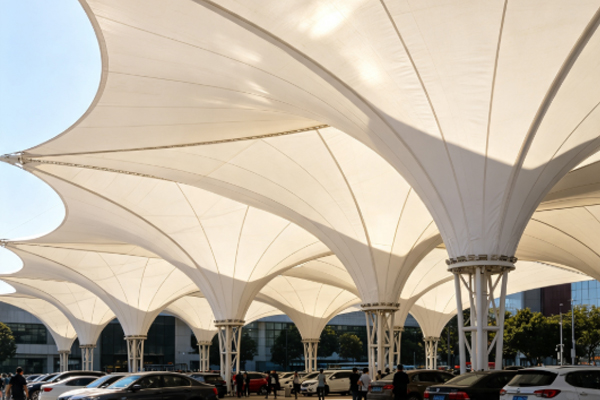
Membrane structure buildings are widely used in parking lots, sports facilities, commercial plazas, outdoor leisure areas, logistics parks, landscape facilities, and public activity spaces because of their flexible shapes, large-span capabilities, efficient installation, and distinctive visual appearance. As outdoor buildings increasingly require shading, rain protection, weather resistance, and improved space comfort, PVC tarpaulin has become a practical covering material for many membrane structure applications. PVC tarpaulin uses high-strength fabric as the supporting base and a PVC coating to improve waterproofing, weather resistance, and tensile performance. It can be cut, heat-welded, and installed according to the building framework and design dimensions to create a flexible architectural covering with shading functions. By selecting suitable PVC tarpaulin thickness, weight, light transmission, and surface treatment, and combining the material with steel structures or other support systems, customized shading structures can be created for different outdoor spaces. For membrane structure projects that require visual appeal, service durability, and convenient maintenance, PVC tarpaulin provides a flexible material solution.
When PVC tarpaulin is used for membrane structure buildings, the material needs to provide shading while also adapting to long-term outdoor exposure to sunlight, rain, wind, and temperature changes. Common PVC tarpaulin consists of high-strength base fabric and a PVC coating. The base fabric provides tensile and tear resistance, while the PVC coating improves waterproofing, weather resistance, and surface protection. Different colors, thicknesses, weights, and light transmission levels can be selected according to architectural requirements. For parking shelters and landscape structures, the appropriate light transmission level can be selected according to shading requirements and visual preferences. For commercial spaces and outdoor leisure areas, colors can also be coordinated with the surrounding architectural design. During membrane structure installation, the tarpaulin needs to maintain appropriate tension to create a stable curved or shaped surface. Therefore, dimensional stability, seam strength, and edge reinforcement are also important considerations.
PVC tarpaulin generally uses a fabric base to provide the primary mechanical support, while the PVC coating forms a protective surface layer. This combination can meet outdoor membrane structure requirements for flexibility and strength. The material can be heat-welded into large sections, reducing the number of connection points required by traditional joining methods. The PVC coating also helps reduce water penetration and provides a degree of shading under direct sunlight. For membrane buildings that require natural daylight, PVC tarpaulin with suitable light transmission can create softer interior or semi-outdoor lighting. For parking areas, leisure platforms, and other spaces that require stronger protection from direct sunlight, products with greater shading performance can be selected. Material color, surface treatment, and texture can also influence the final architectural appearance, so product selection should be coordinated with the design scheme and actual application environment.
When PVC tarpaulin is used for membrane structures, dimensions should be determined according to the building span, frame spacing, membrane shape, and fastening method. Membrane material should not be selected only according to ground area because curved surfaces require additional consideration for actual developed dimensions and installation tension allowance. Large parking shelters, sports facilities, and commercial shading structures often require large membrane sections, with particular attention to seam strength and edge fastening. Smaller landscape shelters and leisure structures can use more flexible specifications according to the frame dimensions. Proper material matching helps maintain membrane flatness and the intended architectural shape while reducing excessive stretching or localized slack during installation.
Membrane Structure Application | Recommended PVC Tarpaulin | Main Function | Design Considerations |
Outdoor Parking Shelter | Weather Resistant, Shading Type | Shading, Rain Protection | Membrane Tension |
Sports Facility | High Strength, Weather Resistant | Shading, Rain Protection | Large-Span Structure |
Commercial Plaza | Rich Colors, Flexible Shapes | Shading, Decoration | Visual Appearance |
Landscape Canopy | Lightweight, Easy to Shape | Shading, Landscaping | Curved Design |
Outdoor Leisure Area | Shading, Weather Resistant | Reducing Direct Sunlight | User Comfort |
Logistics Park | Waterproof, Abrasion Resistant | Shading, Rain Protection | Long-Term Outdoor Use |
PVC tarpaulin installation in membrane structure buildings requires appropriate connections between the membrane material, steel frame, tensioning system, and edge fastening components. Proper pretension allows the membrane to form a stable spatial shape. Before installation, the material should be cut and processed according to the design dimensions, followed by heat welding and edge reinforcement to create complete membrane sections. During construction, the frame dimensions and connection positions should be checked carefully before the membrane is unfolded. After the membrane is installed, tension should be adjusted gradually so that the surface maintains the intended shape. For long-term outdoor projects, local wind conditions, rainfall, sunlight, temperature changes, connection nodes, and drainage positions should also be considered during design and installation.
The installation quality of a membrane shading structure can affect membrane appearance, drainage performance, and long-term stability. A practical installation process can include the following steps:
Confirm the building frame: Inspect steel structures, support members, and connection nodes to ensure their dimensions correspond with the membrane fabrication data.
Inspect the PVC tarpaulin: Unfold the membrane and check the surface, edges, and heat-welded seams before installation.
Position the membrane: Place the tarpaulin on the frame according to the design orientation and initially connect the edge fastening areas.
Apply tension gradually: Adjust tension progressively from the fixed points to other sections so that the membrane develops the intended shape without excessive localized stretching.
Check drainage and connections: Confirm that there are no obvious water accumulation areas and inspect all edges, connectors, and fixing points.
After installation, the complete membrane should be inspected to ensure that the PVC tarpaulin maintains appropriate tension and a stable shape for long-term use.
Parking shelters are one of the common applications of PVC membrane structures. When the membrane is installed over a steel frame, it provides vehicles with a shaded and rain-protected area. Because parking shelters are normally exposed to outdoor conditions for extended periods, weather resistance, drainage design, and fastening structures need careful consideration. Commercial plazas, public leisure areas, and landscape spaces place greater emphasis on architectural shape and visual appearance. Curved, wave-shaped, or tensile structures can create recognizable outdoor spaces. PVC tarpaulin is available in a variety of colors, allowing the selected material to complement surrounding buildings and landscape elements. For schools, communities, parks, and outdoor activity areas, membrane shading structures can also improve the comfort of spaces where people gather and stay.
PVC membrane structures remain exposed to outdoor conditions after installation and therefore require regular inspection of the membrane surface, seams, edges, and fastening points. Routine maintenance can include removing leaves, dust, and other debris from the membrane surface to prevent long-term accumulation in low areas. After heavy rainfall, drainage points should be inspected to ensure that water can flow away properly. Areas with frequent bird activity or dense surrounding vegetation may require more frequent inspections. Cleaning should be carried out using methods suitable for PVC membrane materials, avoiding tools or substances that could damage the coating. If localized abrasion, abnormal seams, or loose fastening components are discovered, timely maintenance can prevent the problem from developing further. Regular inspection and maintenance help preserve both the appearance and shading performance of the membrane.
PVC tarpaulin can be cut, heat-welded, and shaped according to project requirements, making it suitable for various membrane structure buildings:
Car Parking Shelters: Provide shading and rain protection for vehicles in residential communities, commercial areas, and public parking facilities.
Sports Facilities: Can be used for spectator stands, entrances, and selected open spaces requiring shading and rain protection.
Commercial Plazas: Create visually distinctive outdoor spaces through different shapes and colors.
Park Landscape Facilities: Suitable for gazebos, rest areas, landscape canopies, and pedestrian structures.
Activity Spaces: Can be used for exhibitions, markets, leisure areas, and temporary event facilities.
Logistics and Industrial Parks: Suitable for vehicle parking zones, loading areas, and selected outdoor workspaces.
Different PVC tarpaulin dimensions and structures can be customized according to building span, shape, and functional requirements, allowing the membrane material to integrate more effectively with the supporting system.
PVC tarpaulin used in membrane structures can combine shading, rain protection, architectural shaping, and outdoor environmental adaptability. Compared with traditional rigid roofing, flexible membrane materials can form curved and specialized shapes through tensioning, providing greater freedom for architectural design. PVC material offers good waterproofing and weather resistance, making it suitable for long-term outdoor applications. Large membrane sections can also provide coverage for relatively spacious areas after appropriate fabrication. For parking shelters, landscape structures, and public spaces, membrane structures can improve shading conditions while creating visually recognizable architectural forms.
PVC membrane materials can serve as an external shading layer, reducing the impact of direct sunlight on people and vehicles. Installing PVC tarpaulin over parking shelters can reduce prolonged direct sunlight exposure on vehicles. Membrane structures installed over outdoor leisure areas can provide more comfortable spaces for people to rest and stay. Different levels of natural light can also be controlled according to the light transmission characteristics of the membrane. A properly designed membrane shape can reduce direct sunlight entering the covered space while creating a coordinated relationship with surrounding landscaping, roads, and facilities.
Outdoor membrane structures need to withstand sunlight, rainfall, wind, and temperature changes over long periods. The composite structure of PVC tarpaulin provides good environmental adaptability. The PVC coating helps reduce water penetration and protects the underlying fabric, while the high-strength textile provides mechanical support for the membrane surface. Selecting suitable products according to the application environment can improve long-term structural stability. In regions with frequent rainfall, appropriate membrane slopes and drainage paths can also be designed to reduce the impact of water accumulation.
One of the defining characteristics of membrane architecture is its ability to form curved, arched, wave-shaped, and other distinctive structures through tensioning. PVC tarpaulin offers good flexibility and processing adaptability, allowing it to be cut, heat-welded, and assembled according to architectural drawings before being connected to a steel structure. Designers can select different spans and shapes according to functional requirements, creating different visual effects for parking shelters, landscape facilities, commercial spaces, and public buildings. Color and light transmission can also be coordinated with the overall design, allowing functional shading structures to provide decorative value.
After a PVC membrane structure has been completed, it does not require complicated daily operation, but a regular inspection system should still be established. Inspection can include membrane cleanliness, heat-welded seams, edge connections, fastening components, and drainage areas. For large membrane structures, inspection frequency can be increased according to seasonal changes to address leaves, dust, and accumulated water in a timely manner. When localized abrasion or connection problems are discovered, repairs should be performed as early as possible to prevent minor damage from developing into larger issues. Proper maintenance helps preserve the membrane appearance and can contribute to a longer practical service life.
If you are purchasing PVC membrane structure tarpaulin, PVC shading membrane, parking shelter tarpaulin, landscape membrane structure materials, or outdoor shading tarpaulin, suitable products can be selected according to building span, support structure, application environment, shading requirements, and architectural design. For large membrane structure projects, irregular buildings, parking shelters, and bulk engineering purchases, PVC tarpaulin can also be customized according to actual design dimensions, including membrane size, thickness, color, light transmission, heat-welded seams, and edge fastening structures.
WeChat: 0086-13921439224
Email: tarp@newstarventilation.com
Contact us for PVC tarpaulin membrane structure products and shading solutions. By providing building dimensions, application scenarios, and design requirements, you can obtain suitable membrane specifications for parking shelters, public spaces, landscape facilities, and outdoor architectural shading projects.
