
Hot Keywords:
- All
- Product Name
- Product Keyword
- Product Model
- Product Summary
- Product Description
- Multi Field Search
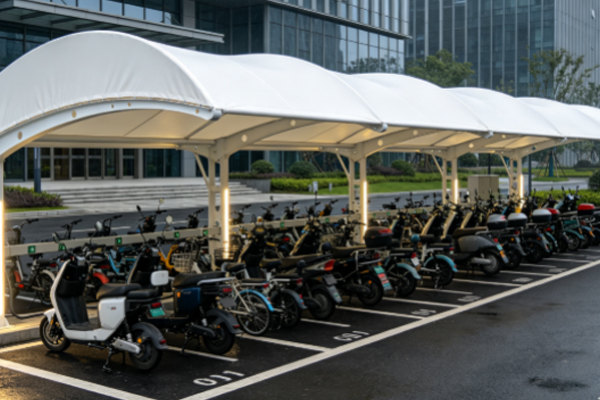
With the increasing use of electric bicycles and electric scooters for commuting, delivery, campus transportation, and community mobility, suitable outdoor parking facilities have become increasingly important. Electric vehicles parked in open areas are exposed to rain, strong sunlight, dust, and changing weather conditions, which can affect user comfort and the condition of vehicle components. A PVC tarpaulin membrane structure electric vehicle shelter combines PVC-coated fabric with steel frames, tensioning systems, fixing components, and drainage facilities to create a practical covered parking space. Compared with simple temporary covers, a properly designed membrane shelter can provide a more stable structure and a larger continuous coverage area. PVC tarpaulin can also be customized according to the number of parking spaces, vehicle arrangement, site dimensions, shelter height, and architectural environment. It can be used for residential communities, factories, schools, office parks, shopping centers, logistics facilities, public service areas, and transportation hubs. For projects that need weather protection while maintaining convenient vehicle access, PVC membrane structures offer a flexible solution for electric vehicle parking.
PVC tarpaulin membrane electric vehicle shelters generally use PVC-coated textile as the main covering material, supported by steel columns, beams, tensioning cables, connection fittings, and drainage components. The textile substrate provides tensile support, while the PVC coating helps improve waterproofing, weather resistance, and surface durability. The membrane can be manufactured into curved, arched, cantilevered, or continuous forms, allowing the shelter to adapt to different parking layouts. Electric vehicle parking areas often require sufficient space for users to push or ride vehicles into and out of designated positions, so column locations should be planned carefully. For larger parking facilities, a wide-span structure can provide a relatively open interior and reduce interference from excessive support columns. The roof height should also allow comfortable access while maintaining effective rain protection. Proper coordination between membrane dimensions, steel structure, vehicle arrangement, drainage routes, and charging facilities can improve the overall usability of the shelter.
Electric vehicle shelters are normally installed outdoors and need to withstand rain, sunlight, dust, humidity, wind, and temperature changes. PVC tarpaulin provides a continuous covering surface that helps reduce direct rainfall on electric vehicles, seats, control panels, baskets, and other exposed components. The PVC coating also helps protect the textile substrate from outdoor environmental exposure. In regions with strong sunlight, membrane specifications with suitable light transmission and weather resistance can be selected according to project requirements. In areas with frequent rainfall, the membrane slope and drainage arrangement should receive particular attention. Heat-welded seams can help create continuous waterproof coverage, while reinforced edges and connection points can support installation on tensioned structures. The appropriate material thickness, weight, and performance grade should be selected according to local weather conditions and expected service requirements.
Electric vehicle shelters need to accommodate different vehicle sizes, parking arrangements, and access patterns. A compact single-row shelter may be suitable for residential communities or small office buildings, while schools, factories, and commercial properties with higher demand may require double-row or continuous parking structures. The distance between columns should be coordinated with parking spaces to prevent interference when users enter or leave their vehicles. The shelter width should provide sufficient overhead coverage, while the height should balance accessibility and rain protection. For electric vehicle charging areas, additional space may be required for charging equipment, cable management, maintenance, and safe pedestrian movement.
Application Area | Recommended Membrane Structure | Main Purpose | Key Design Requirement |
Residential Community | Modular PVC Shelter | E-Bike Parking | Space Efficiency |
Factory | Continuous Membrane Shelter | Employee Vehicle Parking | Large Capacity |
School | Curved Membrane Shelter | Student and Staff Parking | Safe Access |
Office Park | Cantilevered Shelter | Commuter Vehicle Protection | Convenient Entry |
Shopping Center | Large-Span Shelter | Customer Parking | Appearance and Traffic Flow |
Charging Area | Reinforced Membrane Shelter | Charging and Parking | Equipment Clearance |
PVC membrane electric vehicle shelters can be used for daily parking, temporary parking areas, charging stations, employee parking zones, residential parking areas, and public transportation transfer facilities. After entering the shelter, electric vehicles can be positioned according to designated spaces, while the membrane roof provides overhead protection against rain and direct sunlight. Residential communities can install shelters in centralized parking areas to improve vehicle organization. Factories and office parks can place them near employee entrances to make daily commuting more convenient. Commercial complexes can build covered parking areas near entrances, while schools can establish dedicated parking spaces for teachers and students. For charging facilities, the shelter design should leave enough clearance around charging equipment and maintain suitable pedestrian and emergency access. Combining the membrane structure with proper ground drainage can also reduce water accumulation during heavy rainfall.
A complete membrane shelter requires coordination between site planning, foundations, steel structures, PVC membrane fabrication, tensioning, and drainage. A practical construction sequence includes the following steps:
Site measurement and planning: Measure the available parking area, vehicle routes, building boundaries, pedestrian paths, and existing facilities.
Parking layout: Determine the number of parking spaces, vehicle arrangement, access routes, and charging locations.
Structural selection: Select a curved, cantilevered, continuous, or modular membrane structure according to site conditions.
Foundation installation: Construct foundations and embedded components according to the structural design.
Steel frame installation: Install columns, beams, supports, and connection components and inspect each structural joint.
PVC membrane fabrication: Cut, heat-weld, reinforce, and prepare the membrane according to the required dimensions.
Membrane installation: Connect the PVC tarpaulin to the steel frame and tensioning system, adjusting the membrane tension and shape.
Drainage system installation: Establish suitable drainage channels, gutters, and downpipes based on the roof slope.
After installation, the membrane tension, structural connections, vehicle clearance, drainage performance, and access routes should be inspected before the shelter enters regular operation.
PVC tarpaulin electric vehicle shelters are suitable for many environments where electric vehicles are parked outdoors. Residential communities can use them to create centralized parking areas for electric bicycles and scooters, reducing random outdoor parking. Factories can install large continuous shelters to accommodate employee vehicles during working hours. Schools can use compact membrane structures near dormitories, teaching buildings, or campus entrances. Office parks can build covered parking near employee entrances to provide convenient protection for daily commuters. Shopping centers can create customer parking areas close to commercial entrances, while logistics facilities can use membrane shelters for delivery workers and service vehicles. Public transportation hubs can also combine electric vehicle parking shelters with bicycle transfer facilities, helping support short-distance commuting.
Regular inspection helps maintain the performance of a PVC membrane electric vehicle shelter. The membrane surface should be checked for visible tears, abnormal sagging, excessive dirt, or localized water accumulation. Heat-welded seams, reinforced edges, tensioning points, fasteners, and connection fittings should also be inspected periodically. Steel columns, beams, bolts, and embedded components need to be checked for looseness, corrosion, or deformation. Drainage channels and downpipes should be cleaned regularly, particularly before and during the rainy season. After strong winds or heavy storms, the membrane and structural connections should be inspected once conditions are safe. Cleaning should use methods suitable for PVC materials, while sharp objects and unsuitable chemical cleaners should be avoided. Proper maintenance can help preserve the shelter's waterproofing, structural stability, and appearance.
PVC tarpaulin membrane electric vehicle shelters combine outdoor weather protection with flexible structural design. Their relatively lightweight membrane material can cover large parking areas when combined with properly designed steel frames and tensioning systems. Compared with conventional solid roofs, membrane structures can provide more flexible architectural forms and can be customized for different site conditions. The open structure also supports convenient vehicle entry and pedestrian movement. PVC tarpaulin provides a waterproof covering surface, while suitable membrane specifications can offer weather resistance for outdoor use. Different colors, shapes, dimensions, and structural forms can be selected to coordinate with residential, commercial, educational, or industrial environments. Modular designs can also make future parking expansion easier.
Direct exposure to rain and sunlight can make electric vehicle parking less convenient, particularly during periods of heavy rainfall or high temperatures. A PVC membrane shelter creates an overhead protective layer that helps reduce direct rainwater and sunlight reaching parked vehicles. This can improve the parking experience and help keep seats and frequently touched surfaces drier. The effectiveness of protection depends on the shelter dimensions, membrane slope, installation height, local wind conditions, and coverage area. Proper design is therefore important when determining the required membrane size.
PVC tarpaulin combines a woven fabric substrate with a PVC coating, creating a flexible material suitable for membrane structures. The substrate contributes tensile strength, while the coating provides waterproofing and surface protection. The membrane can be cut, heat-welded, reinforced, and connected to structural components to create large covered surfaces. Its flexibility allows designers to create curved, arched, cantilevered, and other customized shelter forms. Different specifications can be selected according to rainfall, sunlight, wind exposure, usage frequency, and expected service conditions.
Electric vehicle parking facilities need to balance parking capacity with comfortable access. PVC membrane structures can use cantilevered or wide-span configurations to reduce the number of columns inside the main parking area. This can make it easier for users to maneuver electric bicycles and scooters into designated spaces. Continuous shelters can cover multiple parking rows and create unified weather protection. In space-limited locations, the membrane dimensions and structural layout can be customized according to existing boundaries, buildings, pathways, and parking requirements.
Different projects require different parking capacities, structural dimensions, colors, and architectural styles. PVC membrane electric vehicle shelters can be customized according to these requirements. The membrane can be supplied in different thicknesses, weights, colors, and sizes, while reinforced edges, heat-welded seams, connection holes, and tensioning components can be added according to the structural design. Curved, cantilevered, continuous, and modular configurations can all be considered. Residential communities may prioritize compact layouts, factories may require large-capacity parking, while commercial projects may place greater emphasis on visual appearance. Where future expansion is expected, modular construction can allow additional shelter units to be added later.
If you are looking for PVC electric vehicle shelter membrane, PVC membrane structure tarpaulin, electric bicycle shelter material, PVC parking canopy fabric, e-bike shelter tarpaulin, PVC charging station canopy material, or customized PVC membrane structures, suitable products can be selected according to parking capacity, site dimensions, vehicle types, local climate, and project requirements. PVC tarpaulin can be customized for residential communities, factories, schools, office parks, shopping centers, industrial facilities, logistics sites, transportation hubs, and public parking areas, including thickness, weight, color, dimensions, light transmission, reinforced edges, heat-welded seams, and connection structures.
WeChat: 0086-13921439224
Email: tarp@newstarventilation.com
Contact us for PVC tarpaulin membrane structure electric vehicle shelter products and customized services. Provide the parking area dimensions, estimated vehicle capacity, required coverage, structural preferences, charging requirements, and operating environment, and we can help identify suitable PVC membrane materials and structural solutions for reliable rain protection, sun shading, and organized electric vehicle parking.
