
Hot Keywords:
- All
- Product Name
- Product Keyword
- Product Model
- Product Summary
- Product Description
- Multi Field Search
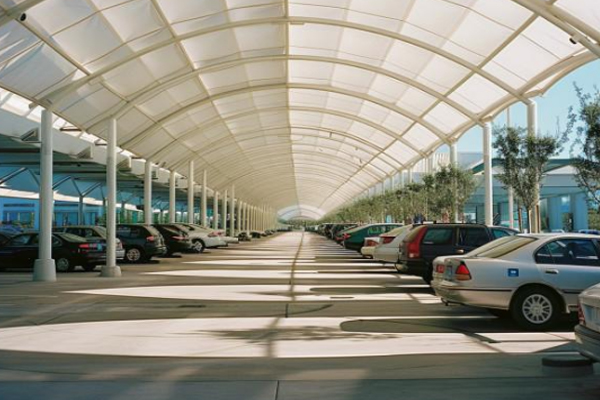
Industrial parks, manufacturing plants, warehouse bases, logistics centers, and large production enterprises often have significant demand for parking spaces for employee vehicles, engineering vehicles, and company vehicles. Open-air parking exposes vehicles to intense sunlight, rainfall, dust, fallen leaves, and changing weather conditions. Industrial parking areas also need to accommodate vehicle access, pedestrian movement, equipment maintenance, and long-term outdoor use. A PVC tarpaulin membrane structure industrial parking canopy combines PVC membrane material with a steel support system and uses tensioning technology to create a stable covered space. It can provide shading, rain protection, and a certain level of wind protection for vehicles while reducing direct solar exposure. PVC tarpaulin offers waterproofing, weather resistance, flexibility, tensile strength, and convenient processing. Through heat welding, cutting, and reinforced edge treatment, large membrane surfaces can be manufactured according to project requirements. For industrial parks, factories, and logistics bases, this structure can create large shaded areas within limited spaces while providing a lightweight architectural appearance that is suitable for long-term vehicle parking.
The performance of a PVC tarpaulin membrane structure industrial parking canopy is closely related to membrane quality, steel structure design, and connection methods. Common PVC tarpaulin consists of high-strength woven fabric and PVC coating. The fabric mainly provides tensile strength for the membrane, while the PVC coating provides waterproofing, moisture resistance, and surface protection. Industrial parking canopies are generally exposed to sunlight, rain, dust, and wind for extended periods, so material selection should consider the local climate, canopy span, vehicle capacity, and expected service period. For large industrial parking areas, PVC membrane materials with higher tensile and weather resistance can be selected, together with reinforced edges, heat-welded seams, and reliable fastening nodes to improve overall stability. Steel structures can use single-column, double-column, truss, or other support configurations according to vehicle entrances, fire lanes, and parking layouts. The membrane surface can be designed in curved, wave-shaped, saddle-shaped, or continuous tensile forms, allowing the industrial parking canopy to combine practical functionality with architectural appearance.
The composite construction of PVC tarpaulin allows it to adapt to long-term outdoor industrial parking conditions. The woven base fabric provides mechanical support, while the PVC surface helps reduce direct water penetration and protects the internal fabric. Industrial parks often contain dust, oil contamination, vehicle exhaust, and particles generated by machinery, so parking canopy materials should also provide practical surface cleaning and maintenance characteristics. PVC tarpaulin can be selected in different thicknesses, weights, colors, and light transmission levels according to project requirements. Employee parking areas can use membranes that balance shading and natural lighting, while engineering vehicle and large truck parking areas can prioritize high-strength and abrasion-resistant products. Combining suitable material specifications with a properly designed steel structure can create covering systems adapted to different industrial environments.
Industrial parking canopies often accommodate more vehicles and larger spaces than residential parking shelters. PVC tarpaulin dimensions should therefore be customized according to parking layouts, vehicle heights, steel structure spacing, and membrane curves. Large membrane sections require accurate cutting and heat welding, while reinforced structures should be added along the edges to support tensioning during installation. Continuous parking areas can use multiple membrane sections to form an integrated covering system, while smaller factory parking zones can use independent modules for easier future expansion. Appropriate membrane dimensions can reduce wrinkles and slackness, improve rainwater drainage, and enhance the overall appearance of the parking canopy.
Industrial Parking Canopy Type | Recommended PVC Tarpaulin | Main Application | Design Focus |
Factory Employee Parking | Shading, Weather Resistant | Sun and Rain Protection | Pedestrian Access |
Industrial Park Parking | High Strength, Weather Resistant | Vehicle Protection | Large-Area Coverage |
Logistics Base Parking | Waterproof, Abrasion Resistant | Rain and Dust Protection | Large-Span Structure |
Engineering Vehicle Parking | Thick, High Strength | Shading and Rain Protection | Vehicle Height |
Warehouse Center Parking | Waterproof, Weather Resistant | Outdoor Vehicle Protection | Drainage Design |
Company Vehicle Parking | Shading, Architectural Type | Sun and Rain Protection | Building Coordination |
Industrial parking canopy construction needs to be coordinated with factory roads, vehicle types, and parking layouts. A PVC tarpaulin membrane structure normally begins with foundation work and steel structure installation, followed by membrane placement and tensioning according to the actual structural dimensions. The membrane should be cut according to the designed curves and heat-welded into complete sections, with reinforced edges and connection components added where necessary. During construction, PVC tarpaulin should be protected from direct contact with sharp areas of the steel structure to prevent scratches. After the membrane is secured, tension should be adjusted gradually according to the design requirements so that the tarpaulin forms a stable curved surface. The industrial parking canopy should also include appropriate drainage directions to allow rainwater to flow naturally and reduce the possibility of water accumulation on the membrane.
Industrial parking canopies are generally intended for long-term use, so the foundation, steel structure, membrane material, and fastening nodes need to match properly during construction. A practical construction process can include the following steps:
Confirm the site and foundation: Determine column positions according to parking spaces, factory roads, and vehicle routes, and inspect whether the foundation and embedded components meet design requirements.
Install the steel structure: Complete installation of columns, beams, trusses, cables, and other support components, and inspect the stability of each connection node.
Measure membrane dimensions: Verify the PVC tarpaulin against the completed steel structure dimensions and confirm membrane orientation, edge positions, and connection points.
Unfold and position the membrane: Unfold the tarpaulin while preventing contact with sharp objects, place it in the designated position, and carry out temporary fastening.
Apply membrane tension gradually: Adjust tension according to the construction sequence so that the membrane achieves the intended shape without excessive localized stretching.
Inspect fastening and drainage: Check reinforced edges, fasteners, cables, and connection points, and confirm that the membrane drainage route remains clear.
After construction, the entire parking canopy should be inspected to ensure that membrane tension, structural connections, vehicle clearance, and drainage conditions meet actual operational requirements.
After an industrial parking canopy is put into service, parking areas can be divided according to vehicle types while the PVC membrane provides stable overhead shading. When employee cars, company vehicles, and engineering vehicles enter the parking spaces, the membrane can reduce direct sunlight exposure and provide overhead rain protection during wet weather. For trucks and engineering vehicles with greater overall height, sufficient clearance should be reserved during the construction stage to prevent contact between the vehicle roof and the membrane or support components. Clear driving routes should also be maintained inside the parking area to reduce the risk of vehicles hitting structural columns during turning. Large industrial parks can use segmented parking canopy structures and gradually expand the covered area according to the number of company vehicles. During daily use, sharp objects or elevated equipment carried by vehicles should not come into direct contact with the membrane surface.
Maintenance of an industrial parking canopy mainly focuses on the membrane surface, seams, reinforced edges, fastening components, and drainage areas. Dust, leaves, and other particles in industrial environments can accumulate on the membrane and should be cleaned regularly according to the level of contamination. During rainy seasons, drainage conditions should be inspected carefully to prevent blocked outlets and localized water accumulation. After strong winds, membrane tension should be checked for significant changes, along with cables, connectors, and edge fastening points. Small scratches or localized abrasion should be repaired promptly to prevent further damage caused by vehicle activity and changing weather conditions. When cleaning, tools and cleaning methods suitable for PVC materials should be selected to avoid excessive friction or unsuitable chemicals that could damage the coating. Regular maintenance can help preserve reliable shading and rain protection performance.
PVC membrane structure parking canopies can be customized according to industrial site conditions and are suitable for different production and logistics environments:
Manufacturing Plants: Provide shaded and rain-protected parking spaces for employee vehicles, company vehicles, and visitors.
Industrial Parks: Suitable for large employee parking lots and centralized internal vehicle parking areas.
Logistics Bases: Can be used for temporary parking, loading and unloading waiting areas, and employee vehicle parking.
Warehouse Centers: Provide outdoor shading and rain protection for vehicles around warehouses.
Engineering Construction Bases: Suitable for engineering vehicles, transportation vehicles, and site staff vehicles.
Energy and Equipment Companies: Suitable for company vehicles, maintenance vehicles, and related transportation vehicle parking areas.
According to vehicle height, parking capacity, site width, and factory road conditions, single-unit, continuous, or modular membrane structures can be selected to create a more flexible industrial parking layout.
PVC tarpaulin membrane structure industrial parking canopies combine flexible membrane materials with steel structures to create continuous covered spaces across large industrial sites. Compared with conventional rigid roofs, membrane structures provide flexible shapes, efficient coverage, and a relatively lightweight visual appearance. For industrial parks and manufacturing companies, parking canopies need to provide vehicle shading and rain protection while also considering factory planning, vehicle access, future expansion, and maintenance convenience. PVC tarpaulin can be fabricated according to actual engineering dimensions and is suitable for projects with different spans and parking capacities. After being tensioned into a stable curved surface, the membrane can reduce the heavy visual appearance associated with conventional flat roofs and coordinate more naturally with surrounding industrial buildings.
Industrial vehicles, employee cars, and company vehicles that remain outdoors for long periods can be strongly affected by direct sunlight. A PVC tarpaulin parking canopy creates a continuous shading layer above the vehicles and reduces solar radiation reaching roofs and windows. For employee parking areas, this shading facility can improve the outdoor parking environment. For engineering and company vehicles, it can reduce the impact of prolonged outdoor sun exposure. Light transmission can be selected according to the membrane specification, allowing the parking canopy to maintain a certain level of natural light while reducing intense direct sunlight.
Outdoor vehicle parking areas in industrial facilities are exposed to rain, dust, and seasonal weather changes. The waterproof PVC coating helps reduce rainwater penetration through the membrane, while a properly designed membrane slope allows rainwater to flow in a controlled direction. In industrial parks with high dust levels, the membrane can also provide a degree of external separation, reducing the amount of dust that falls directly onto vehicle surfaces. PVC tarpaulin offers a certain level of weather resistance and can be suitable for long-term outdoor use, although actual service life depends on local climate, installation methods, material specifications, and maintenance conditions.
Industrial parks often have significant vehicle parking requirements, and small independent shelters may not provide sufficient capacity. PVC membrane structures can connect multiple modules to create continuous coverage or can be constructed in stages according to company development and parking demand. Large parking canopies can reduce certain intermediate supports, creating more open vehicle access areas. For irregular factory sites, customized membranes and steel structures can also be used to adjust the shape of the parking canopy and make more effective use of available space.
PVC membrane materials can be cut, heat-welded, and reinforced along the edges according to design requirements. They can also be combined with different steel structures to create curved, wave-shaped, saddle-shaped, and continuous tensioned forms. Industrial companies can select membrane colors according to factory building colors, corporate visual identity, and surrounding site conditions, allowing the parking canopy to become part of the overall factory planning. For special dimensions, non-standard parking spaces, and large-span projects, membrane dimensions, reinforced edges, heat-welded seams, and fastening positions can be customized to improve compatibility between the membrane and steel structure.
If you are purchasing PVC membrane structure industrial parking canopy tarpaulin, PVC industrial parking canopy membrane, factory parking canopy tarpaulin, logistics park parking shelter materials, or large outdoor shading tarpaulin, suitable products can be selected according to parking capacity, vehicle types, building span, local climate, factory layout, and expected service period. For manufacturing plants, industrial parks, logistics bases, warehouse centers, construction bases, and large enterprise parking areas, PVC tarpaulin can also be customized according to actual engineering requirements, including thickness, weight, color, light transmission, dimensions, heat-welded seams, reinforced edges, and fastening nodes.
WeChat: 0086-13921439224
Email: tarp@newstarventilation.com
Contact us for PVC tarpaulin membrane structure industrial parking canopy products and construction solutions. By providing parking area dimensions, vehicle numbers, vehicle types, and design requirements, suitable PVC membrane specifications can be selected to provide reliable shading and rain protection for industrial vehicles while helping companies create outdoor parking facilities that combine practical performance, efficient space utilization, and attractive architectural appearance.
