
Hot Keywords:
- All
- Product Name
- Product Keyword
- Product Model
- Product Summary
- Product Description
- Multi Field Search

Logistics transportation vehicles are frequently exposed to rain, strong sunlight, road dust, and moisture during highway transportation, cargo loading and unloading, and temporary parking. Flatbed trucks, sideboard trucks, freight trailers, construction transport vehicles, and specialized logistics vehicles often do not have a fully enclosed roof, making external tarpaulin an important solution for cargo protection. PVC tarpaulin is manufactured from a high-strength woven fabric base combined with a PVC coating, providing waterproofing, weather resistance, tensile strength, abrasion resistance, and flexibility. It can be customized according to vehicle length, width, cargo height, and fastening structure. Once installed, it can cover the top and sides of the cargo area, reducing direct exposure to rain and limiting the impact of dust and muddy water during transportation. For logistics fleets, suitable PVC tarpaulin should provide reliable rain protection while remaining convenient for drivers to unfold, secure, remove, and store. By matching the tarpaulin dimensions with the vehicle, designing suitable eyelets and reinforced edges, and using ropes, hooks, or elastic fastening components, PVC tarpaulin can meet the requirements of frequent logistics operations.
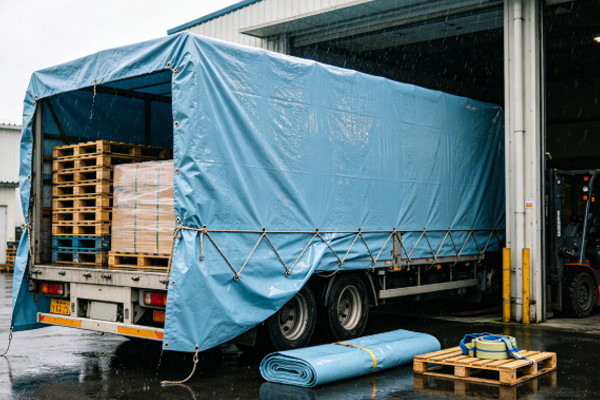
PVC tarpaulin generally consists of a woven fabric base and a PVC coating. The fabric provides the primary tensile strength, while the PVC coating improves waterproofing, moisture resistance, and outdoor weather performance. Tarpaulins used on logistics transportation vehicles are frequently folded, stretched, rubbed, and exposed to airflow, making material strength and edge reinforcement particularly important. Different thicknesses, weights, and flexibility levels can be selected according to vehicle type and cargo requirements. Large flatbed trucks require large-area tarpaulins and usually need more fastening points and reinforced sections, while smaller delivery vehicles can use lighter specifications that are easier for drivers to operate. Reinforced edges can be added around the tarpaulin, together with metal eyelets, rings, or other fastening components, helping distribute tension more evenly. For long-term outdoor transportation, PVC materials with suitable weather resistance can be selected according to local ultraviolet exposure, rainfall, and transportation frequency.
The PVC coating creates a continuous protective layer over the fabric base and helps reduce water penetration through the tarpaulin. During cargo transportation, the tarpaulin normally covers the entire top of the cargo and extends toward both sides of the vehicle, forming a comprehensive rain protection area through fastening points. For cartons, packaged products, timber, machinery components, and certain industrial supplies, reducing direct rain exposure can help lower the risk of packaging and cargo moisture. The PVC coating also helps the material resist dust, humidity, and certain types of abrasion encountered during outdoor transportation. Actual protection depends on tarpaulin specifications, installation methods, vehicle structure, and weather conditions, so the product should be selected according to the actual transportation environment.
Different vehicles have different cargo area lengths, widths, cargo heights, and fastening positions, so tarpaulin dimensions should be designed according to the actual vehicle. Flatbed trucks generally require large tarpaulins covering the top of the cargo, with sufficient material extending over both sides for fastening. Sideboard trucks can use the side panels to provide additional support, while large trailers can use integrated or sectional tarpaulin systems depending on loading frequency. Customization should also consider eyelet spacing, reinforced edge locations, and rope fastening routes so that the tarpaulin maintains suitable tension after installation. Proper dimensional planning can reduce excessive tension on the edges while making it easier for drivers to cover different cargo loads.
Vehicle Type | Recommended PVC Tarpaulin Design | Main Function | Application Characteristics |
Flatbed Truck | Large High-Strength Tarpaulin | Overhead Rain Protection | Large Coverage Area |
Sideboard Truck | Waterproof, Weather-Resistant Tarpaulin | Rain and Dust Protection | Easy Side Fastening |
Semi-Trailer | Integrated or Sectional Tarpaulin | Full Cargo Area Protection | Suitable for Long-Distance Transport |
Construction Transport Vehicle | Abrasion-Resistant PVC Tarpaulin | Rain and Dust Protection | Suitable for Demanding Environments |
Urban Delivery Vehicle | Lightweight, Flexible Tarpaulin | Quick Rain Protection | Easy to Deploy and Store |
Specialized Transport Vehicle | Customized PVC Tarpaulin | Cargo Protection | Fabricated According to Vehicle Structure |
PVC tarpaulin used on logistics vehicles should be operated according to cargo arrangement and transportation routes. After loading, the cargo height should be checked to ensure it remains within the vehicle's safe operating range. The tarpaulin can then be unfolded from one side of the vehicle and positioned across the top of the cargo. During deployment, direct contact between the tarpaulin and sharp cargo edges should be avoided, and protective padding can be used around protruding sections when necessary. After covering the cargo, eyelets, ropes, hooks, and vehicle fastening rings can be connected progressively to maintain suitable membrane tension. Before the vehicle starts moving, the top, sides, and rear should be checked for visible gaps, and all fastening points should be confirmed as secure. During long-distance transportation, the tarpaulin should be inspected after passing through strong winds or heavy rainfall when the vehicle can be safely parked. For logistics vehicles with frequent loading and unloading operations, roll-up or quick-fastening designs can reduce manual handling time.
A standardized installation process can help reduce loose sections, raised edges, and local water penetration while keeping the tarpaulin stable during transportation.
Inspect the tarpaulin: Check the PVC tarpaulin surface, heat-welded seams, reinforced edges, and eyelets before use.
Confirm cargo loading: Check cargo height and arrangement to prevent protruding items from directly pressing against the tarpaulin.
Unfold the tarpaulin: Spread the tarpaulin smoothly across the top of the cargo and adjust its front and rear coverage.
Secure the side edges: Use ropes, hooks, or fastening components to connect the tarpaulin with the vehicle fastening rings.
Adjust overall tension: Gradually tighten the fastening points symmetrically to reduce loose areas.
Complete the pre-driving inspection: Confirm that the tarpaulin has no obvious sagging, damage, or large loose sections before transportation.
After fastening, the connection points on both sides and at the rear should be checked again to ensure the tarpaulin does not interfere with vehicle lights, license plates, or normal driving safety.
PVC tarpaulin can be used on various cargo transportation vehicles, including flatbed trucks, sideboard trucks, semi-trailers, construction transport vehicles, industrial logistics vehicles, and certain specialized transportation equipment. Flatbed trucks can use large-area tarpaulins to cover steel products, timber, machinery, and construction materials. Sideboard trucks can combine side panels with PVC tarpaulin to improve protection on both the top and sides. Long-distance trailers can use continuous covering structures according to cargo body length, reducing exposure to rain and road dust during extended transportation. Urban delivery vehicles can use lightweight PVC tarpaulin to shorten daily loading and unloading operations. Construction transport vehicles frequently enter construction sites, mining areas, and industrial project locations and can therefore use more abrasion-resistant PVC tarpaulin for demanding transportation conditions.
Logistics vehicles use tarpaulins frequently, so routine maintenance can help reduce premature material damage. After each transportation operation, mud, dust, and other debris should be removed from the tarpaulin surface. When the tarpaulin has been used during rainy weather, it should be thoroughly dried before folding or rolling whenever operating conditions allow. During inspections, reinforced edges, eyelets, heat-welded seams, and fastening points should receive particular attention. Tears, loose components, or visible wear should be repaired promptly. Fleet managers can establish tarpaulin usage records according to vehicle numbers, conduct regular inspections, and arrange cleaning and maintenance according to transportation frequency. Spare tarpaulins that are not being used for long periods should be stored in a dry, ventilated location.
PVC tarpaulin can be customized according to vehicle structures and create continuous overhead coverage, helping reduce the direct impact of rain, sunlight, and road dust on cargo during transportation. Compared with ordinary plastic sheets, PVC tarpaulin provides better tensile strength and repeated-use performance. Compared with standard textile covers, the PVC coating provides stronger waterproof protection. Logistics vehicles frequently load, unload, and transfer goods, so tarpaulin selection should also consider weight, flexibility, and operating convenience. Reinforced edges, eyelets, heat-welded seams, and customized dimensions can improve compatibility between the tarpaulin and vehicle fastening system. For logistics companies, standardized sizes and suitable fastening methods can also simplify daily fleet management and tarpaulin replacement.
Cargo vehicles frequently travel through different weather conditions, and long-distance transportation may cross several climate zones. PVC tarpaulin installed over the cargo can reduce direct rainfall on the goods while side and rear coverage can further reduce the possibility of water entering the cargo area. For cartons, timber products, packaged goods, and machinery components, reliable overhead rain protection provides additional protection during transportation. Actual protection also depends on vehicle speed, wind direction, fastening methods, and rainfall intensity. The tarpaulin should therefore be installed with suitable tension and fastening points should be checked regularly.
PVC tarpaulin combines a woven fabric base with a PVC coating to meet logistics vehicle requirements for mechanical strength and waterproof performance. Products used outdoors for extended periods need to withstand sunlight, rain, wind, and temperature changes, so material specifications should be selected according to the transportation region and operating cycle. High-frequency logistics vehicles can use stronger products with reinforced edges. Short-distance transportation vehicles can prioritize flexibility and ease of operation. Actual service life depends on material quality, transportation environment, fastening methods, and maintenance conditions, making regular inspection an important part of long-term use.
Logistics transportation vehicles may load and unload cargo several times each day, making the speed of opening and securing the tarpaulin an important consideration. PVC tarpaulin can be designed with suitable eyelets, rings, and fastening positions according to vehicle structure, allowing drivers and loading personnel to complete covering operations more efficiently. Urban delivery vehicles can use lightweight and flexible tarpaulin designs, while large semi-trailers can use oversized high-strength PVC tarpaulins. For the same logistics fleet, standardized tarpaulin specifications can reduce replacement difficulties and simplify product management.
Logistics vehicles come in many configurations, while cargo dimensions can vary significantly. PVC tarpaulin can therefore be customized according to actual requirements. Products can be manufactured in different dimensions, thicknesses, weights, and colors and fitted with reinforced edges, metal eyelets, rings, and heat-welded seams. Oversized tarpaulins can be designed for long cargo, wide equipment, and large machinery, while lighter structures can be used for standard delivery vehicles. Customizing the tarpaulin according to vehicle fastening points and cargo arrangement can improve coverage while reducing material waste and fastening difficulties.
If you are purchasing PVC logistics transportation tarpaulins, PVC truck rain covers, PVC waterproof vehicle covers, logistics vehicle waterproof tarpaulins, flatbed truck tarpaulins, semi-trailer PVC tarpaulins, construction transport tarpaulins, or customized logistics vehicle covering materials, suitable products can be selected according to vehicle model, cargo dimensions, transportation distance, loading frequency, and operating environment. For logistics companies, freight fleets, manufacturers, construction material transportation companies, industrial equipment transportation projects, and warehouse distribution centers, PVC tarpaulins can also be customized according to actual requirements, including thickness, weight, dimensions, color, eyelet spacing, reinforced edges, and heat-welded seams.
WeChat: 0086-13921439224
Email: tarp@newstarventilation.com
Contact us for PVC tarpaulin rain protection products and customized services for logistics transportation vehicles. By providing vehicle dimensions, cargo type, coverage area, transportation distance, and operating environment, suitable PVC tarpaulin specifications can be selected to provide reliable rain, moisture, and dust protection for logistics transportation vehicles.
