
Hot Keywords:
- All
- Product Name
- Product Keyword
- Product Model
- Product Summary
- Product Description
- Multi Field Search

During logistics transportation, goods are often exposed to rain, moisture, road splashes, strong winds, and prolonged outdoor conditions. This is particularly common with flatbed trucks, semi-trailers, freight trucks, and engineering transport vehicles that do not have fixed enclosed compartments. Without suitable covering, the top and sides of cargo can be directly exposed to changing weather. PVC tarpaulin is made from high-strength fabric combined with a PVC coating, creating a continuous protective covering that helps reduce direct contact between rainwater and cargo while providing good abrasion resistance, tensile strength, flexibility, and reusability. By selecting the appropriate PVC tarpaulin size according to vehicle dimensions, cargo height, loading configuration, and transportation distance, and combining it with reinforced edges, eyelets, ropes, or straps, cargo can remain securely covered during transportation. For logistics companies, freight fleets, engineering transportation providers, and warehouse operators, PVC tarpaulin can be used not only for daily rain protection but also for loading and unloading operations, temporary storage, and outdoor cargo protection.
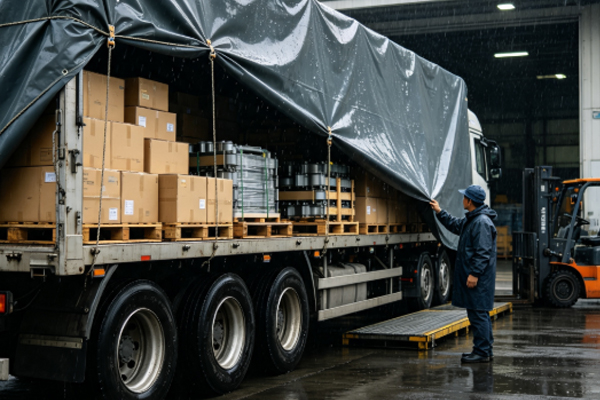
The core performance of PVC tarpaulin comes from its composite structure, in which the base fabric provides tensile strength, tear resistance, and structural support while the PVC coating contributes waterproofing, moisture resistance, and weather resistance. During logistics transportation, a tarpaulin must withstand more than rainwater. It may also experience wind pressure generated by vehicle movement, friction against cargo edges, and mechanical stress caused by repeated folding and unfolding. Therefore, material thickness, fabric strength, coating adhesion, edge reinforcement, and eyelet durability are important factors when selecting a suitable product. Different cargo types also require different tarpaulin specifications. Lightweight packaged goods may use products that are easy to unfold and store, while large machinery, construction materials, and steel products may require stronger and more abrasion-resistant PVC tarpaulins. With appropriate material and structural configuration, PVC tarpaulin can provide reliable rain protection for cargo transported on open logistics vehicles.
PVC tarpaulin generally uses woven fabric as its internal support layer and a PVC material layer on the surface to create a waterproof protective barrier. This structure allows the tarpaulin to combine flexibility with mechanical strength. A properly designed PVC coating can reduce the possibility of rainwater penetrating through the material, making it suitable for outdoor cargo covering. During long-distance transportation, the tarpaulin must also withstand continuous wind and vehicle vibration, so reinforced edges, seam construction, and eyelet positioning can influence actual performance. The PVC surface is also relatively easy to clean during routine maintenance. After transportation, dirt can be removed as needed, followed by thorough drying before storage. When selecting PVC tarpaulin for logistics transportation, the cargo weight, vehicle type, and frequency of use should be considered rather than choosing a product based only on covering area.
PVC tarpaulin dimensions should be properly matched with the vehicle body and cargo shape. The covering area needs to protect the top of the cargo while leaving enough material for side fixing. For tall machinery, the distance between the top of the cargo and vehicle fixing points should be considered. For palletized goods, the tarpaulin should extend beyond the cargo edges sufficiently to reduce the possibility of rain entering from the sides. Logistics fleets with frequent transportation requirements can prepare different tarpaulin sizes according to their vehicle types, reducing adjustment time during daily operations.
Transportation Type | Recommended PVC Tarpaulin | Main Protection | Application Characteristics |
Flatbed Truck | Large Size, High Strength | Top and Side Rain Protection | Large Coverage Area |
Semi-Trailer | Abrasion Resistant, High Tensile Strength | Long-Distance Rain and Dust Protection | Extended Use |
Machinery Transport | Thick, Tear Resistant | Rain and Dust Protection | Requires Edge Isolation |
Timber and Panels | Waterproof, Abrasion Resistant | Moisture and Rain Protection | Suitable for Repeated Use |
Construction Materials | High Strength, Abrasion Resistant | Rain and Mud Splash Protection | Construction Environments |
Warehouse Transfer | Easy to Unfold and Store | Temporary Rain Protection | Highly Flexible |
The actual rainproof performance of PVC tarpaulin is closely related to how it is installed, secured, and used in different environments. Proper operation can reduce the possibility of rain entering through the top, edges, and connection areas. After loading the vehicle, operators should inspect the cargo for sharp metal edges, wooden splinters, or other protrusions that could damage the tarpaulin. The tarpaulin can then be unfolded according to the cargo height and positioned to cover the required area. Once the covering is in place, the edges should be aligned with the vehicle fixing points and secured using eyelets, ropes, or straps. For long-distance transportation, the effects of wind generated by vehicle movement should also be considered so that the tarpaulin maintains appropriate tension and excessive flapping can be reduced.
During long-distance transportation, a tarpaulin may remain in place for many hours or even several days. Its installation should therefore distribute tension as evenly as possible and prevent excessive force from concentrating on individual eyelets or edge sections. The following steps can be used to cover cargo effectively:
Inspect the cargo after loading: Make sure the cargo is securely positioned and protect sharp edges, wires, wooden splinters, or other protrusions that could damage the PVC tarpaulin.
Unfold the tarpaulin: Spread the tarpaulin according to the length and height of the cargo, ensuring that the top is completely covered while leaving sufficient material on both sides for securing.
Create a suitable drainage position: Adjust the tarpaulin surface according to the cargo shape to avoid obvious low points where rainwater could accumulate.
Secure the tarpaulin edges: Connect the eyelets, ropes, or straps to the vehicle fixing points so that the edges remain stable.
Inspect during transportation: After heavy rain or strong winds, inspect the fastening condition at a safe stopping location and make adjustments if necessary.
Proper installation allows PVC tarpaulin to cover cargo more completely while reducing excessive movement and abrasion during vehicle operation, making it suitable for long-distance logistics transportation.
Warehousing and cargo transfer areas often involve outdoor loading, unloading, temporary storage, and short-term cargo placement. Goods waiting for loading can also be exposed to unexpected rainfall. PVC tarpaulin can serve as a flexible temporary rainproof covering for pallets, wooden crates, machinery, construction materials, and other cargo. Ports, logistics parks, and construction sites often require rapid cargo movement, allowing tarpaulins to be prepared in advance and quickly deployed when weather conditions change. For materials stored outdoors for extended periods, larger PVC tarpaulins can be used for overall coverage and secured through reinforced eyelets along the edges. Compared with fixed rain shelters, PVC tarpaulin does not require permanent structures and can be moved, folded, and reused more easily, making it suitable for temporary protection throughout logistics operations.
Before covering cargo, inspect the tarpaulin surface for damage, loose eyelets, or worn edges. After confirming that the product is in good condition, begin installation. Avoid dragging the tarpaulin directly across rough ground because this can increase surface abrasion. For machinery, steel products, and other cargo with hard edges, soft protective materials can be placed between the cargo and tarpaulin. After unfolding, the tarpaulin should be positioned to create a relatively smooth drainage path before fixing points are selected according to the vehicle structure. The spacing between eyelets and straps should correspond to the vehicle dimensions. Excessively loose fixing can cause significant flapping, while excessive tension can place continuous stress on specific sections. After transportation, clean and dry the tarpaulin thoroughly before folding or rolling it, and store it in a dry and well-ventilated location.
PVC tarpaulin offers considerable flexibility and can be manufactured in different sizes according to cargo and vehicle requirements. Common application scenarios include:
Long-Distance Road Transportation: Used for flatbeds, semi-trailers, and freight trucks to cover cargo and reduce direct exposure to rain during extended transportation.
Engineering Material Delivery: Suitable for construction materials, machinery, and project supplies transported on open vehicles, helping reduce exposure to rain and road splash.
Port Loading and Unloading: Provides temporary protection while cargo is waiting for loading, unloading, or transfer during unexpected rainfall.
Warehouse Cargo Transfer: Suitable for short-term outdoor protection of pallets, wooden crates, and large packaged goods while allowing easy movement between locations.
Agricultural Product Transportation: Can be used for certain goods that require protection from rain and moisture during road transportation.
Different logistics environments require different tarpaulin dimensions, strength levels, and fastening structures. Purchasing according to specific vehicle and cargo conditions can provide a more suitable solution for daily operations.
When logistics companies select rainproof tarpaulins, waterproof performance is only one consideration. Ease of operation, reusability, transportation stability, and long-term purchasing costs are also important. PVC tarpaulin can be manufactured in different specifications according to vehicle and cargo requirements, providing a flexible covering solution for open transportation environments. Its composite structure offers waterproofing and abrasion resistance, while reinforced edges, eyelets, and fastening straps can improve compatibility with different vehicle structures. For logistics companies with frequent transportation tasks, preparing different tarpaulin sizes according to common vehicles and cargo types can reduce the impact of changing weather on transportation schedules.
Rainwater exposure during transportation can lead to wet packaging, increased moisture content in timber, corrosion on metal surfaces, and deterioration of certain materials. PVC tarpaulin placed over cargo can reduce direct contact with rainwater and provide an additional protective layer for open vehicles. During cross-regional transportation, the tarpaulin can also reduce direct exposure to road dust and splashing mud. With appropriate coverage and secure fastening, cargo can maintain more stable protection throughout transportation.
PVC tarpaulin is suitable for logistics environments that require frequent unfolding, storage, and reuse. After proper cleaning and maintenance, the same tarpaulin can be used for subsequent transportation tasks. Logistics companies can configure suitable quantities according to their fleet size and classify products by dimensions, purpose, and frequency of use. Regular inspection of eyelets, reinforced edges, and seams can help identify wear at an early stage and reduce unexpected problems during transportation. Proper storage also helps maintain material condition and reduce deterioration caused by prolonged exposure to sunlight, moisture, or improper folding.
PVC tarpaulin can be used for long-distance freight transportation, short-distance delivery, warehouse transfer, engineering logistics, and temporary outdoor storage. Different dimensions can be manufactured according to vehicle requirements. The material combines waterproofing, abrasion resistance, and flexibility, making it convenient for transportation workers to unfold, secure, and store. For logistics routes frequently affected by changing weather, companies can prepare different tarpaulin sizes and select suitable products according to cargo types before each transportation task. Correct installation and regular maintenance can help PVC tarpaulin maintain its practical value throughout repeated transportation operations.
If you are purchasing PVC tarpaulin for logistics transportation, truck rainproof tarpaulin, flatbed cargo covers, or warehouse waterproof tarpaulin, you can select suitable specifications according to vehicle dimensions, cargo type, transportation distance, and frequency of use. For large-size, specially shaped, or bulk purchasing requirements, tarpaulins can also be customized according to actual loading conditions, including dimensions, eyelet positions, reinforced edges, and fastening structures.
WeChat: 0086-13921439224
Email: tarp@newstarventilation.com
Contact us for PVC tarpaulin product information and logistics rainproof solutions, and choose a suitable tarpaulin solution to provide more stable rain protection for cargo during transportation, loading and unloading, and temporary storage.
