
Hot Keywords:
- All
- Product Name
- Product Keyword
- Product Model
- Product Summary
- Product Description
- Multi Field Search

Port workers spend long periods working in outdoor environments. Loading and unloading, inspections, dispatching, equipment operation, and on-site management may all require them to move back and forth between docks, yards, and work areas. When exposed to strong sunlight, sudden rainfall, or continuous rainy weather, it can be difficult for workers to have a short and comfortable break if there is no suitable rest area on site. Especially in summer, the heat generated by concrete floors, metal equipment, and vehicles combines with direct sunlight, causing the temperature in rest areas to rise significantly. On rainy days, the ground can become slippery, while clothing may also become wet.
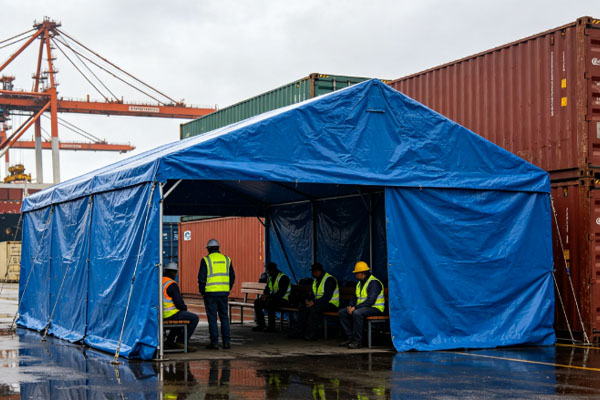
Therefore, building a simple, rainproof, sun-shading, and easy-to-maintain rest shelter at the port is a practical way to improve working conditions for employees on site. PVC tarpaulin has good waterproofing, weather resistance, and tensile strength, and can be combined with steel pipes, aluminum alloy, or other support structures to form a relatively stable temporary or semi-permanent rest shelter. According to the available space, number of personnel, installation location, and weather conditions at the port, different sizes of Tarp, Tarpaulin Cover, or PVC Tarp structures can be customized to make the rest area better suited to actual work requirements.
The port environment differs from ordinary outdoor locations. There may be relatively high levels of moisture, salt, dust, and contaminants generated by mechanical operations in the air. A rest shelter placed outdoors for long periods needs to provide not only rain protection but also resistance to sunlight, wind, and frequent use. Therefore, material selection should not be based solely on price. Service life, tensile strength, and the convenience of daily cleaning and maintenance should also be considered. PVC tarpaulin is usually made by adding a PVC coating to the surface of a fabric base, creating an effective waterproof barrier. Compared with ordinary thin covering materials, it generally has higher overall strength and is more suitable for making large shelter roof covers and side enclosures.
The most direct requirement for a port worker rest shelter is rain protection. The surface of PVC Tarp has good waterproof performance, allowing rainwater to flow toward the edges along the tarpaulin surface after falling onto it. With a properly designed roof slope, water accumulation on the top can be reduced. If the rest shelter needs to be used for long periods during the rainy season, attention should also be paid to tarpaulin seams, edge treatment, and fixing points. Simply choosing a waterproof material cannot guarantee that the entire shelter will be completely leak-proof. Heat sealing, sewing, edge binding, and grommet areas also need to be properly processed.
During summer, simply building a steel frame without a roof cover cannot solve the problem of high temperatures for port workers during breaks. PVC tarpaulin can block most direct sunlight and create a relatively cool area inside the shelter. When designing the roof, side tarpaulins can be added according to the direction of sunlight. For example, when the sun is at a lower angle in the morning and afternoon, the shelter may still be exposed to sunlight from the sides even with roof shading. In this case, adding partial side enclosures can further improve the comfort of the rest area.
Port rest shelters generally need to be opened, closed, cleaned, and assembled or disassembled repeatedly, so the tarpaulin should not be too weak. Good tensile strength can reduce the risk of tearing during installation and use. For larger rest shelters, the spacing between grommets and fixing points should also be properly arranged so that wind forces can be transferred through the support structure rather than concentrated on a single grommet.
Design Content | Recommended Focus |
Tarpaulin Material | PVC-coated tarpaulin, with different thicknesses available according to the environment |
Roof Structure | Maintain a certain slope to facilitate rainwater drainage |
Fixing Method | Combined fixing with grommets, straps, fastening strips, etc. |
Side Design | Side enclosures can be added according to sun and rain protection requirements |
Shelter Size | Customized according to the number of people resting and available site space |
Edge Treatment | Edge binding, reinforcement straps, and other methods can improve the strength of fixing areas |
Daily Maintenance | Regularly clean the tarpaulin and inspect fixing points and the tarpaulin surface |
When designing a practical port rest shelter, it is also necessary to comprehensively consider the wind conditions, rainfall, sunlight direction, ground conditions, and number of workers at the port site. The roof structure should maintain an appropriate slope to prevent long-term accumulation of rainwater; the support frame needs sufficient stability to prevent shaking in strong winds; and the tarpaulin edges, grommets, and connection points should be reinforced to reduce tearing or loosening caused by long-term tension. Only by planning the material, structure, and installation details together can the rest shelter truly meet the requirements for rain protection, sun shading, ventilation, and durability.
The roof tarpaulin is the most important part of the entire rest shelter and needs to provide both sun and rain protection. During design, a single-slope, double-slope, or other structure suitable for the site can be used to allow rainwater to drain naturally toward designated areas. For outdoor environments such as ports, the roof should not be designed as a completely horizontal surface. A flat roof can cause rainwater to accumulate in the middle of the tarpaulin, and long-term water accumulation can increase the load on both the tarpaulin and the support structure.
If port workers only need basic sun protection, an open structure can be used to allow air to circulate freely. If wind and rain protection are also required, PVC tarpaulin can be added to both sides or the rear of the rest shelter. It is not necessary to completely enclose the sides. Although full enclosure provides better rain protection, it can affect air circulation during hot weather. Therefore, a more practical approach is to use partial side enclosures or roll-up designs according to the local weather conditions and the location of the rest shelter.
The areas of PVC tarpaulin that are most likely to experience tension are generally not the center of the tarpaulin but the edges, grommets, and points connected to the support frame. Therefore, when manufacturing tarpaulin for a rest shelter, reinforcement straps can be added along the edges, followed by fixing holes in the form of Tarp with Grommets or Eyelets. If the rest shelter is located in a port area with strong winds, the number of fixing points should also be appropriately increased, and the stability of the support frame foundation should be checked. Even if the tarpaulin itself has high strength, an unstable support structure will affect the overall safety.
Work arrangements at port sites may change, so a rest shelter does not necessarily need to be a permanent structure. For temporary rest areas, a design that is easy to assemble and disassemble can be adopted. Workers can adjust the tarpaulin according to the season, work area, and site arrangements. When the weather is good, some side enclosures can be opened; during the rainy season, additional side protection can be installed; and when the shelter needs to be moved, the tarpaulin can simply be removed.
Since different rest shelters are used in different environments, suitable material specifications also vary. In addition to thickness and weight, waterproof performance, tensile strength, abrasion resistance, weather resistance, and UV resistance should be considered comprehensively. Port environments are usually relatively humid and may expose the tarpaulin to sea winds, salt spray, dust, and mechanical friction. Therefore, suitable PVC tarpaulin specifications should be selected according to service time, installation location, wind conditions, and maintenance requirements. For temporary rest shelters intended for short-term use, lightweight materials can be selected. For rest shelters intended for long-term fixed use, a Heavy Duty Tarp with higher strength and better aging resistance is recommended.
Port rest shelters are generally exposed to outdoor conditions for long periods. Therefore, waterproofing, weather resistance, tensile strength, abrasion resistance, and aging resistance should be prioritized. If the rest shelter is expected to be used for a long time, the UV resistance of the material can also be considered. For temporary rest shelters used for only a short period, relatively lightweight PVC tarpaulin can be selected. For long-term fixed rest shelters, materials such as Heavy Duty Tarp with higher strength and better weather resistance can be considered.
The tarpaulin dimensions of a small rest shelter are relatively simple and can be processed directly according to the roof dimensions. If the shelter has a large area, multiple pieces of material may need to be joined together. The seams should remain flat, and suitable heat-sealing or sewing methods should be selected according to the product structure. The edges can be bound, followed by the installation of grommets and reinforcement straps for subsequent connection with the support structure.
The size of a rest shelter should not be determined simply by whether it can provide sufficient coverage. Workers need space to sit, enter and exit, and place a small amount of personal belongings, so a certain amount of additional space should be reserved. For example, a small shelter for a few workers taking short breaks can use a relatively compact structure. If several workers take turns resting, the roof area should be increased and sufficient ventilation space should be provided.
PVC tarpaulin can be customized not only according to dimensions but also according to actual color requirements. Light-colored materials generally create a brighter visual impression, while dark-colored materials tend to be more resistant to visible dirt. For port sites, colors can also be customized according to corporate identification colors, making the rest shelter easier to identify on site. If a company logo or other markings are required, customization can be carried out after confirming the printing method and application environment, allowing the rest shelter to also serve an on-site identification function.
The construction of a rainproof and sun-shading rest shelter for port workers can follow the sequence of “site confirmation—material selection—size design—processing and manufacturing—on-site installation—regular maintenance.” First, the installation location should be determined according to the port work area, personnel flow, vehicle traffic, and drainage conditions to avoid affecting normal operations. Then, suitable PVC tarpaulin specifications should be selected according to the local climate, number of users, and expected service life, followed by dimension design, cutting, joining, edge binding, and grommet processing. After installation, the stability of the support frame, tarpaulin tension, and drainage performance should be checked. During use, the tarpaulin should be cleaned regularly, and fixing points, edges, and surface wear should be inspected to ensure that the rest shelter remains safe and comfortable over time.
Before installation, the location of the rest shelter needs to be determined. Check whether there are large pieces of equipment, vehicle routes, water accumulation areas, or other factors nearby that may affect personnel rest. If the rest shelter is close to an operating area, care should also be taken not to interfere with the normal movement of vehicles and personnel.
After determining the location, the size of the rest shelter should be designed according to the number of workers, frequency of use, and available site space. The roof tarpaulin should have an appropriate slope and drainage space to prevent long-term accumulation of rainwater, which could cause sagging or leakage. The side enclosures should be determined flexibly according to local wind direction, sunlight angle, rainfall, and ventilation requirements. Fixed, semi-enclosed, or roll-up designs can be used. If the rest shelter is close to a vehicle passage, its overall height and footprint should also be controlled to ensure that port equipment, vehicles, and personnel can move normally.
After the dimensions are confirmed, the tarpaulin can be cut, joined, edge-bound, reinforced, and fitted with grommets. For rest shelters intended for long-term use, edge reinforcement is particularly important because these areas need to withstand greater fixing tension.
After installation, check whether the tarpaulin is properly tensioned, whether the grommets are securely fixed, whether the edges are noticeably loose, and whether the support frame is stable. It is also recommended to conduct an inspection after the first strong wind or heavy rainfall. If loose fixing points, localized water accumulation, or edge wear are found, they should be addressed promptly.
PVC tarpaulin combines rain protection, sun shading, and good mechanical strength, making it suitable for long-term outdoor use.
Yes. The tarpaulin can be cut, joined, and processed according to the roof dimensions, support structure, and number of workers. Grommets, reinforcement straps, and edge binding can also be added according to the fixing method.
Not necessarily. If the main requirement is sun protection, an open design can be used. If the shelter frequently experiences rainfall or side winds, partial side enclosures can be added. For hot weather, it is recommended to maintain sufficient ventilation space.
Material quality, application environment, and installation method all affect service life. For long-term outdoor use, materials with good weather resistance should be selected. At the same time, long-term friction between the tarpaulin and sharp objects should be avoided, and the grommets, edges, and fixing areas should be inspected regularly.
Yes. A removable design can be adopted. After removal, the tarpaulin can be cleaned with water and mild cleaning methods. Strongly corrosive cleaning agents that may damage the PVC surface should be avoided.
In addition to selecting PVC tarpaulin with good strength, an appropriate number of fixing points should be added, and the connection between the support frame and the ground should be reliable. For areas with strong winds, the rest shelter structure should be designed according to the actual local weather conditions.
Port workers are exposed to complex outdoor conditions such as sunlight, rain, sea winds, and humidity for long periods. A properly designed rest shelter with reliable materials can not only provide workers with a temporary space for resting, rain protection, and cooling but can also help improve on-site working conditions and management efficiency. PVC tarpaulin combines waterproofing, sun shading, weather resistance, and tensile strength and can be customized according to the actual dimensions of the rest shelter, support structure, number of users, and local weather conditions. Through roof drainage design, edge reinforcement, grommet fixing, and side enclosure configuration, a more stable, practical, and easy-to-maintain rest area can be created.
Newstar has extensive experience in the production of PVC fabrics and PVC tarpaulins and can provide processing services such as cutting, joining, edge binding, and the installation of grommets and reinforcement straps according to project requirements. We can help customers develop a complete solution from material selection to finished product application. If you are planning a rest shelter for port workers, please provide the required dimensions, installation location, application environment, sun and rain protection requirements, and whether side enclosures are needed. We will assist you in selecting a suitable PVC Tarpaulin, PVC Tarp, or Heavy Duty Tarp solution according to the actual conditions, helping create a more comfortable, reliable, and durable rest space for port workers.
Email: tarp@newstarventilation.com
Phone: 0086-13921439224
