
Hot Keywords:
- All
- Product Name
- Product Keyword
- Product Model
- Product Summary
- Product Description
- Multi Field Search

PVC tarpaulin ventilation ducts are flexible air-conveying products commonly used in ventilation engineering. They can be customized according to fan connections, installation spaces, air delivery distances, and other project requirements. Compared with rigid ducts, PVC tarpaulin ducts can be processed into different diameters, lengths, and configurations through cutting, heat welding, reinforcement, and accessory installation. They are suitable for industrial workshops, warehouses, agricultural facilities, construction areas, temporary buildings, and equipment operating zones. During manufacturing, the thickness of the PVC tarpaulin, base fabric strength, connection method, duct shape, and air outlet structure all need to be considered to ensure that the finished duct maintains good stability during continuous operation. For projects where duct positions need to be frequently moved or adjusted, the flexible PVC structure can be folded, rolled, and connected with quick-installation components, reducing installation and adjustment difficulties. A well-designed manufacturing solution not only improves duct durability but also helps maintain efficient airflow, convenient installation, and manageable maintenance costs.
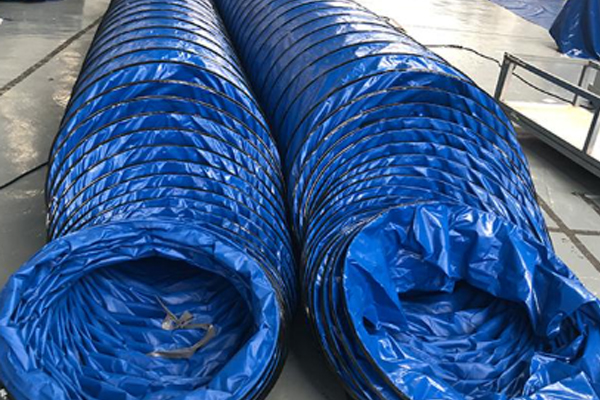
PVC Tarpaulin Ventilation Duct Materials and Manufacturing Solution
The performance of PVC tarpaulin ventilation ducts is closely related to material selection and manufacturing technology. During production, suitable PVC tarpaulin specifications should be selected according to the operating pressure of the ventilation equipment, installation environment, duct dimensions, and expected service life. The material is then processed through accurate cutting and connection procedures to form the main duct structure. Indoor projects may place greater emphasis on flexibility, weight, and processing convenience, while outdoor projects require better weather resistance, moisture resistance, and UV resistance. Since duct diameters, interfaces, and reinforcement requirements vary from project to project, PVC tarpaulin ventilation ducts are generally suitable for customized manufacturing.
PVC Tarpaulin Material Selection and Performance
PVC tarpaulin is generally made from a textile base fabric combined with a PVC coating. The internal fabric provides tensile support, while the outer PVC coating provides properties such as water resistance, moisture resistance, abrasion resistance, and easy cleaning. When manufacturing ventilation ducts, the weight, thickness, fabric density, and coating performance of the material can all affect the final product. For large-diameter ducts or long-distance air delivery, tensile strength and seam strength are particularly important. If the duct needs to be rolled and unfolded frequently, a material with good flexibility should be selected to reduce damage caused by repeated folding. For outdoor ventilation projects, the local climate should also be considered when selecting PVC tarpaulin with suitable weather resistance. Proper material selection helps the duct maintain structural integrity under different operating conditions.
PVC Tarpaulin Ventilation Duct Manufacturing Process
Manufacturing a PVC tarpaulin ventilation duct is more than simply rolling the material into a tube. The process requires layout preparation, cutting, interface fabrication, edge reinforcement, heat welding, and accessory installation according to the designed dimensions. Both ends of the duct generally require connection structures that match the fan or other ventilation equipment. Long ducts can also be equipped with suspension straps, hanging loops, or reinforcement belts to improve stability during installation. Air outlets are designed according to actual airflow distribution requirements so that air can be released effectively throughout the target area.
The common manufacturing process includes the following steps:
Dimension confirmation and layout: Determine the cutting dimensions according to the fan interface, duct diameter, duct length, and installation route. Additional space should be reserved for connection and heat welding to avoid dimensional deviations in the finished product.
Tarpaulin cutting and edge treatment: Cut the material according to the layout dimensions and reinforce areas that are likely to experience greater tension, improving structural stability during lifting and operation.
Heat welding and interface fabrication: Process longitudinal seams and end interfaces using an appropriate PVC heat-welding method. This creates a continuous structure while allowing connection ports to be customized according to the equipment used on site.
Air outlet fabrication: Create circular, strip-shaped, or other outlet structures according to the required air delivery distance, coverage area, and installation position.
Finished product inspection: After manufacturing, inspect dimensions, seams, interfaces, and fastening points to ensure there are no obvious cracks, separation, or processing defects before packaging and transportation.
After these manufacturing steps are completed, PVC tarpaulin can be formed into a complete flexible ventilation duct that can be connected to different types of air supply equipment.
PVC Tarpaulin Duct Installation Methods and Application Scenarios
PVC tarpaulin ventilation ducts offer considerable flexibility in installation. They do not necessarily need to follow the same fixed layout used for rigid duct systems and can be arranged according to the building structure and equipment positions. Before installation, the fan location, main duct route, air outlet height, and suspension points should be determined so that air can flow smoothly into the required areas. For longer ducts, the self-weight and operating conditions should also be considered, with appropriate support structures installed at suitable locations. PVC tarpaulin ducts are suitable for both permanent ventilation systems and temporary projects that require rapid installation and removal.
PVC Tarpaulin Ventilation Duct Installation and Operating Method
Before installing a PVC tarpaulin duct, inspect the material surface, heat-welded seams, and connection points to ensure there is no obvious damage. When connecting the duct to a fan, the interface dimensions should be properly matched, and clamps, straps, or other suitable accessories should be used to secure the connection. For horizontally suspended ducts, suspension points should be arranged according to the duct length to prevent excessive concentrated tension at a single location. During operation, check whether the duct experiences abnormal vibration, local collapse, or air leakage at the connections, and adjust the suspension points when necessary. For ducts with multiple outlets, the number and positions of air outlets can be adjusted according to the actual temperature and airflow conditions. When the system is not in use, the duct can be removed, cleaned, dried, and rolled up for storage if the working area needs to be rearranged. Proper operation can extend material service life while helping maintain stable airflow.
PVC Tarpaulin Ventilation Duct Application Scenarios
PVC tarpaulin ducts can be customized for different project environments, so their applications are not limited to a single type of ventilation system. Industrial production areas, warehouses, agricultural greenhouses, construction sites, and temporary work shelters can all use flexible ducts according to their air delivery requirements. Permanent factories can use long-distance supply ducts, while temporary facilities can use detachable structures for rapid installation. Some equipment areas require concentrated air delivery, and branched ducts with multiple connection ports can be manufactured to distribute air to different working positions. By changing the duct diameter, length, and outlet configuration, the same PVC tarpaulin material can be manufactured into different engineering products.
Duct Configuration for Different Working Environments
In practical projects, PVC tarpaulin duct configuration should be adjusted according to the space size, ventilation equipment capacity, installation height, and work activities. Proper structural planning allows the flexible duct to integrate more effectively into the site instead of simply increasing duct length or the number of outlets.
Industrial production workshops: Flexible air supply ducts can be installed around equipment-intensive areas, with directional outlets delivering air to operator zones or equipment surroundings. Large workshops can use different duct routes according to production zones.
Warehouses and logistics spaces: PVC tarpaulin ducts can be installed along storage aisles, loading areas, or elevated spaces. When cargo positions change, the ducts can also be repositioned, reducing restrictions caused by fixed ventilation facilities.
Agricultural greenhouses: PVC tarpaulin ducts can be installed along the length of a greenhouse and equipped with multiple outlets to distribute air throughout different areas.
Construction and temporary work areas: Since construction environments frequently change, flexible ducts can be removed, relocated, and reinstalled according to construction progress, making them suitable for temporary ventilation and air delivery.
Equipment cooling areas: For work areas containing localized heat sources, short-distance directional ducts can be used to deliver air directly toward designated equipment or operating positions.
Different application environments can use different duct diameters, lengths, and outlet designs, allowing PVC tarpaulin ventilation ducts to better match actual engineering requirements.
PVC Tarpaulin Ventilation Duct Advantages and Product Features
PVC tarpaulin ventilation ducts provide more than air transportation. They also offer flexible installation, convenient transportation, and diverse processing options. For sites where fixed ventilation ducts are difficult to install, the flexible structure can reduce construction limitations. Products can be cut and connected according to project requirements and can also be equipped with reinforcement belts, suspension loops, quick connectors, and other components for long-term or frequently relocated applications. With proper material selection and manufacturing processes, PVC tarpaulin can maintain its flexibility while providing the durability required for regular ventilation applications.
Advantages of PVC Tarpaulin Ventilation Ducts
PVC tarpaulin ducts are suitable for environments requiring flexible air delivery, particularly projects where building layouts frequently change or installation conditions are complex. Their flexible structure provides greater convenience during construction, while the material itself offers protective properties that make it suitable for certain humid, dusty, and outdoor environments.
High flexibility: The duct can be bent and arranged according to the installation route, making it suitable for locations where rigid ducts are difficult to install.
Efficient installation: The relatively lightweight structure makes handling and installation easier when used with suspension straps, fasteners, and quick connectors.
Convenient transportation and storage: The duct can be rolled or folded when not in use, reducing storage space and making it easier to move between different projects.
Wide range of customization options: Diameter, length, fan interface, and air outlet configuration can be customized according to project requirements.
Convenient maintenance: The PVC surface is relatively easy to clean, while regular inspections of seams and fastening points can support routine maintenance.
Suitable for temporary projects: Construction sites, temporary factories, and seasonal facilities can install, remove, and reuse flexible ducts according to project schedules.
These features make PVC tarpaulin ventilation ducts a flexible product choice for a wide range of engineering conditions.
Structural Features of PVC Tarpaulin Ventilation Ducts
PVC tarpaulin ventilation ducts can use a single main duct structure or incorporate branch ducts and multiple air outlets according to the airflow route. Circular ducts are suitable for conventional air transportation, while strip-shaped outlet structures can be used where a wider air distribution range is required. Long ducts can be equipped with longitudinal reinforcement belts and suspension loops to improve stability when suspended. Fan interfaces can be customized according to equipment dimensions, while straps, clamps, or other suitable connection methods can be used at the interface. Some projects also require rapid installation and removal, in which case zippers, fasteners, or dedicated connection components can be added. During the design stage, the material specifications can also be adjusted according to installation height, bending locations, and frequency of use so that the finished product better matches actual project conditions.
Design Item | Customizable Content | Application Requirement |
Duct diameter | Determined according to fan and airflow requirements | Different air delivery capacities |
Duct length | Manufactured according to site distance | Short- or long-distance air supply |
Interface size | Matched with fans and other ducts | Quick connection |
Outlet structure | Circular, strip-shaped, etc. | Directional or uniform air distribution |
Reinforcement structure | Reinforcement belts, suspension loops, etc. | Long-distance suspension |
Installation method | Suspension, fixing, quick removal | Different construction environments |
Material specification | Thickness, weight, base fabric structure | Different service periods |
PVC Tarpaulin Duct Customization and Engineering Services
PVC tarpaulin ventilation ducts are suitable for customized manufacturing based on actual project requirements. Customers can provide the fan interface size, duct diameter, expected length, operating temperature, installation position, and air outlet requirements. Based on this information, the manufacturer can determine the appropriate PVC tarpaulin specification, connection structure, and processing method. For long-term projects, special attention can be given to reinforcing heat-welded seams, suspension points, and fan connection areas. For short-term projects, structures that are easy to install, remove, and store can be prioritized. After manufacturing, the duct should also be inspected for dimensions, interface strength, heat-welding quality, and surface condition to ensure smooth installation at the project site.
If you are looking for customized PVC tarpaulin ventilation ducts with different diameters, lengths, interfaces, or air outlet configurations, you can contact us for a suitable product solution. WeChat: 0086-13921439224; Email: tarp@newstarventilation.com. Please provide the application scenario, fan interface dimensions, and duct specifications, and we can recommend suitable PVC tarpaulin materials and manufacturing structures for industrial workshops, warehouses, agricultural facilities, construction sites, and temporary ventilation projects.
