
Hot Keywords:
- All
- Product Name
- Product Keyword
- Product Model
- Product Summary
- Product Description
- Multi Field Search

Open-air storage yards are commonly used for cargo turnover, temporary equipment storage, building material storage, and logistics transfer. However, long-term exposure to rain, sunlight, strong winds, and dust can easily lead to damp goods, aging packaging, and equipment corrosion. When constructing a PVC tent house, the tarpaulin, metal frame, drainage system, and ground anchoring structure should be properly designed according to the yard area, cargo type, service period, wind and rain conditions, and vehicle access requirements, making the temporary or semi-permanent storage space more stable and secure.
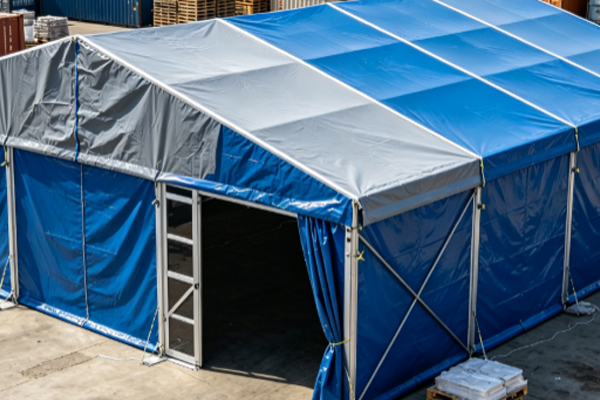
The protection requirements of open-air storage yards are usually more complex than those of ordinary rain shelters. They must cover a large area while also accommodating cargo access and long-term outdoor use.
Goods stored outdoors are easily affected by rain, sunlight, windblown sand, and dust, so comprehensive protection is necessary.
Rain and Moisture Protection: The PVC coating can reduce direct contact between rainwater and the goods.
Sun and UV Protection: UV resistance can reduce the effects of sunlight on the tarpaulin and cargo packaging.
Wind and Dust Protection: Sidewalls can reduce the entry of windblown sand and dust.
Reduced Packaging Damage: They can slow the aging of packaging materials such as cartons and wooden cases.
Convenient Classification and Management: They provide independent temporary storage spaces for different types of goods.
PVC tent houses can help open-air storage yards achieve safer and cleaner cargo storage.
Different goods have different sensitivities to rain, sunlight, and dust, so the construction solution should be adjusted accordingly.
Storage Yard Goods | Main Risks | PVC Tent House Focus | Supporting Measures |
Building materials and panels | Rainwater and dust | Waterproofing and tear resistance | Elevate the goods |
Equipment in wooden cases | Rainwater and ultraviolet rays | Waterproofing, weather resistance, and UV resistance | Maintain bottom ventilation |
Palletized goods | Standing water and strong winds | Waterproofing and tear resistance | Reinforce edge fastening |
Metal equipment | Moisture and rainwater | Waterproofing and weather resistance | Apply rust-prevention measures |
Machinery and equipment | Rainwater, dust, and abrasion | High strength and wear resistance | Customize openings and reinforced areas |
Goods requiring frequent turnover | Frequent loading and unloading | Flexibility, wear resistance, and easy opening | Install roll-up doors or side curtains |
The cargo type and protection requirements determine the configuration of the PVC tent house. One specification cannot be used for every storage yard.
PVC tarpaulins are generally made of high-strength polyester base fabric and PVC coating. Different weights, thicknesses, widths, and functions can be selected according to the application requirements. Large-span outdoor tent houses also require integrated design with metal frames, connectors, and ground anchoring systems.
Material selection should be based on the tent house span, service period, and site conditions.
Short-Term Use: Focus on waterproofing, tear resistance, and installation convenience.
Long-Term Use: Give priority to weather resistance, UV resistance, wear resistance, and aging resistance.
Large-Span Tent Houses: Pay attention to base fabric strength, tear resistance, and the reliability of connection areas.
Special Locations: Flame-retardant or antistatic functions can be selected when required.
PVC tarpaulins are available in different weights and functional options. The specific specifications should be determined according to the tent house structure, climate, and operating environment.
Large storage yards usually require extensive coverage, and the tarpaulin may need to be seamed. Seaming quality affects waterproof performance and service life. PVC tarpaulins can be joined by heat welding to reduce seams and the risk of water leakage. The edges, corners, eyelets, and load-bearing areas of the tarpaulin should be reinforced to prevent tearing caused by long-term tension. Tarpaulins are mainly used for rain protection and enclosure, while the overall stability of the tent house still depends on the metal frame and ground anchoring system.
Material performance is only the foundation. Whether a tent house can withstand outdoor conditions also depends closely on the metal frame, foundation anchoring, drainage slope, fastening points, and on-site construction methods.
If drainage is not properly designed for a large tent house, accumulated rainwater can increase the roof load, cause the tarpaulin to sag, and even affect the stability of the frame. The following points should be considered during construction:
Set an appropriate roof slope to allow rainwater to drain naturally;
Prevent low spots from forming in the middle of the tarpaulin;
Install drainage ditches around the tent house;
Elevate the goods with pallets or supports;
Check standing water, tarpaulin slackness, and drainage channels after rainfall;
Properly design the eaves, downspouts, and ground drainage system.
Ensuring that rainwater drains smoothly is more important than simply increasing the tarpaulin thickness.
The more open the storage yard and the larger the tent house area, the higher the wind-resistance requirements. During construction, suitable frames and fastening methods should be selected according to the span and local wind conditions, with tension ropes, pressure strips, and fasteners arranged properly. Tarpaulin tension should be moderate. The foundation, frame, connectors, and tarpaulin should be inspected before and after strong winds. If wind speeds exceed the design conditions, the tent house should be reinforced, closed, or dismantled in time. PVC tarpaulins are mainly used for waterproofing, tear resistance, and wear resistance, while the wind resistance of the tent house must be jointly ensured by the frame, connectors, and foundation.
For storage yards requiring long-term use, the purchase price is only one part of the total cost. Tarpaulin replacement, repairs, labor for assembly and dismantling, and losses caused by damaged goods should all be included in the overall solution evaluation.
If the tent house needs to be used repeatedly, material quality, frame corrosion protection, foundation anchoring, and routine maintenance will all affect its service life. During procurement, it is recommended to confirm the following points:
Weight, thickness, and base fabric structure of the PVC tarpaulin;
Tear resistance, wear resistance, waterproofing, UV resistance, and weather resistance;
Whether flame-retardant or antistatic functions are required;
Reinforcement methods for heat-welded seams, edges, corners, and eyelets;
Material, specifications, and corrosion protection treatment of the metal frame;
Connection nodes, foundation anchoring, and ballast systems;
Operating temperature, wind conditions, rainfall, and ground conditions.
Proper selection of the PVC tarpaulin, metal frame, and anchoring system can reduce repairs and replacements while improving the service life and safety of the tent house.
To avoid material mismatches, the following information should be confirmed before procurement:
Storage yard dimensions and coverage area;
Tent house span, height, and frame structure;
Cargo type and stacking height;
Whether the tent house will be used temporarily or long term;
Local rainfall, sunlight, and wind conditions;
Ground type and fastening method;
Weight, thickness, and width of the PVC tarpaulin;
Whether UV resistance, flame retardancy, or antistatic functions are required;
Requirements for doors, side curtains, eyelets, and edge reinforcement;
Frame material, corrosion protection treatment, and fastening solution;
Whether customized dimensions, structural calculations, or installation guidance are required.
Confirming these parameters in advance can reduce rework and make the PVC tent house more suitable for use in open-air storage yards.
With the proper configuration of tarpaulins, metal frames, foundation anchoring, and drainage systems, PVC tent houses can meet the needs of open-air storage yards for rain protection, sun protection, wind resistance, and cargo protection. After construction, the tarpaulin tension, welded areas, connectors, anchoring points, and drainage channels should also be inspected regularly. Loose components, standing water, and localized wear should be addressed promptly. Newstar Plastic Industry Co.,Ltd. can provide PVC tarpaulins in different weights, widths, and functional configurations, as well as customized dimensions and material solutions, helping customers select suitable PVC tent house materials according to storage yard area, cargo type, service period, and project structure requirements.
