
Hot Keywords:
- All
- Product Name
- Product Keyword
- Product Model
- Product Summary
- Product Description
- Multi Field Search

In construction projects, logistics transfer, equipment manufacturing, project stockpiling, and other scenarios, large cargo often faces problems such as insufficient fixed warehouse space or increased demand for temporary storage. Compared with ordinary small goods, large equipment, machinery, construction materials, and other cargo not only occupy more space but also have higher requirements for access aisles, lifting operations, and interior height. PVC tent houses can quickly create temporary storage areas by utilizing large internal spaces, while PVC tarpaulins provide rainproof, dustproof, and certain outdoor environmental protection. By properly planning the tent house span, door openings, flooring, and cargo layout, it is possible to meet the storage needs of large cargo while improving site utilization and logistics efficiency.
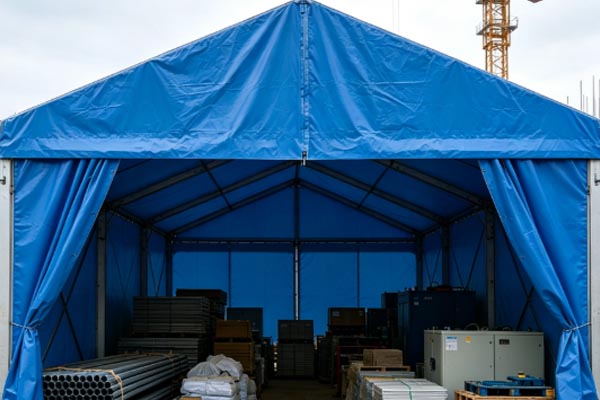
Large cargo is usually difficult to move frequently into fixed warehouses. Therefore, temporary storage space must be sufficiently large and convenient for vehicles, forklifts, and lifting equipment to enter and exit. PVC tent houses can be constructed according to site conditions, providing flexible temporary storage space for large cargo.
When companies face concentrated orders, equipment awaiting delivery, project material stockpiling, or warehouse renovations, indoor warehouses may not be able to meet storage requirements. PVC tent houses can add temporary storage space in suitable outdoor areas, offering the following advantages:
Tent house dimensions can be planned according to the available site area.
Operating space can be reserved for large equipment.
Access aisles can be provided for vehicles and forklifts.
Storage capacity can be expanded temporarily according to project needs.
This approach can help relieve the pressure caused by insufficient fixed warehouse space.
Large machinery, equipment, and construction materials stored outdoors for extended periods are easily affected by rain, dust, and sunlight. PVC tarpaulins can be used as enclosure materials for tent houses to provide protection on the top and sides, including:
Reducing direct contact between rainwater and cargo.
Reducing dust accumulation and cleaning frequency.
Minimizing direct sunlight exposure.
Enhancing protection by combining sidewalls, door curtains, and ground moisture-proof measures.
Comprehensive external protection can provide a more stable temporary storage environment for large cargo.
Temporary storage of large cargo places higher requirements on tent house dimensions and material performance. Proper planning should begin with three aspects: cargo dimensions, service period, and site environment.
The length, width, and height of large cargo determine the dimensions of the tent house. During planning, space should also be reserved for personnel operations, vehicle access, and maintenance. The key planning points for different cargo types are as follows:
Large Cargo Type | Main Storage Requirements | Key Tent House Planning Points | PVC Tarpaulin Considerations |
Construction Machinery | Frequent access and large operating space | Main doors, clear height, aisles | Waterproofing, abrasion resistance |
Industrial Equipment | Dustproof and rainproof protection | Height, lateral space | Waterproofing, weather resistance |
Steel Structures and Building Materials | Long dimensions | Large span, zoning | Tear resistance, weather resistance |
Large Components | Classified storage | Racks, aisles | Waterproofing, dustproofing |
Vehicles and Transport Equipment | Vehicle access | Door openings, turning areas | Waterproofing, UV resistance |
Project Construction Materials | Temporary storage | Modular space | Waterproofing, weather resistance |
Properly reserving sufficient space can improve the utilization of the tent house while preventing access restrictions for large cargo later.
The temporary storage period for large cargo may range from several weeks to several months. PVC tarpaulins should be selected according to the intended service period:
Short-term use: Focus on waterproofing, abrasion resistance, and ease of installation.
Medium-term use: Consider weather resistance, tear resistance, and ease of maintenance.
Long-term use: Focus on UV resistance, aging resistance, and long-term waterproof performance.
The longer the service period, the higher the durability requirements for PVC tarpaulins.
After the tent house is constructed, PVC tarpaulins are mainly used for rainproofing, dustproofing, and shading. Protection for large cargo generally includes the top, sides, and bottom.
The roof area of a large tent house is extensive, so rainwater should be discharged promptly to prevent water accumulation. The following points should be considered during design:
Set an appropriate roof slope.
Properly seal the tarpaulin seams.
Regularly check whether the tarpaulin is damaged or slack.
Keep drainage channels and surrounding ground clear.
PVC tarpaulins have good waterproof performance, but the actual rainproof effect also depends on the structure, seam sealing, and drainage design.
Covering only the roof may not provide sufficient protection for large equipment. Installing sidewalls can reduce the entry of rainwater, dust, and windblown sand.
Strengthen side protection during the rainy season.
Improve enclosure coverage in dusty environments.
Install openable sidewalls in areas with frequent loading and unloading.
Adjust the opening and closing of sidewalls according to seasonal conditions.
Properly adjusting the side coverage can balance protection performance and operational convenience.
Large temporary tent houses must not only solve the problem of “where to store the cargo,” but also address how cargo enters and exits, how it is managed, and how long-term investment can be reduced.
Large cargo storage areas can be divided according to actual operating procedures into cargo storage areas, inspection areas, loading and unloading areas, maintenance and operation areas, temporary transfer areas, and vehicle and forklift access areas. Properly dividing functional areas can reduce interference between different operations, improve the utilization of internal tent house space, and facilitate subsequent cargo management.
Large cargo usually requires mechanical equipment for handling, so aisles cannot be planned simply according to ordinary warehouse standards. The following factors should be considered:
Forklift width and operating radius.
Vehicle turning radius.
Cargo length and placement direction.
Personnel activity areas.
Access routes for loading and unloading equipment.
Space required for temporary cargo transfer.
Sufficient aisle space can reduce collisions and repeated adjustments during handling operations.
During use, the tarpaulins, drainage system, and fixing points should be inspected regularly. Any damage, looseness, or blockage should be addressed promptly to ensure normal tent house operation and storage safety.
Temporary storage of large cargo requires proper planning of the structure, materials, and site management. Setting suitable entrances, exits, aisles, and cargo zones, together with regular inspections of the tarpaulins, drainage system, and fixing points, helps ensure storage safety. Newstar Plastic Industry Co.,Ltd. specializes in PVC tarpaulins, PVC-coated fabrics, and outdoor protective materials, and can provide customized materials in different specifications and functions according to the needs of engineering storage, logistics transfer, equipment protection, and other applications.
