
Hot Keywords:
- All
- Product Name
- Product Keyword
- Product Model
- Product Summary
- Product Description
- Multi Field Search

During logistics transshipment, goods often face problems such as short-term concentrated storage, frequent loading and unloading, and insufficient warehousing space. Especially during peak logistics seasons, warehouse expansion, or temporary transshipment periods, traditional fixed warehouses find it difficult to quickly increase available space. PVC tent warehousing spaces offer flexible installation, convenient use, and adaptability to temporary sites, providing transshipped goods with shelter from rain, dust protection, and centralized management space. Proper planning of tent area, access routes, cargo zones, and protective structures can improve warehousing efficiency and reduce the impact of outdoor conditions on goods.
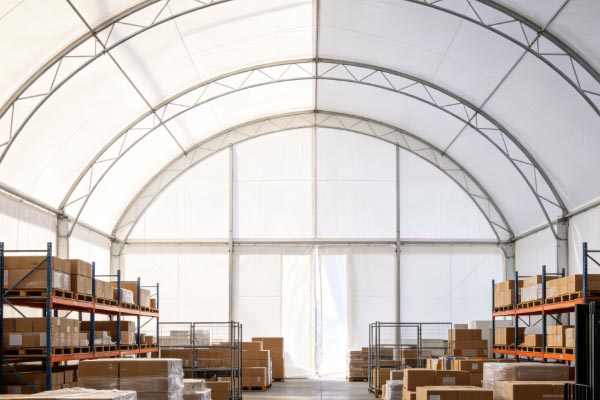
Logistics transshipment is characterized by fast turnover and frequent movement of goods, creating high demands for flexible warehousing space. PVC tents can be quickly installed according to site conditions to create temporary storage areas, making them suitable for short-term warehousing needs.
As orders increase during peak logistics seasons, fixed warehouses may be unable to accommodate all goods. PVC tents can quickly increase temporary warehousing capacity.
Adjust the storage area according to the quantity of goods.
Divide storage areas according to cargo types.
Properly plan personnel and vehicle access routes.
Flexibly increasing warehousing space helps logistics companies cope with inventory pressure during peak seasons.
During the waiting period for loading or transportation, goods may remain outdoors for an extended time. Sudden rainfall can affect their packaging and condition. The top and sides of PVC tents can reduce the amount of rainwater entering the storage area. For goods that are particularly sensitive to moisture, pallets, racks, and other methods can be used to isolate them from the ground, thereby improving environmental protection for transshipped goods.
Logistics transshipment requires not only temporary storage but also receiving, sorting, checking, and loading operations. The interior of the PVC tent should be planned according to the actual workflow.
Set up a temporary storage area for convenient classification and management.
Set up a sorting area to reduce mixed storage and misplacement.
Reserve forklift aisles to ensure smooth handling.
Plan pedestrian routes to reduce intersections between personnel and vehicles.
Set up loading and unloading areas to improve the efficiency of cargo movement.
Properly integrating warehousing and logistics processes can improve the utilization efficiency of tent space.
PVC tent warehousing solutions should be designed according to the quantity, type, turnover frequency, and storage duration of the goods. Material selection and space layout should also be considered simultaneously to reduce the need for later adjustments.
Different goods vary in size, packaging form, and handling method, so the interior layout should not follow a completely uniform pattern.
Logistics Transshipment Scenario | Main Requirement | Key PVC Tent Planning Focus | Main Protection Focus |
General packaged goods | Quick temporary storage | Zoned storage | Rain and dust protection |
Carton goods | Moisture protection | Pallets + racks | Rain protection and ground isolation |
Large equipment | Spacious area | Large-span area | Rain protection and wear resistance |
High-turnover goods | Quick access | Wide aisles and multiple entrances | Rain protection and operational convenience |
Temporary expansion during peak season | Rapid increase in capacity | Modular space | Rain protection and wind resistance |
Long-term temporary transshipment | Stable storage | Durable structure | Waterproofing and weather resistance |
Planning zones according to the characteristics of the goods can improve the utilization rate and operational efficiency of PVC tent warehousing space.
Logistics transshipment may last only a few days or continue for several months, so PVC tarpaulin performance should match the intended service period.
For short-term use, focus on waterproofing, wear resistance, and ease of operation.
For medium-term use, consider weather resistance, tear resistance, and ease of maintenance.
For long-term use, focus on UV resistance, aging resistance, and overall durability.
The longer the service period, the higher the durability requirements for PVC tarpaulins.
The larger the tent area, the higher the requirements for tarpaulin strength and structural stability. When selecting PVC tarpaulins, the following factors should be considered.
Consider the tent span to ensure that the tarpaulin can adapt to the load-bearing requirements of the overall structure.
Take local wind conditions into account and select materials with appropriate strength and tear resistance.
Determine the weather resistance and aging resistance requirements of the tarpaulin according to the service period.
Select suitable edge and connection designs according to the tarpaulin fixing method.
Consider cargo storage density to prevent material damage caused by internal operations or stacking.
Properly matching material specifications with the tent structure can reduce risks caused by environmental factors during use.
Logistics transshipment requires frequent use of forklifts, trucks, and manual handling, so the number and location of entrances affect operational efficiency.
Convenient access routes should be provided in high-frequency loading and unloading areas.
Forklift aisles should maintain sufficient width.
Goods should not be stacked near entrances.
For tents with multiple entrances, each entrance should be assigned according to the flow of goods.
Properly planning entrances and internal aisles can reduce repeated handling and improve transshipment efficiency.
After a PVC tent is put into use, its protective performance depends not only on the material but also on drainage, shielding, fixing, and maintenance. Only when all these aspects work together can a stable warehousing environment be maintained.
PVC tarpaulin is waterproof, but accumulated water on the top can increase the load on the tarpaulin and structure. During installation, attention should be paid to the roof slope and drainage direction.
Set an appropriate slope to prevent water accumulation.
Direct rainwater toward both sides.
Plan the drainage direction in advance for large tents.
Inspect drainage areas before the rainy season to prevent blockages.
Proper drainage can improve the rain protection performance of the tent.
During windy and rainy weather, rainwater may enter through the sides and entrances, so additional protection is required.
Install sidewalls or surrounding fabric according to local climate conditions.
Use curtains or roll-up doors at entrances and exits.
Strengthen entrance shielding for moisture-sensitive goods.
Reduce the entry of rainwater and dust while maintaining convenient loading and unloading.
Joint protection of the top, sides, and entrances can help maintain a stable warehousing environment.
Outdoor tents are susceptible to wind, especially when large-area PVC tarpaulins are used. Suitable anchoring methods should be selected according to ground conditions, and the corners, edges, and connection points should be reinforced. At the same time, fixing points should be reasonably arranged according to the tent area and local wind conditions. Before and after strong winds, inspections should be conducted to check for looseness, displacement, or lifted edges. Proper fixing can reduce tarpaulin displacement and excessive local stress.
Top rain protection cannot completely prevent goods from becoming damp. Groundwater and moisture may also affect the goods, so the bottom of the goods requires protection as well.
Use pallets for cartons and moisture-sensitive goods.
Use racks to isolate goods from the ground during long-term storage.
Avoid low-lying areas whenever possible.
Maintain ventilation inside the tent.
Protecting both the top and bottom of the goods can reduce the risk of moisture damage.
Temporary warehousing should not only increase available space but also reduce warehousing and operating costs. Installation, use, maintenance, and dismantling should all be considered during the design stage.
The tent area should not be too large or too small. It should be planned according to the quantity of goods, stacking height, aisles, loading and unloading areas, and inventory growth.
Calculate the quantity of goods to avoid insufficient space.
Reserve forklift and pedestrian aisles.
Plan vehicle loading and unloading areas.
Retain an appropriate amount of expansion space.
Reasonable area planning can improve space utilization and control costs.
Areas should be divided according to destination, product category, order, or transportation time to reduce mixed storage and improve searching and loading efficiency.
Place goods awaiting loading near the exit.
Place goods awaiting sorting in the interior area.
Store goods from different batches separately.
Store abnormal items and goods awaiting inspection separately.
Use signs or floor markings for management.
Proper zoning can improve the transshipment efficiency of PVC tents.
The warehousing needs of logistics companies may change, and temporary tents may need to be relocated. Therefore, the materials should be suitable for repeated dismantling, installation, and transportation.
Select PVC tarpaulins with good wear resistance.
Pay attention to tear resistance to reduce damage during handling and rolling.
Ensure that the tarpaulin is easy to fold, roll, and transport.
Select appropriate weather resistance and aging resistance according to the frequency of repeated use.
Materials suitable for repeated use can help companies reduce long-term replacement costs.
PVC tents should be inspected regularly after being put into use, especially after strong winds or heavy rain.
Check whether the tarpaulin is damaged or aged.
Check whether seams are cracked or leaking.
Check whether fixing points and connection areas are loose.
Check whether drainage areas are blocked.
Check the operating condition of curtains and entrances.
Repair or replace damaged components promptly.
Regular maintenance can extend the service life of the tent and ensure the normal operation of the warehousing space.
In practical applications, material selection, structural design, and supporting services for PVC tents also affect the performance of the warehousing space. Newstar Plastic Industry Co.,Ltd. specializes in the research, development, and production of PVC tarpaulins, PVC-coated fabrics, and outdoor protective materials. According to the different requirements of logistics transshipment, temporary warehousing, open-air storage yards, and warehouse expansion, the company can provide customized material support with corresponding specifications, weights, widths, and functional configurations. This helps customers improve rain protection, dust protection, weather resistance, and wear resistance, providing stable and durable PVC tent warehousing materials for various logistics scenarios.
